Question
Define the term electric dipole moment. Is it a scalar or a vector quantity?

Answer

It is the product of charge (q) and the seperation (2a) between the pair of charges.

Alternate Answer

In terms of p = Torque/normal electric field  It is a vector quantity.

Need a full question paper?

Generate a complete, print-ready paper with questions like this in minutes — across 16+ boards, with answer keys.
Start Generating Free

Similar questions

A sample of HCl gas is placed in an electric field of $3 \times 10^4 N / C$. The dipole moment of each molecule of HCl is $6 \times 10^{-30} C \times m$. What will be the maximum torque acting on the molecule?
Suppose a charged particle moves with a velocity v near a wire carrying an electric current. A magnetic force, therefore, acts on it. If the same particle is seen from a frame moving with velocity v in the same direction, the charge will be found at rest. Will the magnetic force become zero in this frame? Will the magnetic field become zero in this frame?
The normal duration of I.Sc. Physics practical period in Indian colleges is 100 minutes. Express this period in microcenturies. 1 microcentury = 10-6 × 100 years. How many microcenturies did you sleep yesterday?
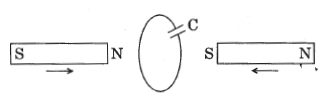
Two bar magnets are quickly moved towards a metallic loop connected across a capacitor 'C' as shown in the figure. Predict the polarity of the capacitor.

Sometimes it is said that "heat is developed" in a resistance when there is an electric current in it. Recall that heat is defined as the energy being transferred due to temperature difference. Is the statement in quotes technically correct?
One of your friends argues that he has read in the previous chapters that there can be no electric field inside a conductor. And hence there can be no current through it. What is the fallacy of this argument?
Choose the correct alternative from the clues given at the end of the each statement:
In the ground state of .......... electrons are in stable equilibrium, while in .......... electrons always experience a net force. (Thomson’s model/ Rutherford’s model.)
What does $q_1+q_2=0$ represent in electrostatics?
A wave is represented by an equation $\text{y}=\text{c}_1\sin(\text{c}_2\text{x}+\text{c}_3\text{t}).$ In which direction is the wave going ? Assume that c1, c2 and c3 are all positive.
Two charged particles are placed at a distance 1.0cm apart. What is the minimum possible magnitude of the electric force acting on each charge?