Question
Define the term electric dipole moment. Is it a scalar or a vector quantity?

Answer

It is the product of charge (q) and the seperation (2a) between the pair of charges.
Alternate Answer
In terms of p = Torque/normal electric field It is a vector quantity.

Need a full question paper?

Generate a complete, print-ready paper with questions like this in minutes — across 16+ boards, with answer keys.
Start Generating Free

Similar questions

The magnetic moment vectors $\mu_\text{s}$ and $\mu_\text{l}$ associated with the intrinsic spin angular momentum S and orbital angular momentum l, respectively, of an electron are predicted by quantum theory (and verified experimentally to a high accuracy) to be given by:
$\mu_\text{s}=-(\text{e}/\text{m})\text{S}.$
$\mu_\text{l}=-(\text{e}/2\text{m})\text{l}.$
Which of these relations is in accordance with the result expected classically? Outline the derivation of the classical result.
What is the necessary condition for diffraction of light?
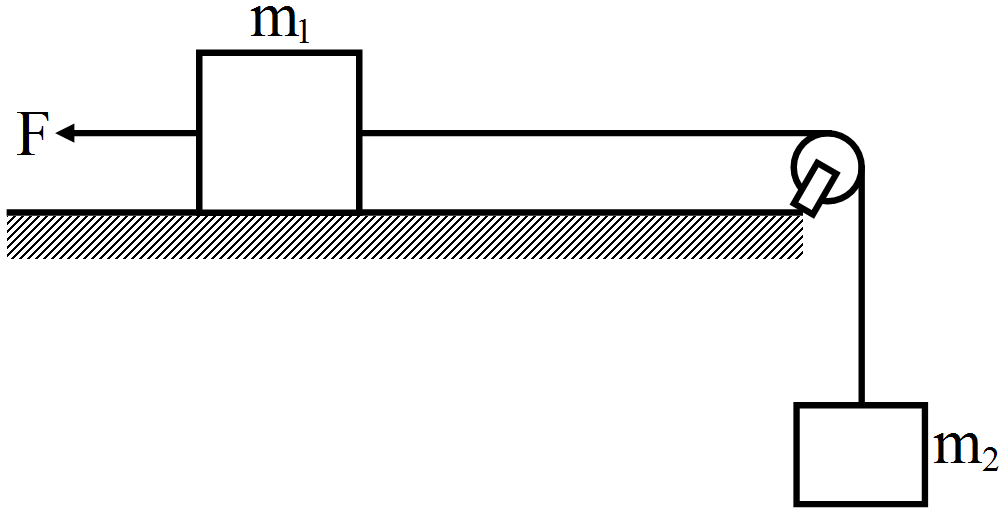
Consider the situation shown in The force F is equal to the $\frac{\text{m}_2\text{g}}{2}$ If the area of cross-section of the string is A and its Young's modulus Y, find the strain developed in it. The string is light and there is no friction anywhere.
In an experiment on photoelectric effect, a photon is incident on an electron from one direction and the photoelectron is emitted almost in the opposite direction. Does this violate conservation of momentu?
Define the S.1. unit of electric charge (coulomb).
The nuclear radius of $^{27}_{13}\text{Al}$ is 3.6 fermi. Find the nuclear radius of $^{64}_{29}\text{Cu}.$
Two wires of equal length are bent in the form of two loops. One of the loops is square shaped whereas the other loop is circular. These are suspended in a uniform magnetic field and the same current is passed through them. Which loop will experience greater torque? Give reasons.
The polarising angle of a medium is 60°. What is the refractive index of the medium?
The following table gives the wavelength range of some constituents of the electromagnetic spectrum.
S. No. Wavelength Range
1. 1mm to 700nm
2. 400nm to 1nm
3. 1nm to $10^{-3}$ nm
4. $< 10^{-3}$ nm
Select the wavelength range and name the electromagnetic waves that are:
  1. Widely used in the remote switches of household electronic devices.
  2. Produced in nuclear reactions.
The speeds of red light and yellow light are exactly same:
  1. In vacuum but not in air.
  2. In air but not in vacuum.
  3. In vacuum as well as in air.
  4. Neither in vacuum nor in air.