Question
Define the term ‘resolving power’ of an astronomical telescope. How does it get affected on:
  1. Increasing the aperture of the objective lens?
  2. Increasing the wavelength of light used?
  3. Increasing the focal length of the objective lens?
Justify your answer in each case.

Answer

Resolving Power of an Astronomical Telescope:The resolving power of an astronomical telescope is its ability to form separate images of two neighbouring astronomical objects (e.g. stars).
The least distance between two neighbouring objects for which astronomical telescope can form separate images is called the resolving limit. The angular limit of resolution is given by:
$\theta_\min=\frac{1.22\lambda}{\text{d}}$
Where $\lambda $ is wavelength and d is diameter of aperture objective lens. Smaller the resolving limit, greater is the resolving power.
$\therefore$ Resolving power $=\frac{\text{d}}{1.22\lambda}$
  1. RP $\alpha$ d, so by increasing aperture of objective lens, the resolving power of telescope increases.
  2. RP $\alpha\frac{1}{\text{y}},$ so by increasing the wavelength of light, the resolving power of telescope decreases.
  3. Resolving power of telescope is independent of its focal length, so there is no effect on resolving power if focal length of objective lens is increased.

Need a full question paper?

Generate a complete, print-ready paper with questions like this in minutes — across 16+ boards, with answer keys.

Start Generating Free

Similar questions

Find the wavelength of the radiation emitted by hydrogen in the transitions (a) n = 3 to n= 2, (b) n = 5 to n = 4 and (c) n = 10 to n = 9.
Explain direct current direct emf and draw their graphs. Define alternating current and explain in detail.
  1. Show that the normal component of electrostatic field has a discontinuity from one side of a charged surface to another given by
$(\text{E}_2-\text{E}_1).\hat{\text{n}}=\frac{\sigma}{\in_0}$

where $\hat{\text{n}}$ is a unit vector normal to the surface at a point and σ is the surface charge density at that point. (The direction of $\hat{\text{n}}$ is from side 1 to side 2.) Hence show that just outside a conductor, the electric field is σ $\hat{\text{n}} /ε_0.$
  1. Show that the tangential component of electrostatic field is continuous from one side of a charged surface to another.
[Hint: For (a), use Gauss’s law. For, (b) use the fact that work done by electrostatic field on a closed loop is zero.]
A 60W load is connected to the secondary of a transformer whose primary draws line voltage. If a current of 0.54A flows in the load, what is the current in the primary coil? Comment on the type of transformer being used.
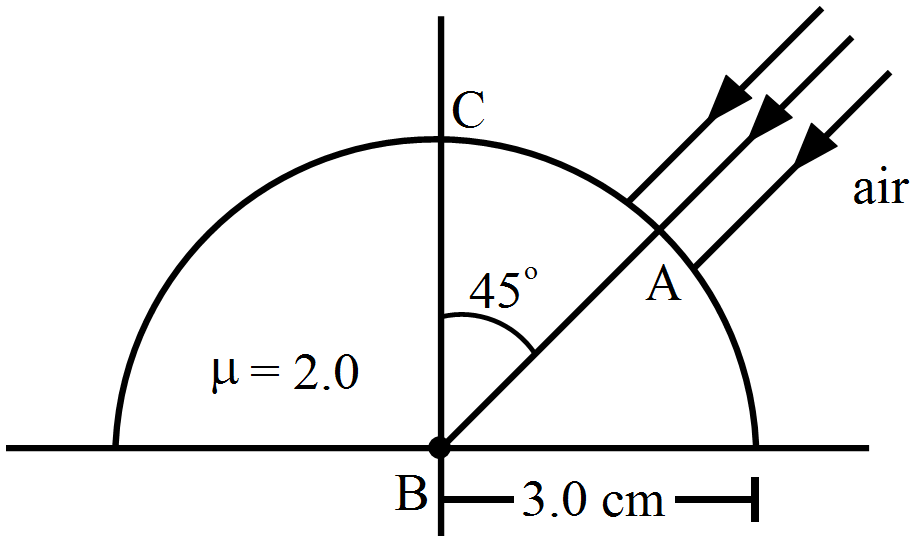
Figure shows a transparent hemisphere of radius 3.0cm made of a material of refractive index 2.0.
  1. A narrow beam of parallel rays is incident on the hemisphere as shown in the figure. Are the rays totally reflected at the plane surface?
  2. Find the image formed by the refraction at the first surface.
  3. Find the image formed by the reflection or by the refraction at the plane surface.
  4. Trace qualitatively the final rays as they come out of the hemisphere.
With the help of circuit diagram, explain the working of junction diode as a full wave rectifier. Draw its input and output waveforms. Which characteristic property of junction diode makes it suitable for rectification?
Derive a mathematical expression for the force per unit length experienced by each of the two long current carrying conductors placed parallel to each other in air. Hence define one ampere of current.Explain why two parallel straight conductors carrying current in the opposite direction kept near each other in air repel?
An LC circuit contains a 20mH inductor and a 50μF capacitor with an initial charge of 10mC. The resistance of the circuit is negligible.
Let the instant the circuit is closed be t = 0.
  1. What is the total energy stored initially? Is it conserved during LC oscillations?
  2. What is the natural frequency of the circuit?
  3. At what time is the energy stored
  1. completely electrical (i.e., stored in the capacitor)?
  2. completely magnetic (i.e., stored in the inductor)?
  1. At what times is the total energy shared equally between the inductor and the capacitor?
  2. If a resistor is inserted in the circuit, how much energy is eventually dissipated as heat?
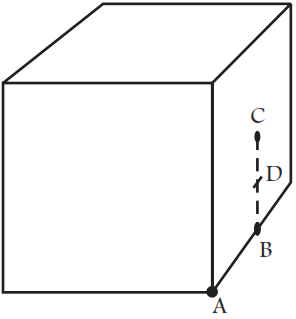
What will be the total flux through the faces of the cube (Fig.) with side of length a if a charge q is placed at:
  1. A: a corner of the cube.
  2. B: mid-point of an edge of the cube.
  3. C: centre of a face of the cube.
  4. D: mid-point of B and C.
What is the speed of a photon with respect to another photon if:
  1. The two photons are going in the same direction and.
  2. They are going in opposite directions?