Question
Define the terms ‘stopping potential’ and ‘threshold frequency’ in relation to photoelectric effect. How does one determine these physical quantities using Einstein’s equation?

Answer

Stopping Potential: The minimum negative potential applied to the anode/plate for which photoelectric current become zero.
Threshold frequency: The minimum (cut-off) frequency of incident radiation, below which no emission of photoelectrons takes place.
By Einstein‟s Equation $\text{??}_{0} =\text{hv}− \phi_{o}$
For any given frequency $\text{?} > \text{v}_{0} , \text{v}_{0}$ can be determined.
Stopping Potential  $\text{?}_{0} =\bigg(\frac{\text{h}}{\text{e}}\bigg)\text{v}−\frac{\phi_{o}}{e}$
as $\phi_{0} = \text{hv}_{0}$
Threshold frequency, $\text{V}_{0} = \frac{\phi_0}{\text{h}}$.

Need a full question paper?

Generate a complete, print-ready paper with questions like this in minutes — across 16+ boards, with answer keys.
Start Generating Free

Similar questions

Two identical capacitors of 12 pF each are connected in series across a battery of 50 V. How much electrostatic energy is stored in the combination? If these were connected in parallel across the same battery, how much energy will be stored in the combination now?
Also find the charge drawn from the battery in each case.
When a photon is emitted by a hydrogen atom, the photon carries a momentum with it. $(a)$ Calculate the momentum carries by the photon when a hydrogen atom emits light of wavelength $656.3\ nm. (b)$ With what speed does the atom recoil during this transition? Take the mass of the hydrogen atom $= 1.67 \times 10^{-27}kg. (c)$ Find the kinetic energy of recoil of the atom.
A vessel contains $1.60g$ of oxygen and $2.80g$ of nitrogen. The temperature is maintained at $300K$ and the volume of the vessel is $0.166m^3$. Find the pressure of the mixture.
A resistance R and a capacitor C are connected in series to a source $\text{V}=\text{V}_0\sin\omega\text{t}.$
Find:
  1. The peak value of the voltage across the (i) resistance and (ii) capacitor.
  2. The phase difference between the applied voltage and current. Which of them is ahead?
Explain polarisation of light.
An alpha particle enters a magnetic field of 0.2 weber $/ m ^2$ with a speed of $6.0 \times 10^5 m / s$ perpendicular to the field. Find out the acceleration of the particle and radius of the path.
A horizontal straight wire 10 m long extending from east to west is falling with a speed of $5.0 ms^{-1}$, at right angles to component of the earth's magnetic field $0.30 \times 10^{-4} Wbm ^{-2}$.
(a) What is the instantaneous value of the emf induced in the wire?
(b) What is the direction of the emf?
(c) Which end of the wire is at the higher electrical potential?
A cube of ice of edge 4cm is placed in an empty cylindrical glass of inner diameter 6cm. Assume that the ice melts uniformly from each side so that it always retains its cubical shape. Remembering that ice is lighter than water, find the length of the edge of the ice cube at the instant it just leaves contact with the bottom of the glass.
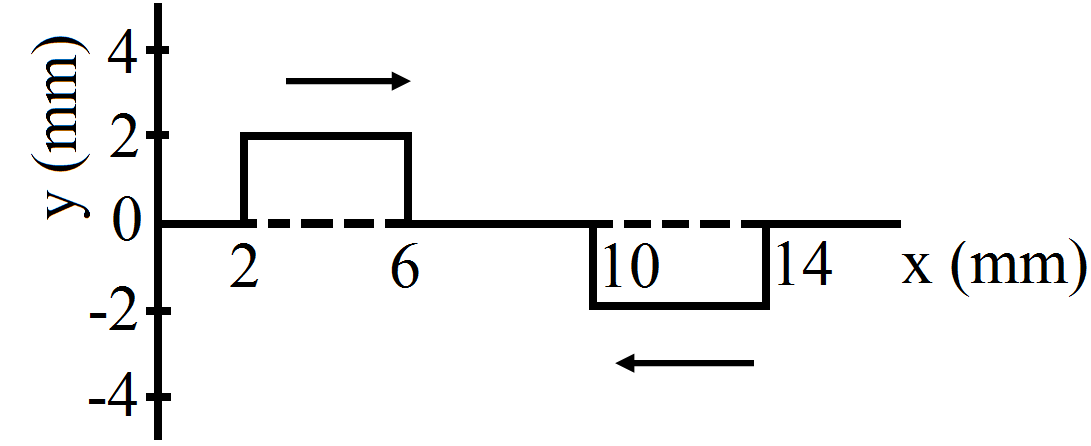
Figure shows two wave pulses at $t = 0$ travelling on a string in opposite directions with the same

wave speed $50\ cm/s$. Sketch the shape of the string at $t = 4\ ms, 6ms, 8\ ms,$ and $12\ ms.$
Let x and a stand for distance. Is $\int\frac{\text{dx}}{\sqrt{\text{a}^2-\text{x}^2}}=\frac{1}{\text{a}}\sin^{-1}\frac{\text{a}}{\text{x}}$ dimensionally correct?