Question
Define thermal conduction. Briefly explain its molecular mechanism.

Answer

Conduction of Heat is a process where heat is transferred from the hotter part of the body to the colder part without involving any actual movement of the body molecules.
In conduction, the heat transfer takes place at the molecular level without actual movement of molecules, from the hottest to the coldest surface.
In the process of heat transfer, the molecules pump into their neighbors and transfer the energy to them which continue as long as heat is still being added
The transfer between bodies continue unit the temperature different decays and a state knows as thermal equilibrium occurs. Greater the value thermal conductivity K of body better is its heat conducting capability.
For insulator this value of K is zero.
Need a full question paper?

Generate a complete, print-ready paper with questions like this in minutes — across 16+ boards, with answer keys.

Start Generating Free

Similar questions

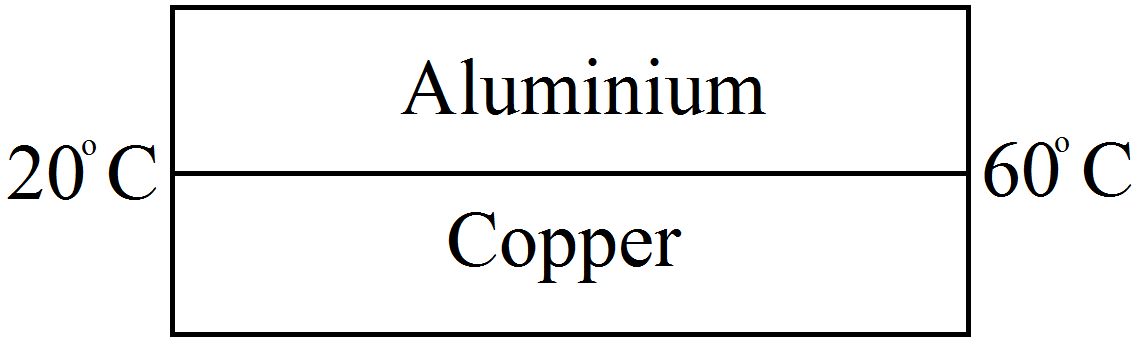
An aluminium rod and a copper rod of equal length 1.0m and cross-sectional area 1cm2 are welded together as shown in figure. One end is kept at a temperature of 20°C and the other at 60°C. Calculate the amount of heat taken out per second from the hot end. Thermal conductivity of aluminium = 200Wm-1°C-1 and of copper = 390Wm-1°C-1.

A traffic policeman sounds a whistle to stop a car-driver approaching towards him. The car-driver does not stop and takes the plea in court that because of the Doppler shift, the frequency of the whistle reaching him might have gone beyond the audible limit of 20kHz and he did not hear it. Experiments showed that the whistle emits a sound with frequency close to 16kHz. Assuming that the claim of the driver is true, how fast was he driving the car? Take the speed of sound in air to be 330m/s. Is this speed practical with today's technology?
Consider a sample of oxygen at 300K. Find the average time taken by a molecule to travel a distance equal to the diameter of the earth.
Is the colour of 620nm light and 780nm light same? Is the colour of 620nm light and 621nm light same? How many colours are there in white light?
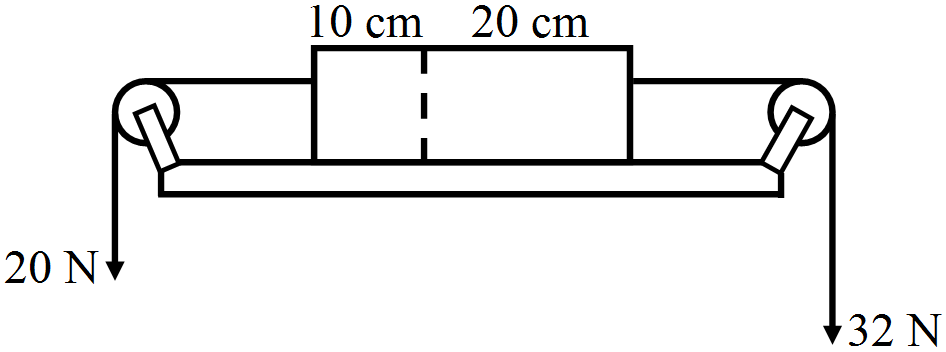
Figure shows a uniform rod of length 30cm having a mass of 3.0kg. The strings shown in the figure are pulled by constant forces of 20N and 32N. Find the force exerted by the 20cm part of the rod on the 10cm part. All the surfaces are smooth and the strings and the pulleys are light.

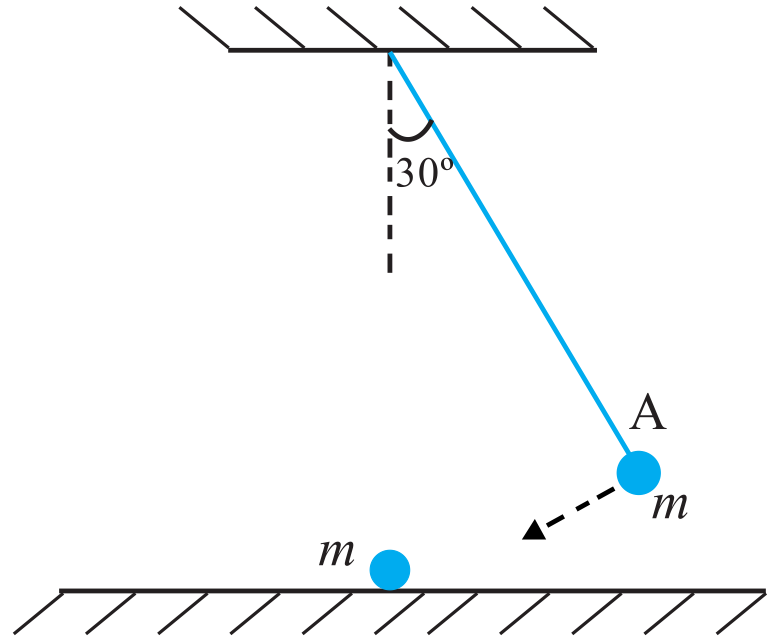
The bob A of a pendulum released from 30° to the vertical hits another bob B of the same mass at rest on a table as shown in. How high does the bob A rise after the collision? Neglect the size of the bobs and assume the collision to be elastic.

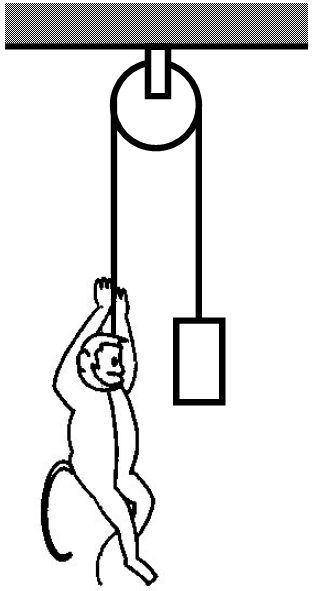
A monkey is climbing on a rope that goes over a smooth light pulley and supports a block of equal mass at the other end figure. Show that whatever force the monkey exerts on the rope, the monkey and the blockmove in the same direction with equal acceleration. If initially both were at rest, their separation will not change as time passes.

Consider two pairs of neutrons. In each pair, the separation between the neutrons is the same. Can the force between the neutrons have different magnitudes for the two pairs?
The length, breadth and thickness of a block of metal were measured with the help of a Vernier Callipers. The measurements are:
$\text{l}=(5.250\pm0.001)\text{cm}$
$\text{b}=(3.450\pm0.001)\text{cm}$
$\text{t}=(1.740\pm0.001)\text{cm}$
Find the percentage error in volume of the block.
A constant retarding force of 50 N is applied to a body of mass 20 kg moving intially with a speed of $15 ms^{-1}$. How long does the body take to stop?