Question
Define wavelength. Give its SI units.

Answer

The wavelength is the distance between two successive crests or two successive troughs on a transverse wave.
It is also equal to the distance between any two points where the particles are passing through their respective mean positions in the same direction.
It is also the distance between two successive compressions or two successive rarefactions on a longitudinal wave.
The SI unit of wavelength is metre (m).

Need a full question paper?

Generate a complete, print-ready paper with questions like this in minutes — across 16+ boards, with answer keys.

Start Generating Free

Similar questions

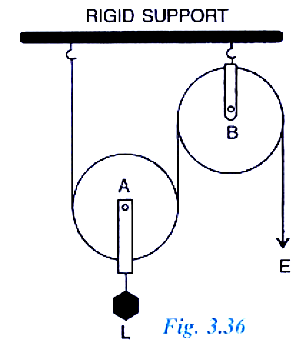
The diagram below shows a pulley arrangement.
(a) In the diagram, mark the direction of tension on each strand of string.
(b) What is the purpose of the pulley B?
(c) If the tension is T, Deduce the relation between T and E.
(d) What is the velocity ratio of the arrangement?
(e) Assuming that the efficiency of the system is 100%, What is the mechanical advantage?
State three safety precautions that you would take while handling the radioactive substances.
State two advantages of ‘the ring system of house wiring’.
A pump is used to lift 500 kg of water from a depth of 80 m in 10 s. calculate:
the work done by the pump
A body of mass 10 kg is moving with a velocity $20 m s ^{-1}$. If the mass of the body is doubled and its velocity is halved, find the ratio of the initial kinetic energy to the final kinetic energy.
How γ - radiations are produced? Mention two common properties of gamma radiations and visible light.
How is accommodation produced?
Calculate the kinetic energy of a body of mass 0.1 kg. and momentum 40kg m/s.
Draw a ray diagram to show how a converging lens can form a real and enlarged image of an object.
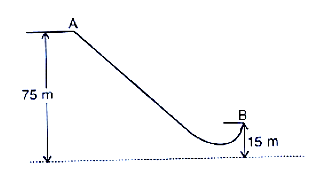
The diagram given below shows a ski jump. A skier weighing $60 kg$ stands at A at the top of ski jump. He moves from A to B and takes off for his jump at $B$.


(a) Calculate the change in the gravitational potential energy of the skier between $A$ and $B$.
(b) If $75 \%$ of the energy in part (a) becomes kinetic energy at B. Calculate the speed at which the skier arrives at B.
(Take $g =10 m s ^{-2}$ )