Question
Definitions needed to understand reflection from a Spherical mirror :

Answer

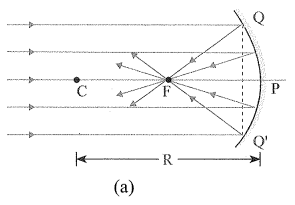
→(1) Centre of Curvature (C): The centre of the spherical shell from which the mirror is made, is called the centre of curvature (C) of the mirror.
(2) Radius of Curvature (R): The radius of the spherical shell from which the mirror is made is called the radius of curvature (R).
(3) Pole (P): The centre of the reflecting surface of a mirror is called pole (P).
(4) Principal Axis: The imaginary line passing through the pole and the centre of curvature is called the principal axis of the mirror.
(5) Aperture: The diameter of the reflecting surface is called aperture of the mirror (QQ').
(6) Principal Focus (F): The point where the rays parallel to the principal axis meet (concave mirror), or appear to meet (convex mirror), after reflection is called the principal focus of the mirror.
Image
Image
(7) Focal Plane: A plane passing through the principal focus and normal to the principal axis is called the focal plane of the mirror.
(8) Focal Length (f): This distance between the pole and the principal focus of a mirror is called focal length.
(9) Paraxial Rays: Rays close to the principal axis are called paraxial rays.

Need a full question paper?

Generate a complete, print-ready paper with questions like this in minutes — across 16+ boards, with answer keys.

Start Generating Free

Similar questions

a. It is not advisable to use a galvanometer as such to measure current directly. Why?
b. Why should the value of resistance connected in parallel to a galvanometer be low?
c. Is the reading shown by an ammeter in a circuit less than or more than the actual value of current flowing in the circuit? Why?
In a potentiometer arrangement, a cell of emf $1.25 V$ gives a balance point at $35.0 \ cm$ length of the wire. If the cell is replaced by another cell and the balance point shifts to $63.0 \ cm,$ what is the emf of the second cell?
An electric field $\vec{\text{E}}=\vec{\text{i}}\text{Ax}$ exists in the space, where $A= 10Vm^{-2}.$ Take the potential at $(10m, 20m)$ to be zero. Find the potential at the origin.
Is it possible to add two vectors of unequal magnitudes and get zero? Is it possible to add three vectors of equal magnitudes and get zero?
Define atomic mass unit (amu) and write its equivalent energy.
Show diagrammatically the behaviour of magnetic field lines in the presence of (i) paramagnetic and (ii) diamagnetic substances. How does one explain this distinguishing feature?
Write down the equation of displacement current and derive the Ampere$-$Maxwell's law.
A metre scale is graduated at every millimetre. How many significant digits will be there in a length measurement with this scale?
It is heard sometime that mercury is used in defining the temperature scale because it expands uniformly with temperature. If the temperature scale is not yet defined, is it logical to say that a substance expands uniformly with temperature?
Lattice structure of $C , Si$ and Ge is similar. Still, why is C an insulator while Si and Ge are intrinsic semiconductors?