MCQ
Dehydrohalogenation of an alkyl halide is
- AAn addition reaction
- BA substitution reaction
- ✓An elimination reaction
- DAn oxidation reaction
$C{H_3}C{H_2}Br + Alc\,.\,KOH \to C{H_2} = C{H_2} + KBr + {H_2}O$
There are two types of elimination reactions.
(a) ${E_1} \to $ Unimolecular elimination
(b) ${E_2} \to $ Bimolecular elimination
Generate a complete, print-ready paper with questions like this in minutes — across 16+ boards, with answer keys.
(1)${H_2} \to {H^ \bullet } + {H^ \bullet }$
(2)$B{r_2} \to B{r^ \bullet } + B{r^ \bullet }$
(3)$B{r^ \bullet } + HBr \to {H^ \bullet } + B{r_2}$
(4)${H^ \bullet } + B{r_2} \to HBr + B{r^ \bullet }$
(5)$B{r^ \bullet } + B{r^ \bullet } \to B{r_2}$
$Image$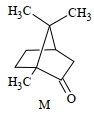
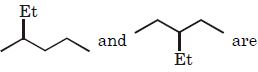
$C{H_3} - \mathop {\mathop {C = }\limits_{|\,\,\,\,} }\limits_{C{l_{}}\,} \mathop {\mathop {C\, - }\limits_{|\,\,\,\,\,\,} }\limits_{C{H_3}\,} \mathop {\mathop {CH - \,}\limits_{|\,\,\,\,\,\,\,\,\,} }\limits_{{C_2}{H_5}\,} C{H_2} - C \equiv CH$