Question
Demonstrate free forced and resonant oscillations.

Answer

SELF

Need a full question paper?

Generate a complete, print-ready paper with questions like this in minutes — across 16+ boards, with answer keys.
Start Generating Free

Similar questions

What happens to a body when it is projected vertically upwards from the surface of the earth with a speed of 11200m/s, and why? Compare escape speeds for two planets of masses M and 4M and radii 2R and R respectively.
Explain the molecular nature of matter. What are the factors affecting Brownian motion? Describe them.
A particle P starts its motion at t = 0 and moves along a circle as shown in figure with period of 4s. Write down the equation representing S.H.M. of the particle P.
A truck starts from rest and accelerates uniformly at $2.0 ms^{-2}$. At $t =10 s$, a stone is dropped by a person standing on the top of the truck ( 6 m high from the ground). What are the (a) velocity, and (b) acceleration of the stone at $t=11 s$ ? (Neglect air resistance.)
A train runs along an unbanked circular track of radius 30m at a speed of 54km/h. The mass of the train is 106kg. What provides the centripetal force required for this purpose - The engine or the rails ? What is the angle of banking required to prevent wearing out of the rail?
Consider the Atwood machine of the previous problem. The larger mass is stopped for a moment 2.0s after the system is set into motion. Find the time elapsed before the string is tight again.
Two stationary particles of masses M1 and M2 are a distance d' apart. A third particle lying on the line joining the particles, experiences no resultant gravitational force. What is the distance of this particle from M1?
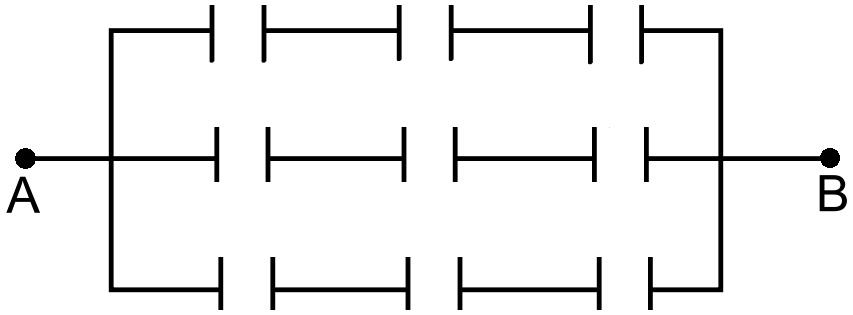
Each of the capacitors shown in figure has a capacitance of $2\mu\text{F}.$ Find the equivalent capacitance of the assembly between the points A and B. Suppose, a battery of emf 60 volts is connected between A and B. Find the potential difference appearing on the individual capacitors.

According to Stefan’s law of radiation, a black body radiates energy $\sigma=\text{T}^4$ from its unit surface area every second where T is the surface temperature of the black body and $\sigma=5.67\times10^{-8}\text{w}/\text{m}^2\text{K}^4$ is known as Stefan’s constant. A nuclear weapon may be thought of as a ball of radius 0.5m. When detonated, it reaches temperature of 106K and can be treated as a black body.

  1. Estimate the power it radiates.
  2. If surrounding has water at 30C°, how much water can 10% of the energy produced evaporate in 1s?

$\big[\text{s}_w=4186.0\text{J/ kgK and L}_v=22.6\times10^5\text{J/ kg}\big]$

  1. If all this energy U is in the form of radiation, corresponding momentum is $\rho=\frac{\text{U}}{\text{c}}$ How much momentum per unit time does it impart on unit area at a distance of 1km?
Use the formula $v =\sqrt{\frac{\gamma P }{\rho}}$ explain why the speed of sound in air
(a) is independent of pressure,
(b) increases with temperature,
(c) increases with humidity.