MCQ
Density of ice is $\rho $ and that of water is $\sigma $. What will be the decrease in volume when a mass $M$  of ice melts
  • A
    $\frac{M}{{\sigma - \rho }}$
  • B
    $\frac{{\sigma - \rho }}{M}$
  • $M\,\left[ {\frac{1}{\rho } - \frac{1}{\sigma }} \right]$
  • D
    $\frac{1}{M}\left[ {\frac{1}{\rho } - \frac{1}{\sigma }} \right]$

Answer

Correct option: C.
$M\,\left[ {\frac{1}{\rho } - \frac{1}{\sigma }} \right]$
c
(c)Volume of ice $ = \frac{M}{\rho }$, volume of water $ = \frac{M}{\sigma }$ .
$>$ Change in volume $ = \frac{M}{\rho } - \frac{M}{\sigma } = M\,\left( {\frac{1}{\rho } - \frac{1}{\sigma }} \right)$

Need a full question paper?

Generate a complete, print-ready paper with questions like this in minutes — across 16+ boards, with answer keys.

Start Generating Free

Similar questions

A metal ball falls from a height of $32$ metre on a steel plate. If the coefficient of restitution is $0.5$, to what height will the ball rise after second bounce ............ $m$
A body is rotating with angular velocity $\omega=(3\hat{\text{i}}-4\hat{\text{j}}-\hat{\text{k}})$ The linear velocity of a point having position vector $\text{r}=(5\hat{\text{i}}-6\hat{\text{j}}+6\hat{\text{k}})$ is:
The point on the pressure temperature phase diagram where all the phases co-exist is called
Two resistors of resistances $R_1 = (100 \pm 3) \,\Omega $ and $R_2 = (200 \pm 4)$ are connected in series. The maximm absolute error and percentage error in equivalent resistance of the series combination is
Which pair has the same dimensions
A bullet is fired from a gun. The force on the bullet is given by:

$F =  600 - 2 \times 10^5\ t$

Where $F$ is in newton and $t$ in second. The force on the bullet becomes zero as soon as it leaves the barrel. What is the average impulse imparted to the bullet?

A body executes simple harmonic motion under the action of a force $F_1$ with a time period $(4/5)\, sec$. If the force is changed to $F_2$ it executes $SHM$ with time period $(3/5)\, sec$. If both the forces $F_1$ and $F_2$ act simultaneously in the same direction on the body, its time period (in $seconds$ ) is
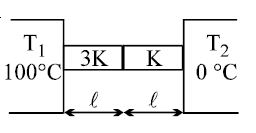
Two rods $A$ and $B$ of same cross-sectional are $A$ and length $l$ connected in series between a source $(T_1 = 100^o C)$ and a sink $(T_2 = 0^o C)$ as shown in figure. The rod is laterally insulated  If $G_A$ and $G_B$ are the temperature gradients across the rod $A$ and $B$, then 
The collisions of the molecules of an ideal gas are:
A stone of mass $1\,kg$ is tied to end of a massless string of length $1\,m$. If the breaking tension of the string is $400\,N$, then maximum linear velocity, the stone can have without breaking the string, while rotating in horizontal plane, is $.......\,ms^{-1}$