Question
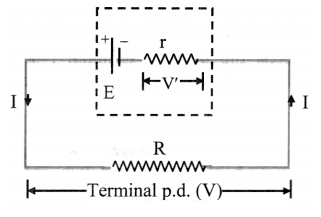
Derive an expression for current flowing through a circuit when an external resistance is connected to a real $\text{e.m.f}$. device.
Answer

Image
$i$. If a current $(I)$ flows through an emf device, there is an internal resistance $(r)$ and the emf $(E)$ differs from the potential difference across its two terminals $(V).$
$V = E – Ir ……… (1)$
$ii$. The negative sign is due to the fact that the current $I$ flows through the emf device from the negative terminal to the positive terminal.
$iii.$ By the application of Ohm's law,
$V=I R ....... (2)$
From equations $(1)$ and $(2),$
$IR = E - Ir$
$\therefore \frac{E}{R+r}$

Need a full question paper?

Generate a complete, print-ready paper with questions like this in minutes — across 16+ boards, with answer keys.

Start Generating Free

Similar questions

Discuss the following as special cases of elastic collisions and obtain their exact or approximate final velocities in terms
of their initial velocities.
(i) Colliding bodies are identical.
(ii) A very heavy object collides on a lighter object, initially at rest.
(iii) A very light object collides on a comparatively much massive object, initially at rest.
An object is falling freely under the gravitational force. Its velocity after travelling a distance $h$ is $v$. If $v$ depends upon gravitational acceleration $g$ and distance, prove with dimensional analysis that $v = k \sqrt{g h}$ where $k$ is a constant.
Find the angle between the vectors $\overrightarrow{ A }=\hat{ i }+2 \hat{ j }-\hat{ k }$ and $\overrightarrow{ B }=-\hat{ i }+\hat{ j }- 2 \hat{ k }$
If $100$ joules of work must be done to move electric charge equal to $4 C$ from a place, where potential is $-10$ volt to another place where potential is $V$ volt, find the value of $V$.
Newton’s first law is contained in the second law. Prove it.
Give any four applications of thermal conductivity in every day life.
At what distance below the surface of the Earth, the acceleration due to gravity decreases by 10% of its value at the surface, given radius of Earth is 6400 km.
Explain how different types of waves emitted by stars and galaxies are observed?
A body is projected with a velocity of $40 \ ms^{-1}.$ After $2 s$ it crosses a vertical pole of height $20.4 m.$ Find the angle of projection and horizontal range of projectile, $(g = 9.8 \ ms^{-2}).$
The speed of a projectile u reduces by 50% on reaching maximum height. What is the range on the horizontal plane?