Question
Derive an expression for the excess of pressure inside an air bubble.

Answer

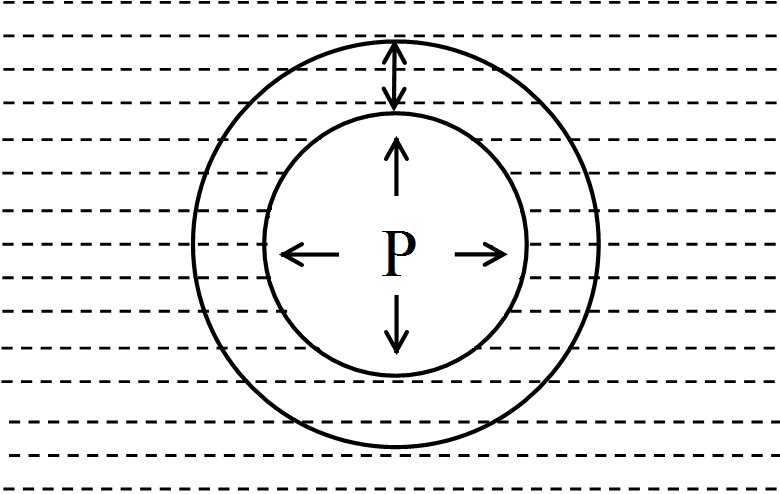
Consider a bubble of radius R with $\sigma$ the surface tension of liquid. Excess pressure inside the bubble, $P = P_i - P_0$ ($\because$ air bubble has only one free surface)$\delta\text{R}$ = Small increase in radius of bubble due to excess pressure
Work done, W = Force × Displacement. = (Excess pressure × Area) × Increase in radius$=\text{P}\times4\pi\text{R}^2\times\delta\text{R}$
Increase in surface area of bubble = Final surface area - Initial surface area$=4\pi(\text{R}+\delta\text{R})^2-4\pi\text{R}^2$
$=8\pi\text{R}(\delta\text{R})(\text{Neglecting }\delta\text{R}^2)$
$\therefore\text{P}\times4\pi\text{R}^2\times\delta\text{R}=8\pi\text{ R}(\delta\text{R})\times\sigma$
Increase in P.E. = increase in surface area × Surface tension$=8\pi\text{R}(\delta\text{R})\times\sigma$
Since the drop is in equilibrium.$\therefore\text{P}\times4\pi\text{R}^2\times\sigma\text{R}=8\pi\text{ R}(\delta\text{R})\times\sigma$
$\text{P}=\frac{2\sigma}{\text{R}}$

Need a full question paper?

Generate a complete, print-ready paper with questions like this in minutes — across 16+ boards, with answer keys.
Start Generating Free

Similar questions

If each square metre of sun's surface, radiates energy at the rate of $6.3 \times 10^7 \mathrm{~J} / \mathrm{m}^2 / \mathrm{s}$ and the Stefan's constant is $5.669 \times 10^{-8} \mathrm{~W} / \mathrm{m}^2 / \mathrm{k}^4$. Calculate the temperature of the sun's energy assuming Stefan's Law applies to the sun's rediation.
Let $\vec{\text{a}}=4\vec{\text{i}}+3\vec{\text{j}}$ and $\vec{\text{b}}=3\vec{\text{i}}+4\vec{\text{j}}. (a)$ Find the magnitudes of:
  1. $\vec{\text{a}}$
  2. $\vec{\text{b}}$
  3. $\vec{\text{a}}+\vec{\text{b}}$
  4. $\vec{\text{a}}-\vec{\text{b}}$
While gas from a cooking gas cylinder is used, the pressure does not fall appreciably till the last few minutes. Why?
Find the moment of inertia of a pair of spheres, each having a mass m and radius r, kept in contact about the tangent passing through the point of contact.
The wavelength à associated with a moving particle depends upon its mass m, its velocity v and Planck's constant h. Show dimensionally the relationship between them.
Why it is much hotter above a fire than by its side?
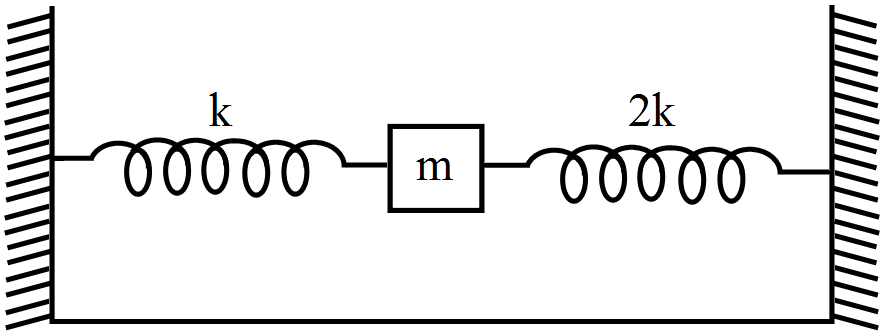
Two springs of force constants K and 2K are connected to a block of m as shown below. What is the frequency of oscillation of this block?
If two vectors of equal magnitude add to either of them by magnitude, what is the angle between them?
A sample of 0.177 g of an ideal gas occupies $1000 \mathrm{~cm}^3$ at STP. Calculate the rms speed of the gas molecules.
Name one system where the compressional and tensional modulus of elasticity are different. Give reason.