Question
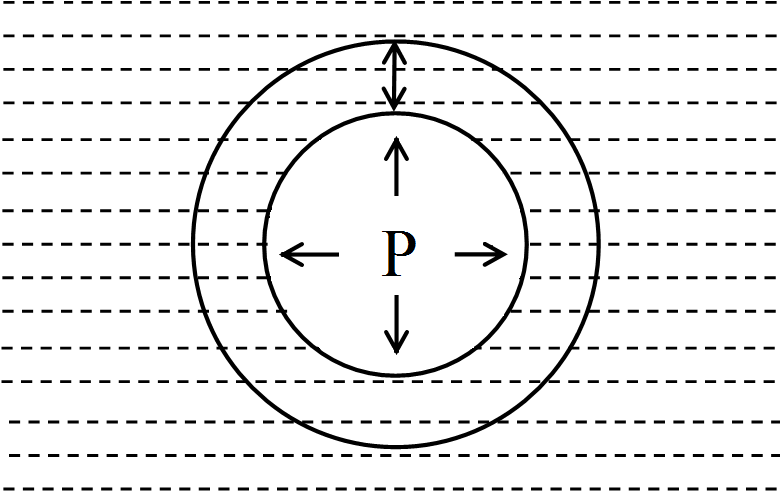
  1. Derive an expression for the excess pressure inside a soap bubble.
  2. State Bernoulli's theorem.

Answer

  1.  

Consider a bubble of radius R with $\sigma$ the surface tension of liquid. Excess pressure inside the bubble,

P = Pi - P0

 ($\because$ air bubble has only one free surface)

$\delta\text{R}=$ Small increase in radius of bubble due to excess pressure

Work done,

W = Force × Displacement

= (Excess pressure × Area) × Increase in radius

$=\text{P}\times4\pi\text{R}^2\times\delta\text{R}$

Increase in surface area of bubble,

= Final surface area - Initial surface area

$=4\pi(\text{R}+\delta\text{R})^2-4\pi\text{R}^2$

$=8\pi\text{R}(\delta\text{R})$ $($Neglecting $\delta\text{R}^2)$

$\therefore\text{P}\times4\pi\text{R}^2\times\delta\text{R}=8\pi\text{R}(\delta\text{R})\times\sigma$

Increase in P.E. = Increase in surface area × Surface tension

$=8\pi\text{R}(\delta\text{R})\times\sigma$

Since the drop is in equilibrium.

$\therefore\text{P}\times\text{R}^2\times\delta\text{R}=8\pi\text{R}(\delta\text{R})\times\sigma$

$\text{P}=\frac{2\sigma}{\text{R}}$

  1. Bernoulli's Theorem: For an incompressible, non-viscous, irrotational liquid having streamlined flow, the sum of the pressure energy, kinetic energy and potential energy per unit mass is a constant, i.e.,

$\frac{\text{P}}{\rho}+\frac{\text{V}^2}{2}+\text{gh}=\text{constant}$

$\Rightarrow\frac{\text{P}}{\rho\text{g}}+\frac{\text{V}^2}{2\text{q}}+\text{h}=\text{constant}$

Need a full question paper?

Generate a complete, print-ready paper with questions like this in minutes — across 16+ boards, with answer keys.
Start Generating Free

Similar questions

A body is in translational equilibrium under the action of coplanar forces. If the torque of these forces is zero about a point, is it necessary that it will also be zero about any other point?
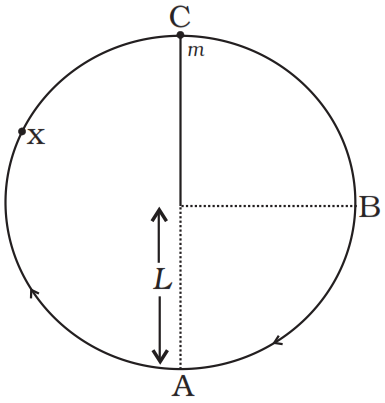
A bob of mass m suspended by a light string of length L is whirled into a vertical circle as shown in what will be the trajectory of the particle if the string is cut at:

  1. Point B?
  2. Point C?P
  3. oint X?
A ball of mass m is dropped onto a floor from a certain height. The collision is perfectly elastic and the ball rebounds to the same height and again falls. Find the average force exerted by the ball on the floor during a long time interval.
What is meant by Steady state heat flow by conduction in case of a thick copper bar with its two ends maintained at two different temperatures? On what factors does the amount of heat flowing through the bar depends? Define thermal conductivity and draw labelled diagram of Searl's apparatus for determination of thermal conductivity.
If a number of little droplets of water, each of radius r, coalesce to form a single drop of radius R, and the energy released is converted into kinetic energy then find out the velocity acquired by the bigger drop.
The illuminance of a small area changes from 900 lumen/m2 to 400 lumen/m2 when it is shifted along its normal by 10cm. Assuming that it is illuminated by a point source placed on the normal, find the distance between the source and the area in the original position.
Suppose the $19\Omega$ resistor of the previous problem is disconnected. Find the current through P2Q2 in the two situations:
  1. Both the wires move towards right.
  2. If P1Q1 moves towards left but P2Q2 moves towards right.
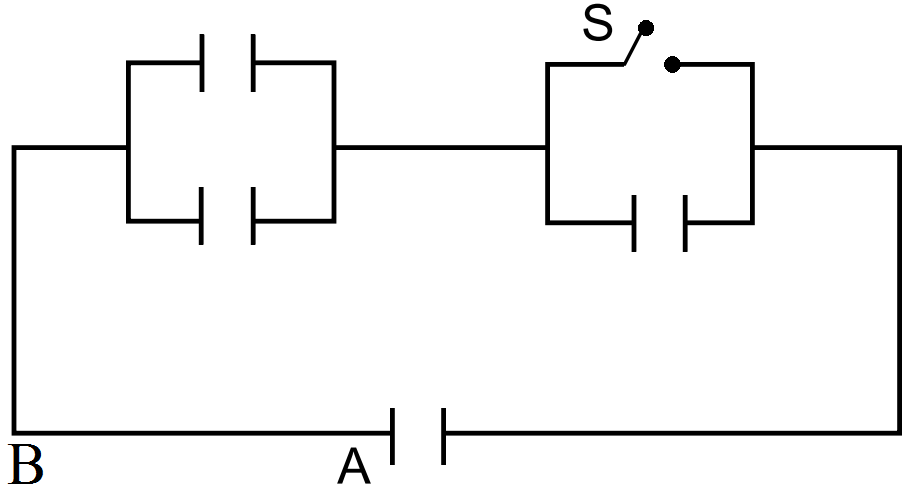
Each capacitor shown in figure has a capacitance of $5.0\mu\text{F}.$ The emf of the battery is 50V. How much charge will flow through AB if the switch S is closed?

A simple pendulum with a brass bob has a time period T. The bob is now immersed in a non-viscous liquid and oscillated. If the density of the liquid is $\frac{1}{9}$ that of brass, find the time of the same pendulum.
A 6.5m long ladder rests against a vertical wall reaching a height of 6.0m. A 60kg man stands half way up the ladder.
  1. Find the torque of the force exerted by the man on the ladder about the upper end of the ladder.
  2. Assuming the weight of the ladder to be negligible as compared to the man and assuming the wall to be smooth, find the force exerted by the ground on the ladder.