Question
Derive an expression for the force experienced by a current carrying straight conductor placed in a magnetic field. Under what condition is this force maximum?
Answer

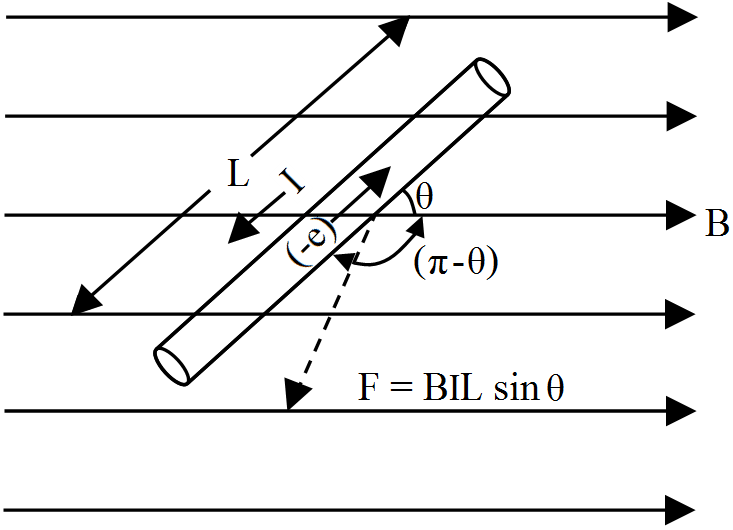
Force on a current carrying conductor on the basis of force on a moving charge: Consider a metallic conductor of length L, cross-sectional area A placed in a uniform magnetic field B and its length makes an angle $\theta$ with the direction of magnetic field B. The current in the conductor is I.

According to free electron model of metals, the current in a metal is due to the motion of free electrons. When a conductor is placed in a magnetic field, the magnetic field exerts a force on every free-electron. The sum of forces acting on all electrons is the net force acting on the conductor. If vd is the drift velocity of free electrons, then

Current $\text{I}=\text{neAv}_\text{d}\ \ .....(\text{i})$

Where n is number of free electrons per unit volume.

Magnetic force on each electron $=\text{ev}_\text{d}\text{B}\sin\theta\ \ .....(\text{ii}) $

Its direction is perpendicular to both $\overrightarrow{\text{vd}}$ and $\vec{\text{B}}$

Volume of conductor V = AL

Therefore, the total number of free electrons in the conductor = nAL

Net magnetic force on each conductor

F = (force on one electron) × (number of electrons)

$=\text{ev}_\text{d}\text{B}\sin\theta.(\text{nAL})=(\text{neAv}_\text{d}).\text{BL}\sin\theta$  $$

Using equation (i) $\text{F}=\text{IBL}\sin\theta$$$ ...(iii)

$\therefore\text{F}=\text{IBL}\sin\theta$

This is the general formula for the force acting on a current carrying conductor.

In vector form $\vec{\text{F}}=\text{I}\vec{L}\times\vec{\text{B}}$

Force will be maximum when $\sin\theta=1$ or $\theta=90^\circ$. That is when length of conductor is perpendicular to magnetic field.

Need a full question paper?

Generate a complete, print-ready paper with questions like this in minutes — across 16+ boards, with answer keys.
Start Generating Free

Similar questions

A small bulb is placed at the bottom of a tank containing water to a depth of 80cm. What is the area of the surface of water through which light from the bulb can emerge out? Refractive index of water is 1.33. (Consider the bulb to be a point source).
Hari is a student of Class X in a school near his village. His uncle gifted him a bicycle with a dynamo fitted in it. He was thrilled to find that while cycling during night, he could light the bulb and see the objects on the road clearly. He, however, did not know how this device works. He asked this question to his teacher. The teacher considered it an opportunity and explained the working of a dynamo to the whole class.
Answer the following questions:
  1. State the principle and working of a dynamo.
  2. Write two values each displayed by Hari and his Science teacher.
Find the current in the sliding rod AB (resistance = R) for the arrangement shown in Fig. B is constant and is out of the paper. Parallel wires have no resistance. v is constant. Switch S is closed at time t = 0.

In an experiment on photoelectric effect, the stopping potential is measured for monochromatic light beams corresponding to different wavelengths. The data collected are 11s follows:

wavelength (nm) 350 400 450 500 550
stopping potential(V): 1.45 1.00 0.66 0.38 0.16

Plot the stopping potential against inverse of wavelength $\big(\frac{1}{\lambda}\big) $ on a graph paper and find
  1. The Planck constant,
  2. The work function of the emitter and.
  3. The threshold wavelength.
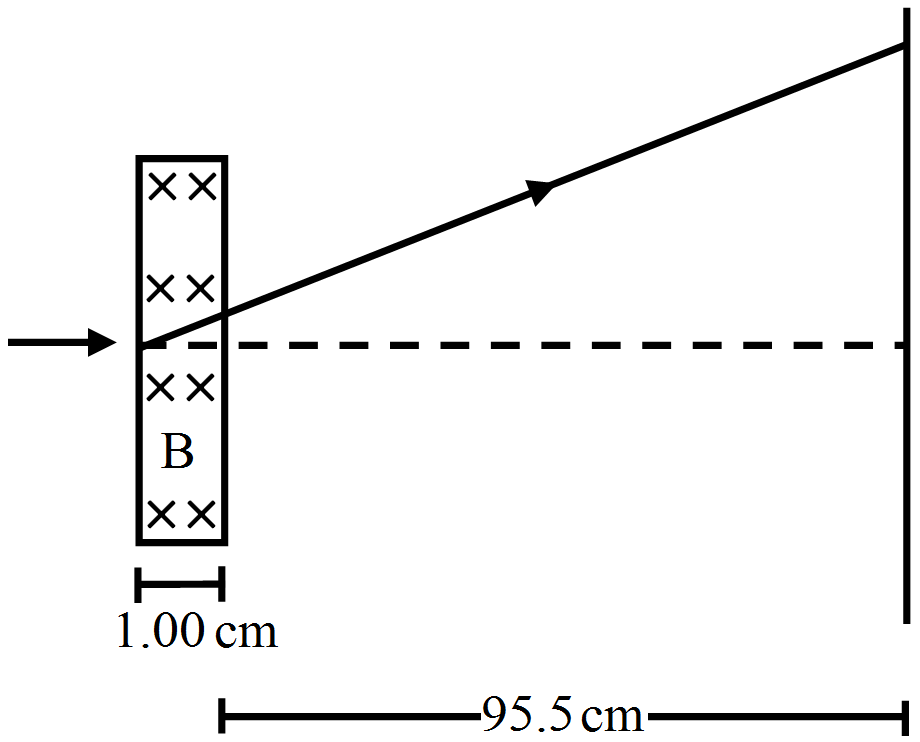
A narrow beam of singly charged potassium ions of kinetic energy 32keV is injected into a region of width 1.00cm with a magnetic field of strength 0.500T, as shown in the figure. The ions are collected at a screen 95.5cm away from the field region. If the beam contains isotopes of atomic weights 39 and 41, find the separation between the points where these isotopes strike the screen. Take the mass of a potassium ion = A (1.6 × 10⁻²⁷)kg, where A is the mass number.

What is the minimum energy that must be given to a H atom in ground state so that it can emit an $\text{H}_\gamma$ line in Balmer series. If the angular momentum of the system is conserved, what would be the angular momentum of such $\text{H}_\gamma$ photon?
A system has two charges qA = 2.5 × 10⁻⁷ C and qB = –2.5 × 10⁻⁷ C located at points A: (0, 0, –15 cm) and B: (0, 0, +15 cm), respectively. What are the total charge and electric dipole moment of the system?
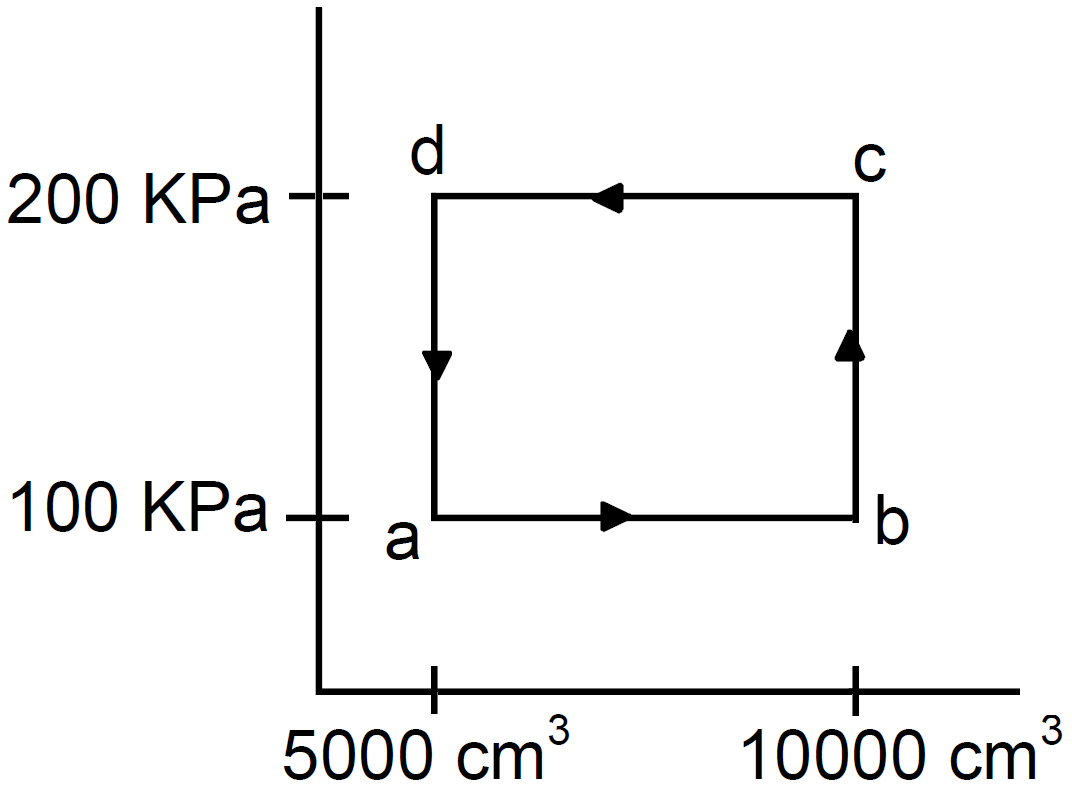
Half mole of an ideal gas $\Big(\gamma=\frac{5}{3}\Big)$ is taken through the cycle abcda, as shown in the figure. Take $\text{R}=\frac{25}{3}\text{JK}^{-1}\text{mol}^{-1}.$
  1. Find the temperature of the gas in the states a, b, c and d.
  2. Find the amount of heat supplied in the processes ab and bc.
  3. Find the amount of heat liberated in the processes cd and da.

The $\text{K}_\alpha$ X-rays of aluminium (Z = 13) and zinc (Z = 30) have wavelengths 887pm and 146pm respectively. Use Moseley's law $\sqrt{\text{v}}=\text{a}(\text{z-b})$ to find the wavelengths of the $\text{K}_\alpha$ X-ray of iron (Z = 26).
The plates of a capacitor are 2.00cm apart. An electronproton pair is released somewhere in the gap between the plates and it is found that the proton reaches the negative plate at the same time as the electron reaches the positive plate. At what distance from the negative plate was the pair released?