Question
Derive an expression for the magnetic force experienced by a straight current$-$carrying conductor placed in a uniform magnetic field.
Discuss the cases when the force is maximum and minimum.
State the expressions for the force experienced by a current-carrying
$(i)$ conductor of arbitrary shape
$(ii)$ closed circuit $($conducting loop$)$.
Answer

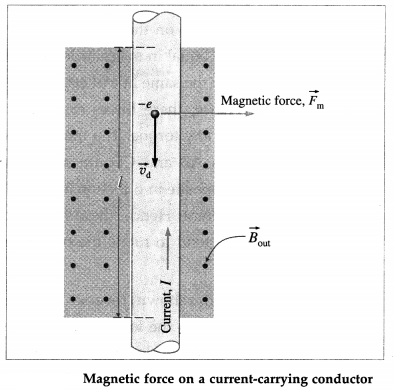
Consider a straight current-carrying conductor placed in a region of uniform magnetic field of induction $\vec{B}$ pointing out of the page, as shown in below figure by the evenly placed dots. Let the length of the conductor inside the field be $I$ and the current in it be I.
In metallic conductors, electrons are the charge carriers. The direction of conventiona current is, however, taken to be that of flow of positive charge which is opposite to the electron current.
Image

Let $d q$ be the positive charge passing through an element of the conductor of length dl in time ot.
$\overrightarrow{d l}$ has the same direction as that of the current.
Then, $1=\overrightarrow{d l} / d$ t $(1)$
and drift velocity: $\overrightarrow{v_d}=\overrightarrow{d l} / d t$
The magnetic force on the charge $d q$ is
$=I(\overrightarrow{d i} \times \vec{B})$
$( \because I=$ da $/ d t)$
The charge dq is constrained to remain within the conductor. Hence, the conductor itself experiences this force. The force on the entire part of the conductor within the region of the magnetic field is
$\vec{F}-\Sigma \vec{f}_{ m } -I(\Sigma \overrightarrow{d l}) \times \vec{B}$
$ =I \vec{I} \times \vec{B}$
In magnitude, $F-l l B \sin \theta$
where $\theta$ is the smaller angle between $\vec{l}$ and $\vec{B}$.
Case $1:$ When the conductor is parallel to the magnetic field, $\vec{l}$ is parallel or antiparallel to $\vec{B}$ according as the current is in the direction of $\vec{B}$ or opposite to it; then $\theta=0^{\circ}$ or $\theta=180^{\circ}$, so that $\sin \theta=0$.
Hence, in either of these two cases, $F=0$.
Case $2:$ The maximum value of the force is $F_{\max }=\| B$, when $\sin \theta=1$, that is, when the conductor lies at right angles to $\vec{B}\left(\theta=90^{\circ}\right)$.
$(i)$ For a current-carrying wire of arbitrary shape in a uniform field,
$\vec{F}=\int \vec{f}_{ m }=I\left(\int \overrightarrow{d l}\right) \times \vec{B}$
$(ii)$ For a current-carrying conducting loop (closed circuit) in a uniform field
$\vec{F}=\int \vec{f}_{ m }=I(\oint \overrightarrow{d l} \times \vec{B})$
But for a closed loop of arbitrary shape, the integral is zero.
$\therefore \vec{F}=0$
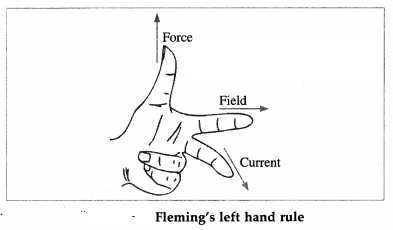
$[$Notes: $(1)$ While the direction of $\vec{F}$ can be found from the cross product of $\vec{l}$ and $\vec{B}$, there is a handy rule due to Sir John Ambrose Fleming $(1849-1945)$, British physicist and electrical engineer.
Flaming's left hand rule : If the forefinger and the middle finger of the left hand are stretched out to point in the directions of the magnetic field and the current, respectively, then the outstretched thumb indicates the direction of the magnetic force on the current$-$carrying straight conductor from below figure.$]$
Image
$(2)$ Equation $(3)$ is usually used to define the unit of magnetic field induction, the tesla. See the note to $Q. 6. (3)$ B cannot be taken out of the integral in Eq. $(6).]$

Need a full question paper?

Generate a complete, print-ready paper with questions like this in minutes — across 16+ boards, with answer keys.

Start Generating Free