Maharashtra BoardEnglish MediumSTD 12 SciencePhysicsMechanical Properties of Fluids4 Marks
Question
Derive an expression of excess pressure inside a liquid drop.
✓
Answer
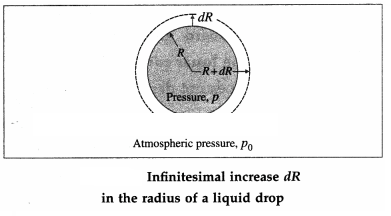
Consider a small spherical liquid drop with a radius R. It has a convex surface, so that the pressure p on the concave side (inside the liquid) is greater than the pressure p0 on the convex side (outside the liquid). The surface area of the drop is
$A=4 \pi R^2 \ldots(1)$
Imagine an increase in radius by an infinitesimal amount $d R$ from the equilibrium value $R$. Then, the differential increase in surface area would be $d A=8 \pi R \cdot d R$...(2)
The increase in surface energy would be equal to the work required to increase the surface area:
$dW = T \cdot dA =8 \pi TRdR \ldots . .(3)$
We assume that dR is so small that the pressure inside remains the same, equal to p. All parts of the surface of the drop experience an outward force per unit area equal to $\rho — \rho _0$. Therefore, the work done by this outward pressure-developed force against the surface tension force during the increase in radius dR is
$d W=(\text { excess pressure } \times \text { surface area }) \cdot d R$
$=\left(\rho-\rho_0\right) \times 4 \pi n R^2 \cdot d R \ldots .(4)$
$\text { From Eqs. (3) and }(4)$
$\left(\rho-\rho_0\right) \times 4 \pi R^2 \cdot d R=8 \pi T R d R$
$\therefore \rho-\rho_0=\frac{2 T}{R} \ldots \ldots \text { (5) }$
which is called Laplace’s law for a spherical membrane (or Young-Laplace equation in spherical form).
[Notes : (1) The above method is called the principle of virtual work. (2) Equation (5) also applies to a gas bubble within a liquid, and the excess pressure in this case is also called the gauge pressure. An air or gas bubble within a liquid is technically called a cavity because it has only one gas-liquid interface. A bubble, on the other hand, such as a soap bubble, has two gas-liquid interfaces.]
Need a full question paper?
Generate a complete, print-ready paper with questions like this in minutes — across 16+ boards, with answer keys.