Question
Derive $\frac{n_1}{-u}+\frac{n_2}{v}=\frac{n_2-n_1}{ R }$ for refraction at a spherical surface.
Answer


Image
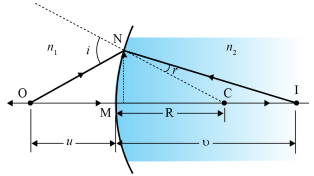
→ As shown in figure, a point like object $O$ is placed on the principal axis of the spherical surface. A spherical surface has centre of curvature ' $C$ ' and radius of curvature $R$.
→ Rays emerge from a medium having refractive index $n_1$. Here, OM and ON are the incident rays.
→ They refract in a medium having refractive index $n_2$. Here NI and MI are the refractive rays. As a result, image I of the point object $O$ is obtained.
→ Assume that the aperture of the spherical surface is small compared to the object distance, image distance and radius of curvature, so that the angles can be taken small.
→ Since the aperture of the surface is assumed to be small here, NM will be taken to be nearly equal to the length of the perpendicular from the point N on the principal axis.
→ From figure,
$
\begin{array}{l}
\tan \angle NOM \approx \angle NOM=\frac{MN}{OM}...(1) \\
\tan \angle NCM \approx \angle NCM=\frac{MN}{MC} \ldots(2) \\
\tan \angle NIM \approx \angle NIM=\frac{MN}{MI} \ldots(3)
\end{array}
$
→ For $\triangle N O C, i$ is the exterior angle.
Therefore,
$
i=\angle NOM+\angle NCM
$
Substituting values from equation (1) and equation (2),
$
\therefore i=\frac{MN}{OM}+\frac{MN}{MC} \ldots(4)
$
→ From figure for $\triangle NIC , \angle NCM$ is the exterior angle.
$
\begin{array}{l}
\therefore \angle NCM=r+\angle NIM \\
r=\angle NCM-\angle NIM
\end{array}
$
$
\therefore r=\frac{MN}{MC}-\frac{MN}{MI} \ldots(5)
$
→ By applying Snell's law at point N ,
$
\begin{array}{l}
n_1 \sin i=n_2 \sin r \\
\text { But, } \sin i \approx i \\
\sin r \approx r \\
\therefore n_1 i=n_2 r
\end{array}
$
→ Substituting $i$ and $r$ from equation (4) and equation (5),
$
\begin{array}{l}
\therefore n_1\left(\frac{MN}{OM}+\frac{MN}{MC}\right)=n_2\left(\frac{MN}{MC}-\frac{MN}{MI}\right) \\
\therefore \frac{n_1}{OM}+\frac{n_1}{MC}=\frac{n_2}{MC}-\frac{n_2}{MI} \\
\therefore \frac{n_1}{OM}+\frac{n_2}{MI}=\frac{n_2}{MC}-\frac{n_1}{MC} \\
\therefore \frac{n_1}{OM}+\frac{n_2}{MI}=\frac{n_2-n_1}{MC}
\end{array}
$
→ But from figure, applying Cartesian sign convention,
$
\begin{array}{l}
OM=-u, MI=v \text { and } MC=R \\
\therefore-\frac{n_1}{u}+\frac{n_2}{v}=\frac{n_2-n_1}{R}
\end{array}
$
→ Above equation gives us a relation between object and image distance in terms of refractive index of the medium and the radius of curvature of the curved spherical surface.

Need a full question paper?

Generate a complete, print-ready paper with questions like this in minutes — across 16+ boards, with answer keys.

Start Generating Free

Similar questions

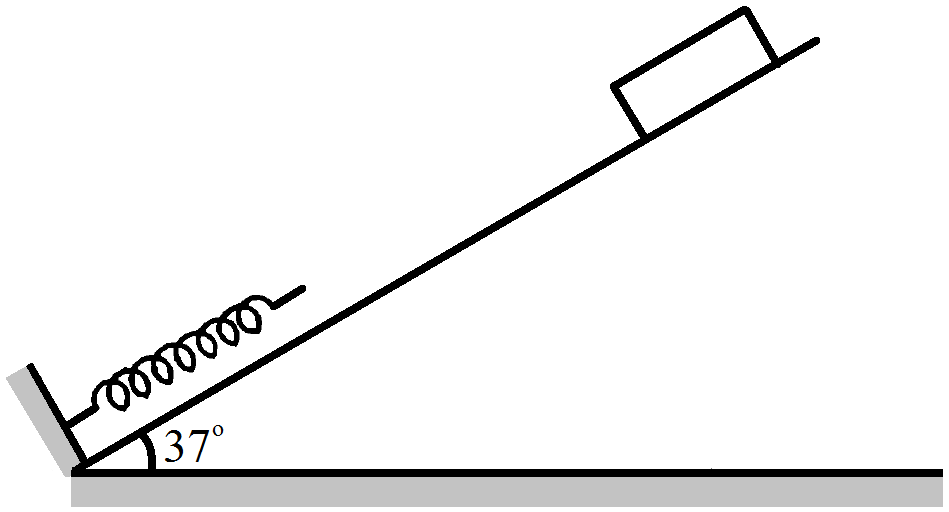
Figure shows a spring fixed at the bottom end of an incline of inclination 37°. A small block of mass 2kg starts slipping down the incline from a point 4.8m away from the spring. The block compresses the spring by 20cm, stops momentarily and then rebounds through a distance of 1m up the incline. Find.
  1. The friction coefficient between the plane and the block.
  2. The spring constant of the spring. Take g = 10m/s2.

The potential difference between the terminals of a battery of emf 6.0V and internal resistance $1\Omega$ drops to 5.8V when connected across an external resistor. Find the resistance of the external resistor.
Explain the construction of refracting telescope by figure and obtain the equation of magnification.
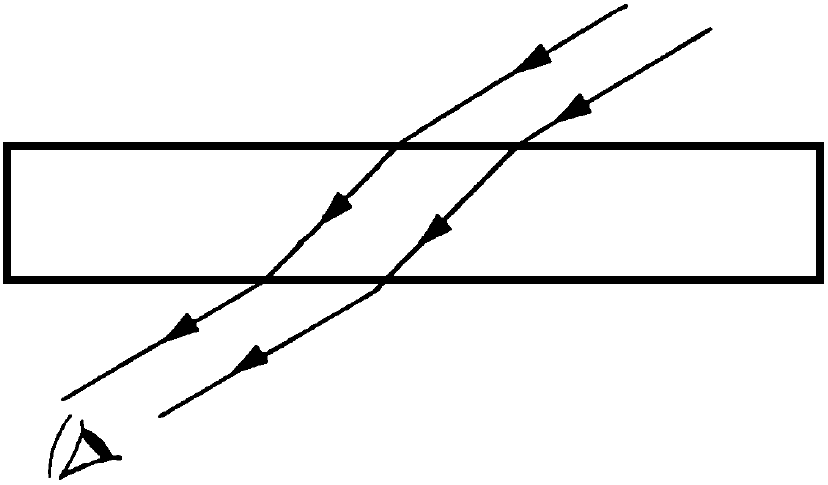
A narrow beam of light passes through a slab obliquely and is then received by an eye. The index of refraction of the material in the slab fluctuates slowly with time. How will it appear to the eye? The twinkling of stars has a similar explanation.

Four point charges qA = 2 μC, qB = –5 μC, qC = 2 μC, and qD = –5 μC are located at the corners of a square ABCD of side 10 cm. What is the force on a charge of 1 μC placed at the centre of the square?
Explain the refraction of a plane wave by
(a) a thin prism
(b) a convex lens and
(c) reflection of a plane wave by a concave mirror.
A ball is dropped from a height. If it takes 0.200s to cross the last 6.00m before hitting the ground, find the height from which it was dropped. Take g = 10m/s2.
Derive the equation of drift velocity by explaining the drift motion of electrons and the drift velocity of electrons in a conductor.
Double - convex lenses are to be manufactured from a glass of refractive index 1.55, with both faces of the same radius of curvature. What is the radius of curvature required if the focal length is to be 20cm?
Explain the process of thermonuclear fusion with example.