Question
Derive integrated rate equation for first order reaction and also explain how than rate constant can be determine with help of graph.

Answer

→ "First order reaction means that the rate reaction is proportional to the first power the concentration of the reactant R."
→ For example, consider the following reaction
R → P
→ Rate of reaction for this reaction can be expressed as
$
\begin{array}{l}
\text { Rate }=-\frac{ d [ R ]}{ dt }= k [ R ] \\
\text { Or } \frac{ d [ R ]}{[ R ]}=- kdt
\end{array}
$
→ Integrating this equation, we get
$
\ln [R]=-k t+I .. ..Eq. (1)
$
where, $I$ is the constant of integration and its value can be determined easily.
→ When $t =0, R =[ R ]_0$, where $[ R ]_0$ is the initia concentration of the reactant.
→ Therefore, equation (1) can be written as
$\ln [R]_0=- k \times 0+ I$
$\ln [ R ]_0= I$
→ Substituting the value of I in equation (1)
$
\ln [ R ]=- kt +\ln [ R ]_0 \quad \ldots \quad \ldots \text { Eq. (2) }
$
→ Rearranging this equation
$\ln \frac{[ R ]}{[ R ]_0}=- kt$
or $k =\frac{1}{ t } \ln \frac{[ R ]_0}{[ R ]}$....Eq. (3)
→ At time $t_1$ from equation (1)
$\ln [R]_1=-k t_1+\ln [R]_0 \ldots \ldots$ Eq. (4)
At time $t _2$
$\ln [R]_2=- kt _2+\ln [ R ]_0 \ldots \ldots$ Eq. (5)
where, $[ R ]_1$ and $[ R ]_2$ are the concentration the reactants at time $t_1$ and $t_2$ respectively. → → → Subtracting Eq. (5) from (4)
$
\begin{array}{l}
\ln [ R ]_1-\ln [ R ]_2=- kt _1-\left(- kt _2\right) \\
\ln \frac{[ R ]_1}{[ R ]_2}= k \left( t _2- t _1\right) \\
k =\frac{1}{\left( t _2- t _1\right)} \ln \frac{[ R ]_1}{[ R ]_2} \quad \ldots \ldots \text { Eq. (6) }
\end{array}
$
→ So, equation (2) can also be written as
$
\ln \frac{[ R ]}{[ R ]_0}=- kt
$
Taking antilog of both the side
$
[ R ]=[ R ]_0 e ^{- kt }
$.. ... Eq. (7)
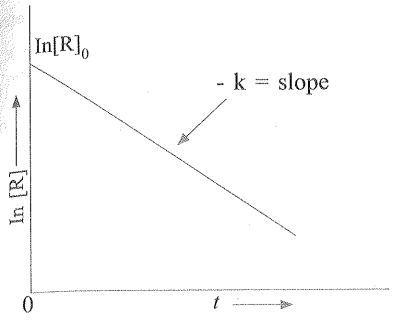
→ Comparing equation (2) with $y = mx + c$, if we plot $\ln [R]$ against $t$, we get a straight line with slope $=- k$ and intercept equal to $\ln [ R ]_0$
Image
→ The first order rate equation (3) can also be written in the form
$
k =\frac{2.303}{ t } \log \frac{[ R ]_0}{[ R ]} \quad \ldots \ldots \text { Eq. (8) }
$
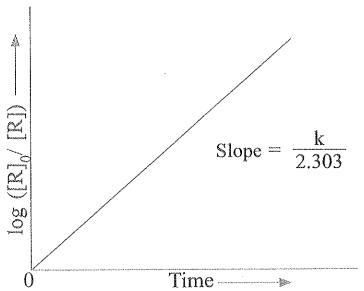
or $\log \frac{[ R ]_0}{[ R ]}=\frac{ kt }{2.303}$
→ If we plot a graph between $\log \frac{[R]_0}{[R]}$ vs $t$, the slope $=\frac{ k }{2.303}$
Image

Need a full question paper?

Generate a complete, print-ready paper with questions like this in minutes — across 16+ boards, with answer keys.
Start Generating Free