Question
Derive relation between electric field $(E)$ and electric potential $(V).$

Answer

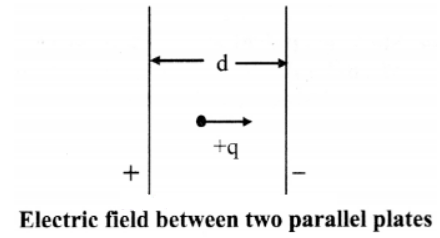
$i.$ A pair of parallel plates is connected as shown in the figure. The electric field between them is uniformImage
$ii.$ A potential difference $V$ is applied between two parallel plates separated by a distance $‘d \ ’.$
$iii.$ The electric field between them is directed from plate $A$ to plate $B.$
$iv.$ A charge $+q$ placed between the plates experiences a force $F$ due to the electric field.
$v.$ If the charge is moved against the direction of field, i.e., towards the positive plate, some amount of work is done on it.
$vi.$ If the charge is moved $+q$ from the negative plate $B$ to the positive plate $A,$ then the work done against the field is $W = Fd;$ where $‘d \ ’$ is the separation between the plates.
$vii.$ The potential difference $V$ between the two plates is given by $W = V_q,$
but $W = Fd$
$\therefore Vq = Fd$
$\therefore \frac{F}{q}=\frac{V}{d}= E$
$\therefore$ Electric field can be defined as $E = V/d.$

Need a full question paper?

Generate a complete, print-ready paper with questions like this in minutes — across 16+ boards, with answer keys.
Start Generating Free

Similar questions

A 2 m long ladder of mass 10 kg is kept against a wall such that its base is 1.2 m away from the wall. The wall is smooth but the ground is rough. Roughness of the ground is such that it offers a maximum horizontal resistive force (for sliding motion) half that of normal reaction at the point of contact. A monkey of mass 20 kg starts climbing the ladder. How far can it climb along the ladder? How much is the horizontal reaction at the wall? [Ans: 1.5 m, 15 N]
What is focal power of a spherical mirror or a lens? What may be the reason for using $P=$ $\frac{1}{f}$ its expression?
A $20 g$ bullet leaves a machine gun with a velocity of $200 \ m/s.$ If the mass of the gun is $20 \ kg,$ find its recoil velocity. If the gun fires $20$ bullets per second, what force is to be applied to the gun to prevent recoil?
A charge $+ q$ exerts a force of magnitude $– 0.2 N$ on another charge $-2q$. If they are separated by $25.0\ cm$, determine the value of $q$.
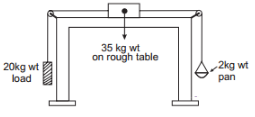
Figure below shows a block of mass $35\ kg$ resting on a table. The table is so rough that it offers a self adjusting resistive force $10 \%$ of the weight of the block for its sliding motion along the table. A $20\ kg$ wt load is attached to the block and is passed over a pulley to hang freely on the left side. On the right side there is a $2\ kg$ wt pan attached to the block and hung freely. Weights of $1\ kg$ wt each, can be added to the pan. Minimum how many and maximum how many such weights can be added into the pan so that the block does not slide along the table? [Ans: Min $15$, maximum $21$].
Image
State the main characteristics of EM waves.
The value of $G$ in $\text{C.G.S}$ system is $6.67 \times 10^{-8} dyne \ cm^2 g^{-2}.$ Calculate its value in $\text{S.l.}$ system.
A hole of radius $r$ is cut from a uniform disc of radius $2r.$ Centre of the hole is at a distance $r$ from centre of the disc. Locate centre of mass of the remaining part of the disc.
State the consequences of Newton’s third law of motion.
A magnetic pole of bar magnet with pole strength of $100\  Am$ is $20\ cm$ away from the centre of a bar magnet. Bar magnet has pole strength of $200\ Am$ and has a length $5\ cm$. If the magnetic pole is on the axis of the bar magnet, find the force on the magnetic pole.