Question
Derive the balance condition for Wheatstone Bridge.

Answer


Image
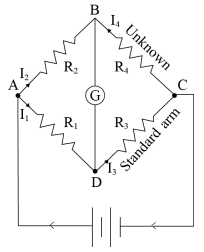
→ The circuit shown in the figure is called the wheatstone bridge. It uses four resistors $R_1, R_2, R_3$ and $R_4$ out of them three resistors are known and one is unknown, wheatstone bridge is used to find the value of unknown resistance.
→ As shown in the figure, across one pair of diagonally opposite points ( $A$ and $C$ in the figure) a source is connected hence $A C$ is called the battery arm.
→ Between the other two vertices, B and D , a galvanomenter G is connected hence BD is called the galvanometer arm.
→ When battery is connected, the currents flowing through the resistors $R_1, R_2, R_3$ and $R_4$ are $I_1, I_2, I_3$ and $I_4$ respectively.
→ Here, there resistors are chosen in such a way that current flowing through galvanometer is zero ( $I _g=0$ ).
→ When the current flowing through the galvanometer becomes zero, the bridge is said to be in balanced condition.
→ From the figure, in balanced condition
$
I_1=I_3 \text { and } I_2=I_4
$
→ Applying Kirchhoff's loop rule to closed loop A - D - B - A
$
\begin{array}{l}
-I_1 R_1+0+I_2 R_2=0 \\
\therefore I_1 R_1=I_2 R_2 \ldots(1)
\end{array}
$
→ Applying similarly, for closed loop $C - B - D - C$
$
\begin{array}{l}
I_4 R_4+0-I_3 R_3=0 \\
\therefore I_3 R_3=I_4 R_4 \ldots \text { (2) }
\end{array}
$
→ Taking ratio of equation (1) and (2)
$
\therefore \frac{I_1 R_1}{I_3 R_3}=\frac{I_2 R_2}{I_4 R_4}
$
But $I_1=I_3$ and $I_2=I_4$
$
\therefore \frac{R_1}{R_3}=\frac{R_2}{R_4} \text { OR } \frac{R_1}{R_2}=\frac{R_3}{R_4} \ldots(3)
$
→ which is a condition for the whetstone bridge to be in balanced condition.
→ If three resistors $R_1, R_2$ and $R_3$ are known then unknown resistence of $R_4$ is given by
$
R_4=R_3 \cdot \frac{R_2}{R_1} \ldots(4)
$
→ A practical device using this principle is called the meter bridge.

Need a full question paper?

Generate a complete, print-ready paper with questions like this in minutes — across 16+ boards, with answer keys.
Start Generating Free

Similar questions

Both the springs shown in figure are unstretched. If the block is displaced by a distance x and released, what will be the initial acceleration?

Derive the relation between focal length $(f)$ and radius of curvature ( R ) for a spherical convex mirror with the help of a geometrical diagram of reflection of incident ray on a convex spherical mirror.
What conclusion can you draw from the following observations on a resistor made of alloy manganin?
Current A
Voltage V
Current A
Voltage V
0.2 
0.4
0.6
0.8
1.0
2.0
3.94
7.87
11.8
15.7
19.7
39.4
3.0
4.0
5.0
6.0
7.0
8.0
59.2
78.8
98.6
118.5
138.2
158.0
The 6563 Å $\text{H}\alpha$ line emitted by hydrogen in a star is found to be redshifted by 15 Å. Estimate the speed with which the star is receding from the Earth.
A potential difference of 12 volt is applied across the ends of 0.24 m long conductor. Calculate the drift velocity of the electrons. Mobility of electron is $5.6 \times 10^{-6} m^2 V^{-1} s^{-1}$.
57Co decays to 57Fe by $\beta^+-\text{ emission.}$- emission. The resulting 57Fe is in its excited state and comes to the ground state by emitting $\gamma-\text{rays}.$ The half-life of $\beta^+-\text{decay}$ is 270 days and that of the $\gamma-\text{emissions}$ is 10-8 s. A sample of 57Co gives 5.0 × 10⁹ gamma rays per second. How much time will elapse before the emission rate of gamma rays drops to 2.5 × 10⁹per second?
A block of mass m having a charge q is placed on a smooth horizontal table and is connected to a wall through an unstressed spring of spring constant k as shown in figure. A horizontal electric field E parallel to the spring is switched on. Find the amplitude of the resulting SHM of the block.

A radioactive nucleus A undergoes a series of decay according to following scheme:
$\text{A}\ \xrightarrow{\ \alpha\ }\ \text{A}_1\ \xrightarrow{\ \beta\ }\ \text{A}_2\ \xrightarrow{\ \alpha\ }\ \text{A}_3\ \xrightarrow{\ \text{g}\ }\ \text{A}_4$
The mass number and atomic number of A are 180 and 72 respectively. What are these numbers for A4?
By explaining the (Electric) current density, derive Ohm's law in vector form.
Two satellites going in equatorial plane have almost same radii. As seen from the earth one moves from east to west and the other from west to east. Will they have the same time period as seen from the earth? If not, which one will have less time period?