Question
Derive the equation required for finding the activation energy.

Answer

self

Need a full question paper?

Generate a complete, print-ready paper with questions like this in minutes — across 16+ boards, with answer keys.
Start Generating Free

Similar questions

Decinormal solution of NaCl developed an osmotic pressure of 4.6 atm at 300 K. Calculate the degree of dissociation.
Answer the following question:
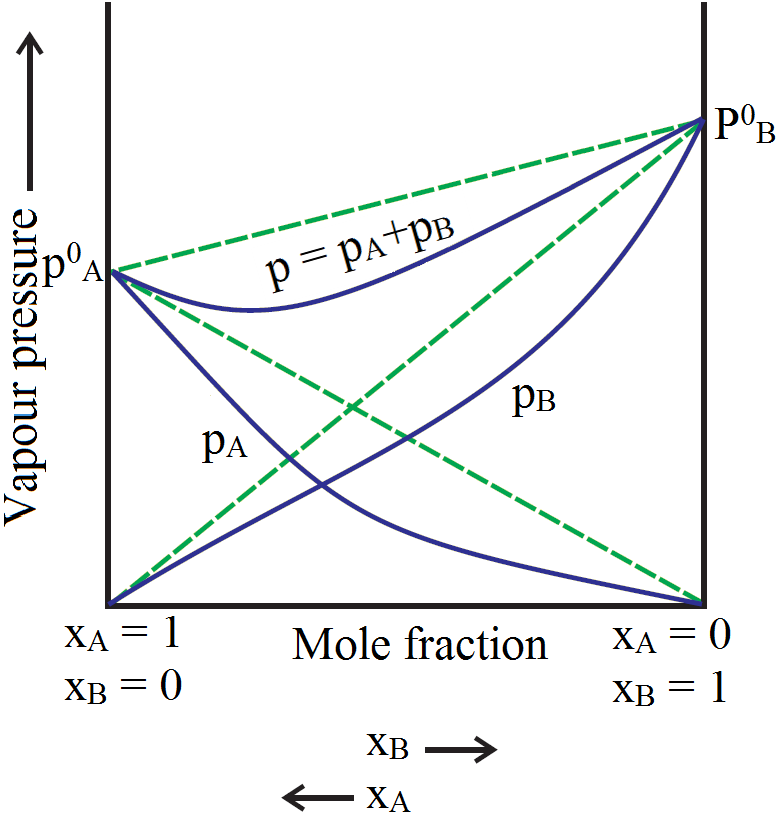
The graphical representation of vapour pressures of two component system as a function of composition is given alongside. By graphic inspection, answer the following questions:
  1. Are the A-B interactions weaker, stronger or of the same magnitude as A-A and B-B?
  2. Name the type of deviation shown by this system from Raoult’s law.
  3. Predict the sign of $\Delta_\text{mix}\text{H}$ for this system.
  4. Predict the sign of $\Delta_\text{mix}\text{H}$ for this system.
  5. Give an example of such a system.
  6. What type of azeotrope will this system form, if possible?
Answer the following questions:
Give chemical reactions for the following observations:
  1. Potassium permanganate is a good oxidising agent in basic medium.
  2. Inter convertibility of chromate ion and dichromate ion in aqueous solution depends upon pH of the solution.
  3. Potassium permanganate is thermally unstable at 513K.
What do you understand by rate of a reaction? What factors affect the rate of a reaction? Discuss.
Describe the reactions of carboxylic acids in which C-OH bond is broken.
Explain the properties of vitamins and also classify them.
Explain Kohlrausch's law of independent migration of ions. Mention the application of Kohlrausch's law.
Write the rate law for a first order reaction. Justify the statement that half life for a first order reaction is independent of the initial concentration of the reactant.
$19.5 g$ of $\ce{CH2FCOOH}$ is dissolved in $500 g$ of water. The depression in the freezing point of water observed is $1.0^\circ C$. Calculate the van’t Hoff factor and dissociation constant of fluoroacetic acid.
  1. $30\ g$ of urea $(M = 60\ g\ mol^{-1})$ is dissolved in $846\ g$ of water. Calculate the vapour pressure of water for this solution if vapour pressure of pure water at $298\ K$ is $23.8\ mm\ Hg.$
  2. Write two differences between ideal solutions and non-ideal solutions.