Question
Derive the expression for force per unit length between two long straight parallel current carrying conductors. Hence define one ampere.

Answer

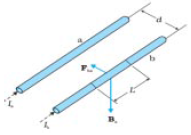
Figure shows two long parallel conductors a and b separated by a distance d and carrying (parallel) currents Ia and I b, respectively. The conductor ‘a’ produces, the same magnetic field Ba at all points along the conductor ‘b’. The right-hand rule tells us that the direction of this field is downwards (when the conductors are placed horizontally). Its magnitude is given by

$\text{B}_{\alpha} = \frac{\mu_\circ\text{I}_{\alpha}}{2\pi\text{d}}$

The conductor ‘b’ carrying a current I b will experience a sideways force due to the field Ba. The direction of this force is towards the conductor ‘a’. We label this force as Fba, the force on a segment L of ‘b’ due to ‘a’. The magnitude of this force is given by

$\int_{ba} = \text{I}_{b}\text{LB}_{a}$ $ = \frac{\mu_\circ\text{I}_{a}\text{I}_{b}}{2\pi\text{d}}\text{L}$

Let $\int_{ba}$ represent the magnitude of the force $\text{F}_{ba}$ per unit length.

$\int_{ba} = \frac{\mu_\circ\text{I}_{a}\text{I}_{b}}{2\pi\text{d}}$

One ampere: The ampere is the value of that steady current which, when maintained in each of the two very long, straight, parallel conductors of negligible cross-section, and placed one metre apart in vacuum, would produce on each of these conductors a force equal to 2 × 10⁻⁷ newton per metre of  their length.

Need a full question paper?

Generate a complete, print-ready paper with questions like this in minutes — across 16+ boards, with answer keys.
Start Generating Free

Similar questions

Three uniform spheres each having a mass M and radius a are kept in such a way that each touches the other two. Find the magnitude of the gravitational force on any of the spheres due to the other two.
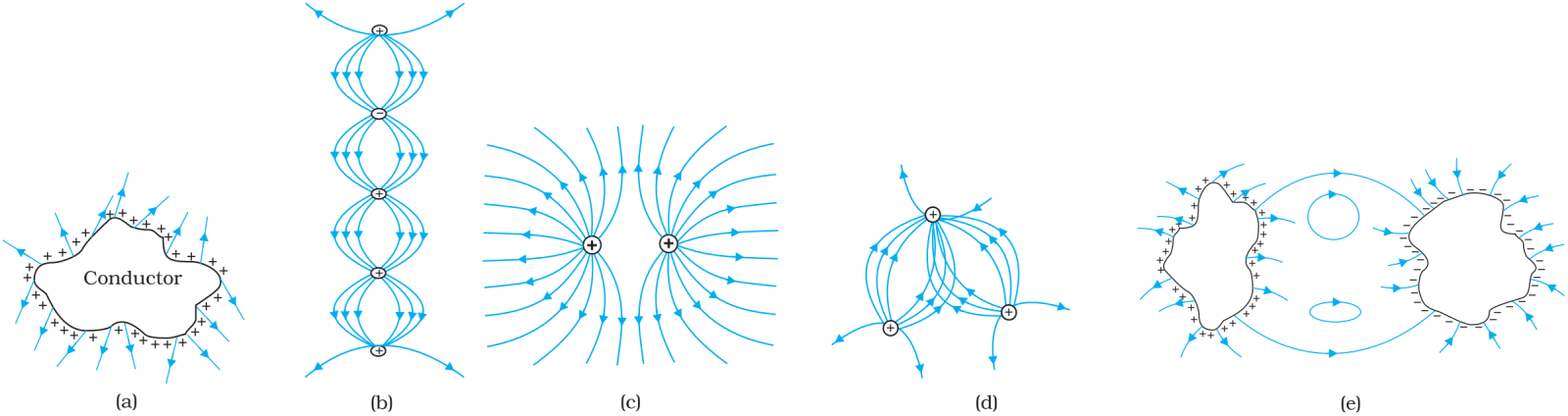
Which among the curves shown in figure cannot possibly represent electrostatic field lines?

Explain : Bar magnet as an equivalent solenoid.
In Young’s double slit experiment, the two slits are separated by a distance of 1·5 mm and the screen is placed 1 m away from the plane of the slits. A beam of light consisting of two wavelengths 650 nm and 520 nm is used to obtain interference fringes. Find.
  1. The distance of the third bright fringe for$\lambda = 520$ nm on the screen from the central maximum.
  2. The least distance from the central maximum where the bright fringes due to both the wavelengths coincide.
Which constituent radiation of the electromagnetic spectrum is used:
  1. In RADAR,
  2. To photograph internal parts of a human body,
  3. For taking photographs of the sky during night and foggy conditions?
Give one reason for your answer in each case.
An electric bulb, when connected across a power supply of 220V, consumes a power of 60W. If the supply drops to 180V, what will be the power consumed? If the supply is suddenly increased to 240V, what will be the power consumed?
Consider a sample of oxygen at 300K. Find the average time taken by a molecule to travel a distance equal to the diameter of the earth.
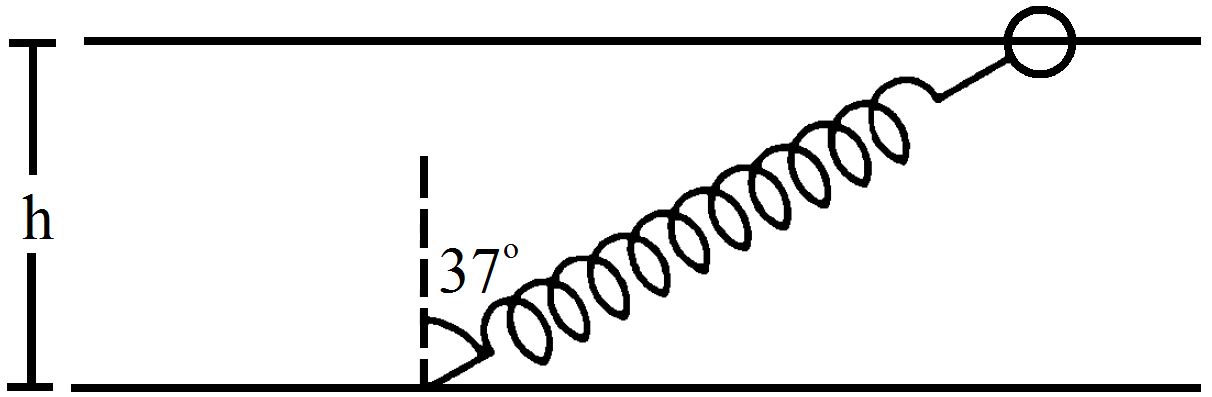
One end of a spring of natural length h and spring constant k is fixed at the ground and the other is fitted with a smooth ring of mass m which is allowed to slide on a horizontal rod fixed at a height h (figure). Initially, the spring makes an angle of 37° with the vertical when the system is released from rest. Find the speed of the ring when the spring becomes vertical.

If a piece of paper is placed at the position of a virtual image of a strong light source, will the paper burn after sufficient time? What happens if the image is real? What happens if the image is real but the source is virtual?
In a p-n junction, the depletion region is 400nm wide and an electric field of 5 × 10⁵V/m exists in it.
  1. Find the height of the potential barrier.
  2. What should be the minimum kinetic energy of a conduction electron which can diffuse from the n-side to the p-side?