Chemical Thermodynamics — Chemistry STD 12 Science — Question
Maharashtra BoardEnglish MediumSTD 12 ScienceChemistryChemical Thermodynamics4 Marks
Question
Derive the expression for the maximum work.
✓
Answer
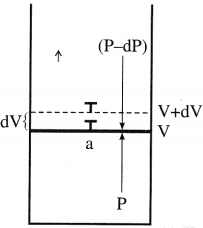
Consider n moles of an ideal gas enclosed in an ideal cylinder fitted with a massless and frictionless movable rigid piston. Let V be the volume of the gas at a pressure P and a temperature T .
If in an infinitesimal change pressure changes from $P$ to $P-d P$ and volume increases from $V$ to $V+d V$. Then the work obtained is, $d W=-(P-d P) d V$
$=-P d V+d P d V$
Since dP.dV is negligibly small relative to PdV
$d W=-P d V$
Let the state of the system change from $A\left(P_1, L_1\right)$ to $B\left(P_2, V_2\right)$ isothermally and reversibly, at temperature $T$ involving number of infinitesimal steps.
$ \ \ \ \ A \longrightarrow T \longrightarrow B$
$P_1, V_1 \quad \ \ \ \ \ \ \ \ \ \ P_2, V_2$
Then the total work or maximum work in the process is obtained by integrating above equation.
$\begin{aligned} W_{\max } & =\int_{ A }^{ B } d W \\ & =\int_{ A }^{ B }-P d V \quad \because P V=n R T \\ \therefore P & =\frac{n R T}{V} \\ W_{\max } & =\int_{V_1}^{V_2}-n R T \frac{d V}{V} \\ & =-n R T \int_{V_1}^{V_2} \frac{d V}{V} \\ & =-n R T\left(\ln V_2-\ln _{V_1}\right) \\ & =-n R T \log _{ c } \frac{V_2}{V_1} \text { } \\ \therefore W_{\max } & =-2.303 n R T \log _{10} \frac{V_2}{V_1}\end{aligned}$
At constant temperature,
$\because P_1 \times V_1=P_2 \times V_2$
$\therefore \frac{V_2}{V_1}=\frac{P_1}{P_2} \quad \text { }$
$\therefore W_{\max }=-2.303 n R T \log _{10} \frac{P_1}{P_2}$
where $n, P, V$ and T represent number of moles, pressure, volume and temperature respectively. For the process,
$\Delta U =0, \Delta H =0 \text {. }$
The heat absorbed in reversible manner
$Q_{\text {rev, }}$ is completely converted into work.
$Q _{ rev }=- W _{\max }$
Hence work obtained is maximum.
Need a full question paper?
Generate a complete, print-ready paper with questions like this in minutes — across 16+ boards, with answer keys.