Question
Derive the formula for electrostatic potential due to a point charge.

Answer

Image

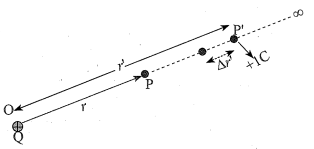
As shown in fig., charge $Q(Q>0)$ is placed on the origin of the cartesian co-ordinates system. We want to find electric potential at some point P , having its position vector $\vec{r}$ from origin O. For this we should calculate work done by external force in bringing unit positive charge (test charge) from infinity to point $P$.
Suppose, there is a point $P ^{\prime}$ at distance $r^{\prime}$ in between the path from infinity to P .
Force on unit positive charge kept at point $P ^{\prime}$ is
$\overrightarrow{ F }^{\prime}=\frac{1}{4 \pi \varepsilon_0} \cdot \frac{ Q }{r^{\prime^2}} \cdot \hat{r}^{\prime}$

Where $\hat{r}^{\prime}$ is the unit vector in the direction of $\overrightarrow{ OP ^{\prime}}$.

The work done against the (field) force in giving $\overrightarrow{\Delta r^{\prime}}$ displacement to the unit positive charge,
$\Delta W =-\frac{1}{4 \pi \varepsilon_0} \cdot \frac{ Q }{r^{\prime 2}} \cdot \Delta r^{\prime}$

Need a full question paper?

Generate a complete, print-ready paper with questions like this in minutes — across 16+ boards, with answer keys.
Start Generating Free

Similar questions

The electric potential inside a charged spherical ball is given by $\phi=a r^2+b$. Where $r$ is the distance from the centre, $a$ and $b$ are constants. Calculate the charge density inside the ball.
A Galilean telescope is 27cm long when focused to form an image at infinity. If the objective has a focal length of 30cm, what is the focal length of the eyepiece?
If the total mechanical energy of a particle is zero, is its linear momentum necessarily zero? Is it necessarily non-zero?
Find the equivalence between points $P$ and N of the combination shown in the figure.
Image
Explain electric field due to system of charges.
Depict the field-line pattern due to a bar magnet.
The circuit arrangement given below shows that when an a.c. passes through the coil A, the current starts flowing in the coil B.
  1. State the underlying principle involved.
  2. Mention two factors on which the current produced in the coil B depends.
Name the nucleus for which the binding energy per nucleon is maximum.
Magnetic force is always normal to the velocity of a charge and therefore does no work. An iron nail held near a magnet, when released, increases its kinetic energy as it moves to cling to the magnet. What agency is responsible for this increase in kinetic energy if not the magnetic field?
A block of massip, sliding on a smooth horizontal surface with a velocity $\vec{\text{v}}$ meets a long horizontal spring fixed at one end and having spring constant k as shown in figure. Find the maximum compression of tin spring. Will the velocity of the block be the same $\vec{\text{v}}$ when it comes back to the original position shown?