Question
Derive the position$-$velocity relation for uniformly accelerated motion from $v-t$ graph. $OR$
  1. Acceleration is defined as the rate of change of velocity. Suppose we call the rate of change of acceleration as $\text{SLAP}$, then what is the unit of $\text{SLAP}$?
  2. A body travels a distance $s_1$ with velocity $v_1$ and distance $s_2$ with velocity $v_2$ in the same direction. Calculate the average velocity of the body.
Answer

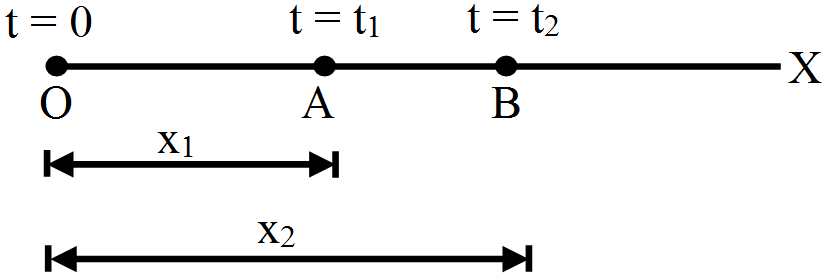
Position$-$velocity relation: Consider an object, moving with a uniform acceleration a along a straight line $OX$, with origin at $0$.

Let the object reach at points $A$ and $B$ at instants $t_1$ and $t_2$.
Let $x_1$ and $x_2$ be the displacements of the objects at time $t_1$ and $t_2$ respectively and $v_1$ and $v_2$ be the velocities of the object at positions $A$ and $B$ respectively.
Acceleration of the object $=\frac{\text{Change in velocity}}{\text{time taken}}$
$\text{a}=\frac{\text{v}_2-\text{v}_1}{\text{t}_2-\text{t}_1}$
$\Rightarrow \text{v}_2-\text{v}_1=\text{a}(\text{t}_2-\text{t}_1)$
$\Rightarrow\text{t}_2-\text{t}_1=\frac{(\text{v}_2-\text{v}_1)}{\text{a}}\ \dots(\text{i})$
From position$-$time relation,
we have $\text{x}_2-\text{x}_1=\Big(\frac{\text{v}_1-\text{v}_2}{2}\Big)(\text{t}_2-\text{t}_2)\ \dots(\text{ii})$
Substituting the value of $(t_2 - t_1)$ in the above equation $(ii)$,
we get $\text{x}_2-\text{x}_1=\Big(\frac{\text{v}_2+\text{v}_1}{2}\Big)\Big(\frac{\text{v}_2-\text{v}_1}{\text{a}}\Big)=\frac{\text{v}^2_2-\text{v}^2_1}{2\text{a}}$
$\text{v}^2_2-\text{v}^2_1=2\text{a}(\text{x}_2-\text{x}_1)\ \dots(\text{iii})$
If $u$ and $v$ are the velocities of an object at position $x_0$ and $x$ respectively,
then using $v_1 = u, v_2= v, x_1 = x_0$ and $x_2 = x$ in $(iii)$,
we get $\text{v}^2-\text{u}^2=2\text{a}(\text{x}_0-\text{x})\ \dots(\text{iv})$ If $\text{x}_0-\text{x}=\text{s},$
then $\text{v}^2-\text{u}^2=2\text{as}$
The above equation is the required position velocity relation.Alternate answer
  1. Given $\text{SLAP} =\frac{\text{Change in acceleration}}{\text{time taken}}$
Unit of $\text{SLAP} =\frac{\text{ms}^{-2}}{\text{s}}=\text{ms}^{-3}$
  1. Given: distanve $-\text{s}_1,\text{s}_2$
Velocities $-\text{v}_1,\text{v}_2$
$\because \text{v}=\frac{\text{s}}{\text{t}}$
$\therefore \text{t}_1=\frac{\text{s}_1}{\text{v}_1},\text{t}_2=\frac{\text{s}_2}{\text{v}_2}$
Total time, t $=\text{t}_1+\text{t}_2=\frac{\text{s}_1}{\text{v}_1}+\frac{\text{s}_2}{\text{v}_2}$
Total distance, $\text{s}=\text{s}_1+\text{s}_2$
$\therefore$ Average velocity $(\text{v}_\text{avg})=\frac{\text{s}}{\text{t}}$
$\Rightarrow \text{v}_\text{avg}=\frac{\text{s}_1+\text{s}_2}{\frac{\text{s}_1}{\text{v}_1}+\frac{\text{s}_2}{\text{v}_2}}$

Need a full question paper?

Generate a complete, print-ready paper with questions like this in minutes — across 16+ boards, with answer keys.

Start Generating Free

Similar questions

Given below are some functions of x and t to represent the displacement of an elastic wave.
$​​​​\text{y}=100\cos(100\pi\text{t+0.5x})$
A wire of length L and radius r is clamped rigidly at one end. When the other end of the wire is pulled by a force f, its length increases by l. Another wire of the same material of length 2L and radius 2r, is pulled by a force 2f. Find the increase in length of this wire.
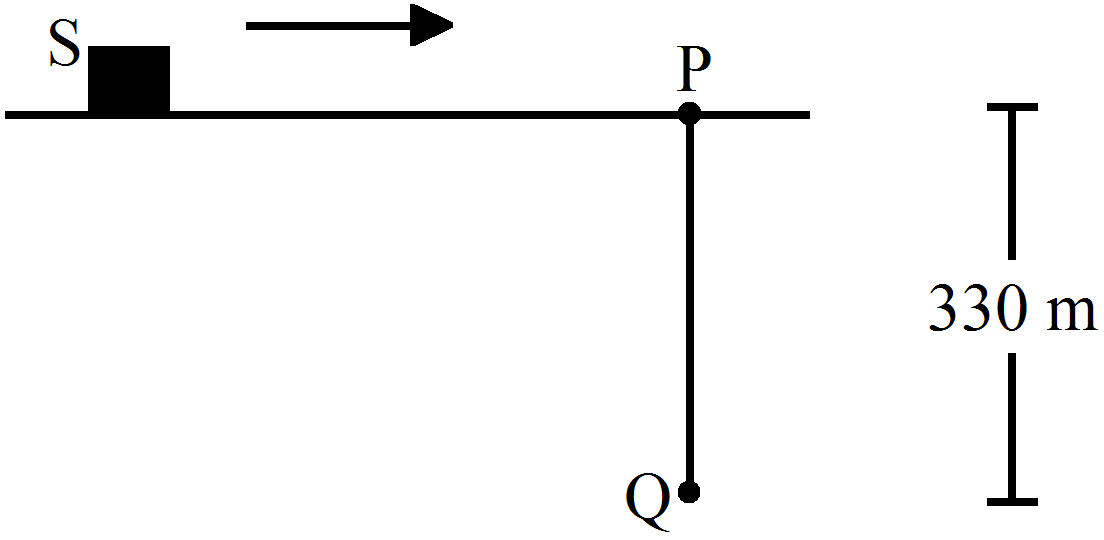
Figure, shows a source of sound moving along the X-axis at a speed of 22m/s continuously emitting a sound of frequency 2.0kHz which travels s in air at a speed of 330m/s. A listener Q stands on the Y-axis at a distance of 330 m from the origin. At t = 0, the source crosses the origin P.
  1. When does the sound emitted from the source at P reach the listener Q?
  2. What will be the frequency heard by the listener at this instant?
  3. Where will the source be at this instant?
An air chamber of volume $V$ has a neck of the area of cross-section $A$ into which a ball of mass $m$ can move without friction. Show that when the ball is pressed down through some distance and released, the ball executes SHM. Obtain the formula for the time period of this SHM, assuming pressure-volume variations of the air to be
i. isothermal and
ii. adiabatic.
A $100kg$ gun fires a ball of $1kg$ horizontally from a cliff of height $500m$. It falls on the ground at a distance of $400m$ from the bottom of the cliff. Find the recoil velocity of the gun. (acceleration due to gravity $= 10m s^{–2}$)
Do permeability and relative permeability have the same dimensions?
(i) Whatement is position vector $\cos ^2 \alpha+\cos ^2 \beta+\cos ^2 \gamma=1$(ii) Explain the displacvector
Write the parallelogram rule of vector addition. Draw the necessary labelled picture. Obtain an expression for the resulting vector $\overrightarrow{ R }$. Mention their special circumstances also.
or
The angle between two vectors $\overrightarrow{ P }$ and $\overrightarrow{ Q }$ is $\theta$. Write the magnitude and direction of their resultant vector in terms of their magnitude and $\theta$.
Or
Write and prove the parallelogram law of vector addition. Discuss some specific examples.
A body describes simple harmonic motion with an amplitude of 5cm and a period of 0.2s. Find the acceleration and velocity of the body when the displacement is (a) 5cm (b) 3cm (c) 0cm.
Explain the following rule of vector combination: (i) Triangle law of vector addition. (ii) Polygon law of vector addition