Question
Describe 'agranulocytes' with the help of diagrams.

Answer

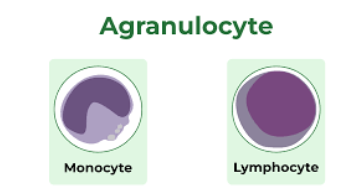
Image
Agranulocytes show absence of granules in the cytoplasm and the nucleus is not lobed. They are of two types viz.
1) Lymphocytes – They show round nucleus, constitute about 25 – 33 % of total WBC and are responsible for immune response of the body
2) Monocytes – They show large kidney-shaped nucleus, constitute about 3 – 9% of total WBC and are phagocytic in function

Need a full question paper?

Generate a complete, print-ready paper with questions like this in minutes — across 16+ boards, with answer keys.

Start Generating Free

Similar questions

You are repeating the Hershey-Chase experiment and are provided with two isotopes: $^{32}P$ and $^{15}N$ (in place of $^{35}S$ in the original experiment). How do you expect your results to be different?
How are oncogenic viruses different from proto oncogenes?
What is meant by total fertility rate? How does it differ from replacement level?
What are allosomes?
Give reasons : Prevention is better than cure for AIDS.
Differentiate between the genetic codes given below:
  1. Unambiguous and Universal.
  2. Degenerate and Initiator.
What is amplification with reference to DNA fingerprinting?
Plenty of algal bloom is observed in a pond in your locality.
  1. Write what has caused this bloom and how does it affect the quality of water.
  2. Suggest a preventive measure.
A new type of drug, PTC 124, enables translation to continue through the nonsense codon. Trials in mice homozygous for a CFTR allele containing the nonsense codon have found that animals treated with PTC 124 produce normal CFTR protein in their cells. The drug is taken orally and is readily taken up into cells all over the body.
Using your knowledge of the progress towards successful gene therapy for cystic fibrosis, suggest why PTC 124 could be simpler and more reliable treatment for this disease.
Honeybees produce their young ones only by sexual reproduction. Inspite of this, in a colony of bees we find both haploid and diploid individuals. Name the haploid and diploid individuals in the colony and analyse the reasons behind their formation.