Question
Describe an experiment to demonstrate that air exerts pressure.

Answer

Air exerts pressure and this can be demonstrated by this experiment.
Image
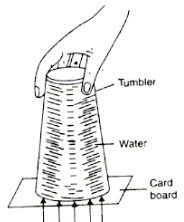
Take a glass tumbler. Fill it to the brim with water, with water overflowing the rim of the tumbler. Cover it with a piece of cardboard. Press the cardboard so that it touches the rim of the tumbler at all points. This will ensure that no air is left inside.
With the hand on the cardboard, invert the tumbler gently and remove the hand. Both cardboard and water shall not fall. This shows that air exerts pressure on the lower surface of the cardboard in the upward as shown in the figure. The upward thrust acting on the cardboard due to air pressure supports the combined weight of cardboard and water in the tumbler.
So, this shows that air exerts pressure.

Need a full question paper?

Generate a complete, print-ready paper with questions like this in minutes — across 16+ boards, with answer keys.

Start Generating Free

Similar questions

State Archimedes' principle, describe an experiment to verify Archimedes' principle.
What do you understand by the following terms as applied to micrometre screw gauge?
1. Sleeve cylinder
2. Sleeve scale
3. Thimble
4. Thimble scale
5. Base line.
What do you mean by a simple pendulum?
A space craft flying in a straight course with velocity of $75 km s ^{-1}$ fires its rocket motors for 6.0 s . At the end of this time its speed is $120 km s ^{-1}$ in the same direction. Find (i) The space craft's average acceleration while the motors were firing (ii) The distance travelled by the space craft in the first 10 s after the rocket motors were started, the motors being in action for only 6 s .
A work of 25 J and 30 J is done when 5 C charge is moved first to point A and then to point B from infinity. Calculate the potential difference between points A and B .
Explain the following:
1. Why do we jerk wet clothes before spreading them on a line?
2. Why does dust fly off, when carpet is hit with a stick?
3. Why do fruits fall off the branches in the strong wind?
4. Why does a pillion rider fall forward, when the driver of a two-wheeler suddenly applies the brakes?
5. Why does a boatman push the bank backward with a long bamboo pole, on launching his boat in water?
6. Why is it difficult to walk on marshy ground?
7. Why is it dangerous to jump out of a moving vehicle? How can the danger be minimised?
8. Why does a boat-man push water backward with the oars, while rowing a boat?
A rubber ball floats in water with $2 / 7$ of its volume above the surface of water. Calculate the average relative density of rubber ball.
Draw a neat and labelled diagram of a vernier callipers. Name its main parts and state their functions.
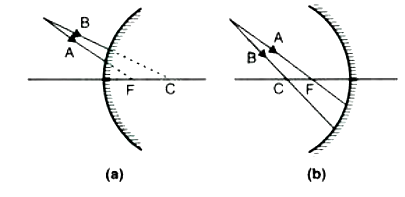
Complete the following diagrams shown in Fig. by drawing the reflected ray for each of the incident ray A and B.
What do you understand by the term acceleration due to gravity? What is its value in C.G.S. and S.I. systems?