Question
Describe an experiment to show that sound cannot pass through vacuum.
Answer

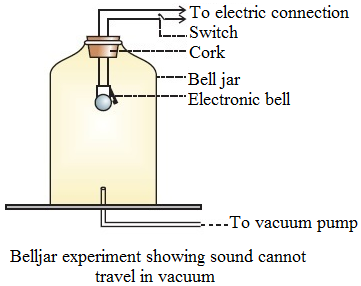
Sound cannot travel through vacuum. This can be shown by the following experiment:
  1. A ringing electric bell is placed inside an air tight glass jar containing air. We can hear the sound of ringing bell clearly. Thus, when air is present as medium in the bell jar, sound can travel through it and reach our ears.
  2. The bell jar containing ringing bell is placed over the plate of a vacuum pump. Air is gradually removed from the bell jar by switching on the vacuum pump. As more and more air is removed from the bell jar, the sound of ringing bell becomes fainter and fainter. And when all the air is removed from the bell jar, no sound can be heard at all. Thus, when vacuum is created in the bell jar, then the sound of ringing bell placed inside it cannot be heard.
This shows that sound cannot travel through vacuum.

Need a full question paper?

Generate a complete, print-ready paper with questions like this in minutes — across 16+ boards, with answer keys.

Start Generating Free

Similar questions

Give an illustrated account of nucleus.
Obtain a relation for the distance travelled by an object moving with a uniform acceleration in the interval between 4th and 5th seconds.
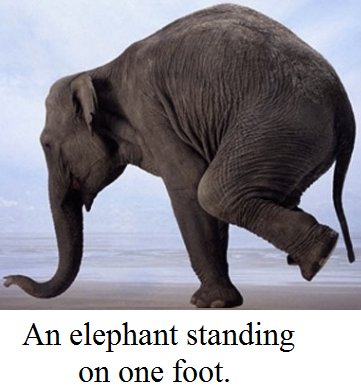
An elephant weighing 40,000N stands on one foot of area 1000cm2 whereas a girl weighing 400N is standing on one ‘stiletto’ heel of area 1cm2.

  1. Which of the two, elephant or girl, exerts a larger force on the ground and by how much?
  2. What pressure is exerted on the ground by the elephant standing on one foot?
  3. What pressure is exerted on the ground by the girl standing on one heel?
  4. Which of the two exerts larger pressure on the ground: elephant or girl?
  5. What is the ratio of pressure exerted by the girl to the pressure exerted by the elephant?
Explain the role of workers in a bee colony.
An automobile engine propels a 1000kg car (A) along a levelled road at a speed of 36km h-1. Find the power if the opposing frictional force is 100N. Now, suppose after travelling a distance of 200m, this car collides with another stationary car (B) of same mass and comes to rest. Let its engine also stop at the same time. Now car (B) starts moving on the same level road without getting its engine started. Find the speed of the car (B) just after the collision.
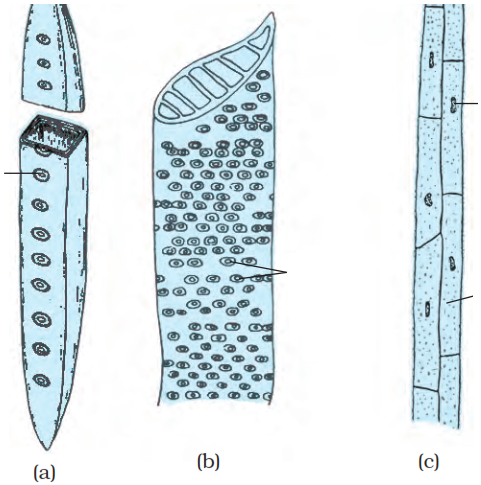
  1. Identify the structures marked below as A, B and C.
  2. Complete the labeling of each structure.
  3. Write the function of each structure.

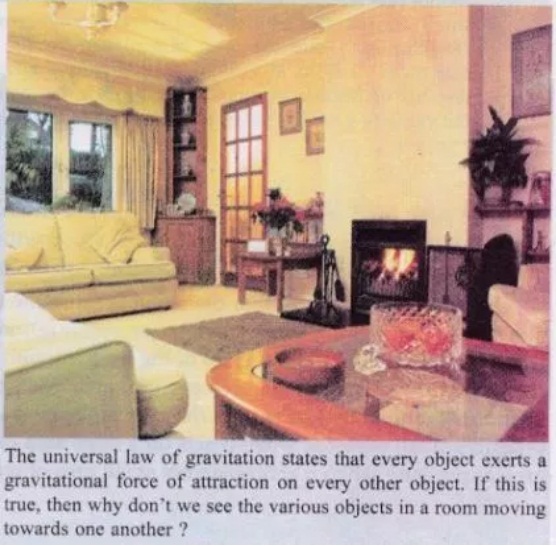
Universal law of gravitation states that every object exerts a gravitational force of attraction on every other object. If this is true, why don’t we notice such forces? Why don’t the two objects in a room move towards each other due to this force?
How will you separate the components of a mixture containing two miscible liquids? Give experimental details.
How will you separate a mixture of mercury, oil and water?