Question
Describe biopiracy.

Answer

→ Biopiracy is the term used to refer to the use of bio-resources by multinational companies and other organisations without proper authorisation from the countries and people concerned without compensatory payment.
→ Most of the industrialised nations are rich financially but poor in biodiversity and traditional knowledge.
→ In contrast the developing and the underdeveloped world is rich in biodiversity and traditional knowledge related to bio-resources.
→ Traditional knowledge related to bio-resources can be exploited to develop modern applications and can also be used to save time, effort and expenditure during their commercialisation.
→ There has been growing realisation of the injustice, inadequate compensation and benefit sharing between developed and developing countries.
→ Therefore, some nations are developing laws to prevent such unauthorised exploitation of their bio-resources and traditional knowledge.
→ The Indian Parliament has recently cleared the second amendment of the Indian Patents Bill, that takes such issues into consideration, including patent terms, emergency provisions and research and development initiative.

Need a full question paper?

Generate a complete, print-ready paper with questions like this in minutes — across 16+ boards, with answer keys.

Start Generating Free

Similar questions

  1. How has the development of bioreactor helped in biotechnology?
  2. Name the most commonly used bioreactor and describe its working.
Draw well labelled diagram of semeniferous tubules.
In which food would you find lactic acid bacteria? Mention some of their useful applications.
Answer the following questions:
Why is geitonogamy also referred to as genetical autogamy?
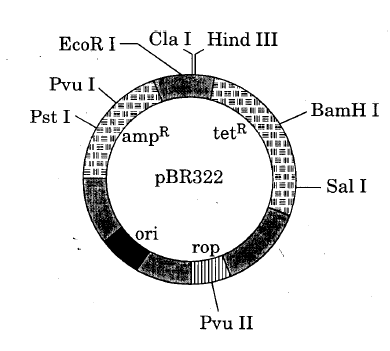
  1. Name the organism in which the vector shown is inserted to get the copies of the desired gene.
  2. Mention the area labelled in the vector responsible for controlling the copy number of the inserted gene.
  3. Name and explain the role of a selectable marker in the vector shown.
Arrange the following parts of mammary gland in correct order in which milk secreted from the cells of alveoli of lobes reaches the nipple. Lactiferous duct, mammary duct, mammary tubules, mammary ampulla.
Given below is a list of autotrophs and heterotrophs. With your knowledge about food chain, establish various linkages between the organisms on the principle of ‘eating and being eaten’. What is this inter-linkage established known as?
Algae, hydrilla, grasshopper, rat, squirrel, crow, maize plant, deer, rabbit, lizard, wolf, snake, peacock, phytoplankton, crustaceans, whale, tiger, lion, sparrow, duck, crane, cockroach, spider, toad, fish, leopard, elephant, goat, Nymphaea, Spirogyra.
  1. A DNA segment has a total of 1,500 nucleotides, out of which 410 are Guanine containing nucleotides. How many pyrimidine bases this segment possesses?
  2. Draw a diagrammatic sketch of a portion of DNA segment to support your answer.
Fertilisation is essential for production of seed, but in some angiosperms, seeds develop without fertilisation.
Explain the two ways by which seeds develop without fertilisation.
i. Write how parasites have evolved with adaptation to co-exist with their hosts in an ecosystem.
ii. Parasites are host specific and tend to co-evolve. How would the parasite respond if the host evolves a certain mechanism to resist or reject the parasite?