Question
Describe Bohr’s model of the atom.
Answer

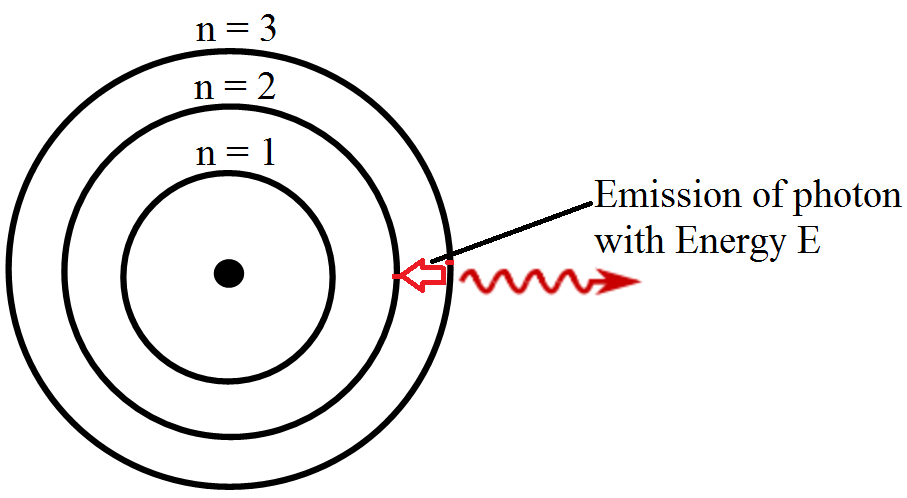
The nucleus of an atom is present in the centre. Around this nucleus will revolve the negatively charged electrons. Discrete orbits of electrons are present inside the atom. While in this orbits, the electrons do not radiate energy. These discrete orbits are represented as $K, L, M, N$ orbits or denoted with the numbers $n = 1, 2, 3, 4$

Need a full question paper?

Generate a complete, print-ready paper with questions like this in minutes — across 16+ boards, with answer keys.

Start Generating Free

Similar questions

A car falls off a ledge and drops to the ground in $0.5 s .$ Let $g =10\ ms^{-2} ($for simplifying the calculations$).$
$i.$ What is its speed on striking the ground?
$ii.$ What is its average speed during the $0.5 s ?$
$iii.$ How high is the ledge from the ground?
Show by using the graphical method that:
$\text{s}=\text{ut}+\frac{1}{2}\text{at}^2$
where the symbols have their usual meanings.
Write down symptoms of sick animals. Discuss any two diseases of cattle.
Write a note on kingdom Monera.
Pragya tested the solubility of three different substances at different temperatures and collected the data as given below (results are given in the following table, as grams of substance dissolved in $100$ grams of water to form a saturated solution).
Substance Dissolved Temperature in K
283 293 313 333 353
Solubility
Potassium nitrate $21$ $32$ $62$ $106$ $167$
Sodium chloride $36$ $36$ $36$ $37$ $37$
Potassium chloride $35$ $35$ $40$ $46$ $54$
Ammonium chloride $24$ $37$ $41$ $55$
$66$
  1. What mass of potassium nitrate would be needed to produce a saturated solution of potassium nitrate in $50$ grams of water at $313\ K$?
  2. Pragya makes a saturated solution of potassium chloride in water at $353K$ and leaves the solution to cool at room temperature. What would she observe as the solution cools? Explain.
  3. Find the solubility of each salt at $293\ K$. Which salt has the highest solubility at this temperature?
  4. What is the effect of change of temperature on the solubility of a salt?
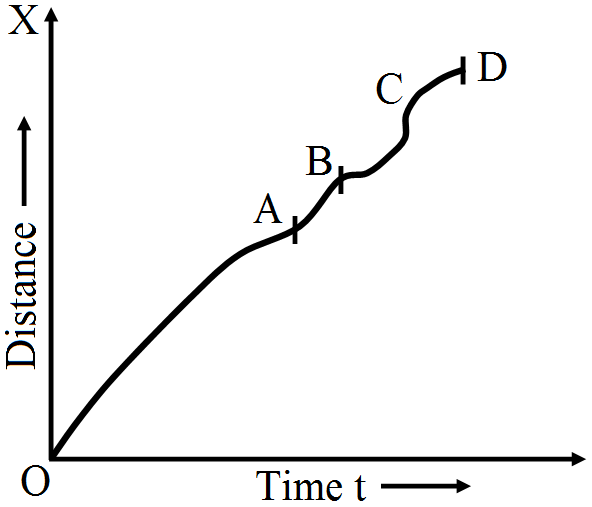
The figure shows an $x-t$ graph of a particle moving along a straight line. What is the sign of the acceleration during the intervals $OA, AB, BC,$ and $CD?$
Discuss the method of separating a mixture containing chalk powder, iron fillings and naphthalene.
Write a note on cattle feed.
Discuss:
  1. Principles of treatment.
  2. Vaccination.
A ball $X$ of mass $1\ kg$ travelling at $2\ m/s$ has a head-on collision with an identical ball $Y$ at rest. $X$ stops and $Y$ moves off. Calculate the velocity of $Y$ after the collision.