Question
Describe briefly about embryonic stages in human being.

Answer

Summary of embryonic development stages in human being :
1 day Fertilization, diameter of fertilized egg is about 0.15 mm.
2 days Two cell stage.
3 days 16 celled stage, Morula.
4 days Entry of blastocyst into uterine lumen.
7-8 days Partial Embedding of Blastocyst into endometrium of uterus implantation.
12 days Implantation completed. Formation of embryonic disc, extraembryonic membrane like Amnion, Chorion and Yolk sac etc.
14 days Formation of primitive streak.
18 days Formation of 3-5 pairs of somites.
19 days Formation of neural groove, neural plate, notochordal plate and 6-8 pairs of somites.
24 days Determination of cephalic and caudal parts, formation of 21-23 pairs of somites and heart.
28 days Imitation of heart beat, complete formation of nasal tube, three pairs of visceral arch, 30-31 pairs of somites as blood islands.
32 days Formation of 30-39 pairs of somites.
7 weeks Jaw, fingers, external ear begin to visible CR Length (crown rump-length) of Embryo becomes 19-20 mm.
8 weeks Embryo or foetus fully surrounded by Amnion. Fingers and toes distinctly visible.
All the organs have been formed and growing. By the end of 8th week Embryo takes shape of human and is now called foetus with CR length 28-30 mm.
5 months Blood formation in bone marrow begins, decidua capsularis fused with parietalis hair begin to grow.
9 months Placenta attains maximum size. Nails grow on fingers and foetus becomes ready to take birth in next 10 days.
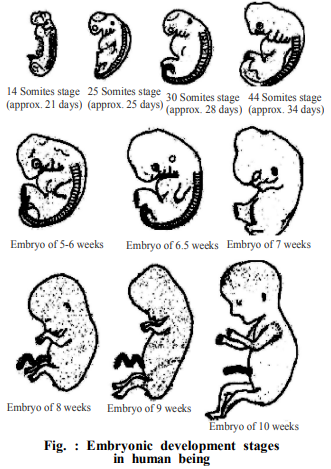
Image
A – 14 somite stage (about 21 days)
B – 25 somite stage (about 25 days)
C – 30 somite stage (about 28 days)
D – 44 somite stage (about 34 days)
E – 5-6 week embryo
F – 6-5 week embryo stage
G – 7 week embryo stage
H – 8 week embryo stage
I – 9 week embryo stage
J – 10 week embryo stage
The above mentioned time period is approximate time period. Sometimes some babies take birth before their gestation time due to some unknown reasons. 

Need a full question paper?

Generate a complete, print-ready paper with questions like this in minutes — across 16+ boards, with answer keys.
Start Generating Free

Similar questions

Explain the different stages of oogenesis in humans starting from foetal life till its completion. When and where in the body is oogenesis completed?
State the law of independent assortment.
Diseases like dysentery, cholera, typhoid etc., are more common in over crowded human settlements. Why?
Differentiate between:
  1. Predator and parasite.
  2. S-Shaped and J-Shaped growth curve.
What are the factors which led to flourishing fishery industry in India?
For question 1-4, use this key:Key-
  1. Ecology.
  2. Population.
  3. Community.
  4. Ecosystem.
  1. A community plus its physical environment.
  2. Study of the interactions of organisms with each other and with the physical environment.
  3. All populations that are found in a particular area.
  4. All members of the same species that inhabit a particular area.
Write three important characteristics of population.
Answer the following questions:
Name the stages in a human female where:
  1. Corpus luteum and placenta co–exist.
  2. Corpus luteum temporarily ceases to exist.
Sakshi's father announced that the children are going to spend this weekend with their grandparents. During the journey, Sakshi saw some farmers who were spraying agrochemicals in their field. She requested her father to stop them. Her father praised her and contacted the farmers. He explained the side effects of such agrochemicals. He also suggested them to use biopesticides and biofertilisers instead of such chemicals. The farmers gave up spraying agrochemicals.
  1. What did Sakshi's father explain to the farmers?
  2. What are agrochemicals?
  3. Why are biofertilisers or biopesticides preferred to chemical fertilisers or pesticides?
  4. What values did Sakshi promote?
If a desired gene is identified in an organism for some experiments, explain the process of the following:
i. Cutting this desired gene at specific location.
ii. Synthesis of multiple copies of this desired gene.