Question
Describe different outbreeding devices in detail.###Describe different devices to discourage self pollination.###Describe different devices to encourage cross pollination.

Answer

→ Majority of flowering plants produce hermaphrodite (bisexual) flowers and pollen grains are likely to come in contact with the stigma of the same flower. Continued self-pollination result in inbreeding depression.
→ Flowering plants have developed many devices to discourage self-pollination and to encourage cross-pollination.
→ Dichogamy - In some species, pollen release and stigma receptivity are not synchronised. Either the pollen is released before the stigma becomes receptive or stigma becomes receptive much before the release of pollen.
→ Heterostyly - In some other species, the anther and stigma are placed at different positions so that the pollen cannot come in contact with the stigma of the same flower.
→ Both these devices prevent autogamy.
→ Self-incompatibility - This is a genetic mechanism and prevents self-pollen (from the same flower or other flowers of the same plant) from fertilising the ovules by inhibiting pollen germination or pollen tube growth in the pistil.
→ Dicliny/Unisexuality It is the production of unisexual flowers.
→ If both male and female flowers are present on the same plant such as castor and maize (monoecious), it prevents autogamy but not geitonogamy.
→ In several species such as papaya, male and female flowers are present on different plants, that is each plant is either male or female (dioecy). This condition prevents both autogamy and geitonogamy.

Need a full question paper?

Generate a complete, print-ready paper with questions like this in minutes — across 16+ boards, with answer keys.

Start Generating Free

Similar questions

Give a brief account of evolution of vertebrates.
Read the following and answer any four questions from (i) to (v) given below:
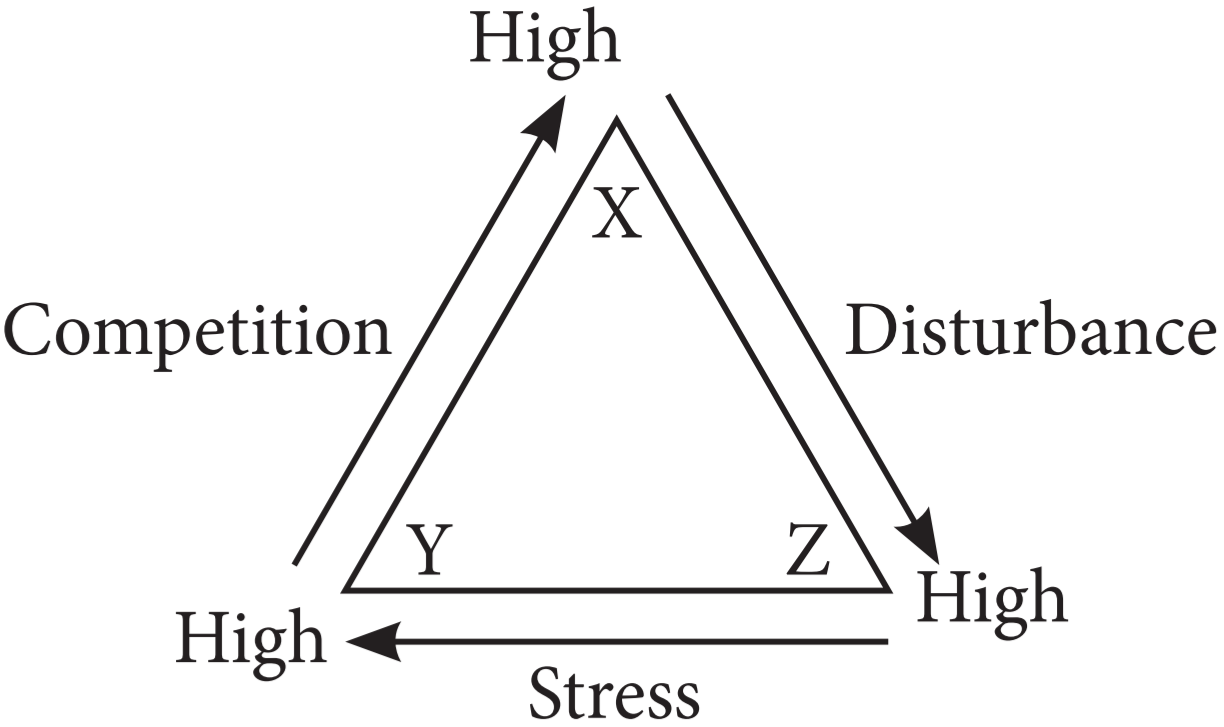
During teaching about various environmental factors, a teacher draw a figure that depicts like history strategies for three plant species (X, Y and Z) along 3 axes - strength of competition with other organisms, level of disturbance in the habitat and level of environmental stress in the habitat. Species X grows in habitats where competition among species is high but disturbance and stress are low. Species Y grows in habitats with high environmental stress but with low intraspecies competition. Species Z grows in highly disturbed habitats with low environmental stress.
  1. Which of the following is correct regarding plant type X?
  1. It has slow growth rate.
  2. It lives in area with high probability of severe environmental changes.
  3. It has good competitive ability at low population densities near the carrying capacity.
  4. None of these.
  1. Environmental stress occurs through.
  1. Very low temperature.
  2. Drought.
  3. Nutrient deficiency.
  4. All of these.
  1. Select the correct option regarding plant type X, Y and Z.
  1. X type of plants are likely to be trees.
  2. Y type of plants could be desert plants.
  3. Z type of plants could be herbaceous plant.
  4. All of these.
  1. Y type of plants grow under high stress and:
  1. Produce large number of seeds in a short time after rains.
  2. Have rapid growth.
  3. Produce less number of seed in a long time after rain.
  4. Both (a) and (b).
  1. Assertion: Plant growth rate is high in area of high stress and high disturbance.
Reason: High stress and high disturbance promote breeding capacity in plants.
  1. Both assertion and reason are true and reason is the correct explanation of assertion.
  2. Both assertion and reason are true but reason is not the correct explanation of assertion.
  3. Assertion is true but reason is false.
  4. Both assertion and reason are false.
Read the following text carefully and answer the questions that follow:
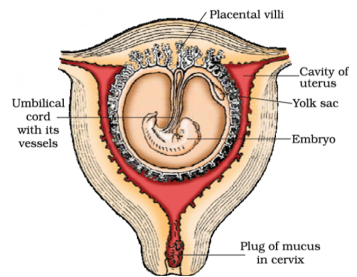
After implantation, finger-like projections appear on the trophoblast called chorionic villi which are surrounded by the uterine tissue and maternal blood. The chorionic villi and uterine tissue become interdigitated with each other and jointly form a structural and functional unit between the developing embryo (foetus) and the maternal body.
Image
i. Name the hormone crucial in parturition. Does the parturition signal originate from the mother or the fetus?(1)
ii. When and where do chorionic villi appear in humans? (1)
iii. Woman has conceived and implantation has occurred. Discuss the impact of progesterone and estrogen. (2)
OR
Fetal ejection reflex leads to parturition. Justify (2)
How is a transgenic tobacco plant protected against Meloidogyne incognita? Explain the procedure.
The bacterium Bacillus thuringiensis is widely used in contemporary biology as:
Read the following text carefully and answer the questions that follow:
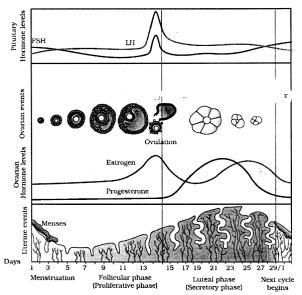
The reproductive cycle in female primates (e.g. monkeys, apes and human beings) is called the menstrual cycle. In human females, menstruation is repeated at an average interval of about 28/29 days, and the cycle of events starting from one menstruation till the next one is called the menstrual cycle Anita has show Diagrammatic presentation of various events during a menstrual cycle.
Image
i. What role do pituitary gonadotropins play during the follicular and ovulatory phases of the menstrual cycle? (1)
ii. The first half of the menstrual cycle is called the proliferative phase as well as the follicular phase. Give reason.(2)
iii. Why does corpus luteum stay active throughout pregnancy and in the absence of fertilization, is active only for 10-12 days?
OR
What happens to corpus luteum in human female if the ovum is (2)
a. fertilised,
b. not fertilised?
Read the following and answer any four questions from (i) to (v) given below:
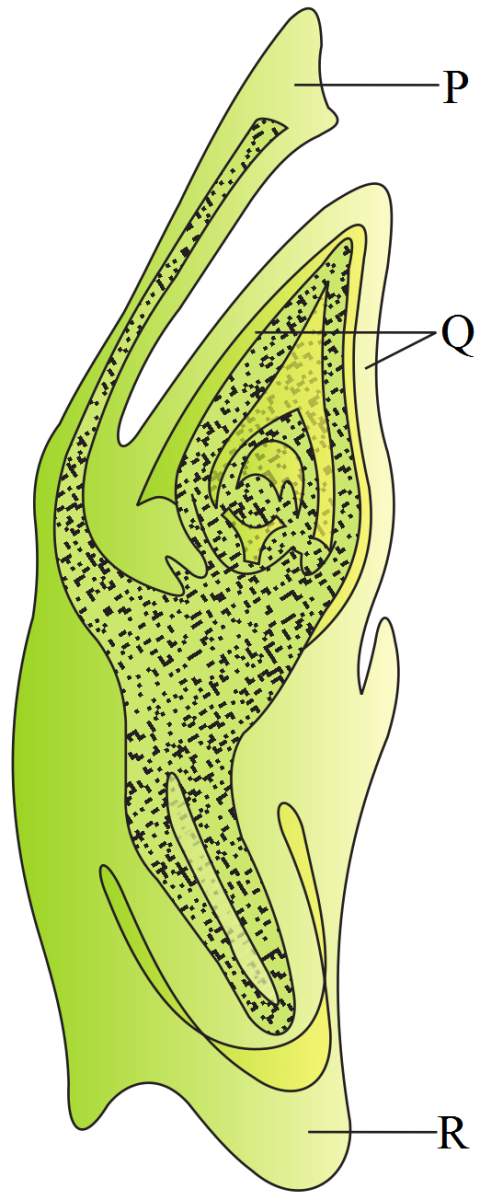
Embryo develops at the micropylar end of the embryo sac, where the zygote is situated. Most zygotes divided only after certain amount of endosperm is formed. The early stages of embryo development are similar in both monocotyledons and dicotyledons. The zygote gives rise to the proembryo and subsequently to the globular heart-shaped and mature embryo. A typical dicotyledonous embryo consists of an embryonal axis and two cotyledons. Embryo of monocotyledons possess only one cotyledon.
  1. True embryo develops as a result of fusion of:
  1. Two polar nuclei of embryo sac.
  2. An egg cell and a male gamete.
  3. Synergid and male gamete.
  4. A male gamete and antipodals.
  1. Refer to the given diagram of the embryo of an angiospermous plant with parts labelled P, Q and R. Select the correct statement(s) regarding this.
  1. Part 'P' supplies nutrition to the developing embryo.
  2. Part 'Q' is the protective sheath of radicle and root cap.
  3. Part 'R' is the protective sheath of shoot apex and leaf primordia.
  4. The embryo shown in the diagram is present in members of Family Poaceae.
  1. (IV) only.
  2. (II) and (III) only.
  3. (I) and (IV) only.
  4. (I), (II), (III) and (IV).
  1. Which of the given statements are true?
  1. During the development of a dicot embryo, heart-shaped embryo is followed by globular embryo.
  2. The part of embryonal axis above the level of cotyledons is epicotyl, while the part below the level of cotyledons is hypocotyl.
  3. Monocot seeds possess a single cotyledon, represented by scutellum.
  1. (I) and (II).
  2. (II) and (III).
  3. (I) and (III).
  4. (I), (II) and (III).
  1. Consider the following parts of an embryonal axis of a dicot seed.
  1. Hypocotyl.
  2. Epicotyl.
  3. Radicle.
  4. Plumule.
In which of the following the above parts are correctly arranged from top to base?
  1. (III) → (I) → (II) → (IV).
  2. (II) → (I) → (III) → (IV).
  3. (IV) → (II) → (I) → (III).
  4. (III) → (IV) → (II) → (I).
  1. In grass family, the cotyledon, is called:
  1. Epiblast.
  2. Plumule.
  3. Scutellum.
  4. Perisperm.
Read the following and answer any four questions from (i) to (v) given below:
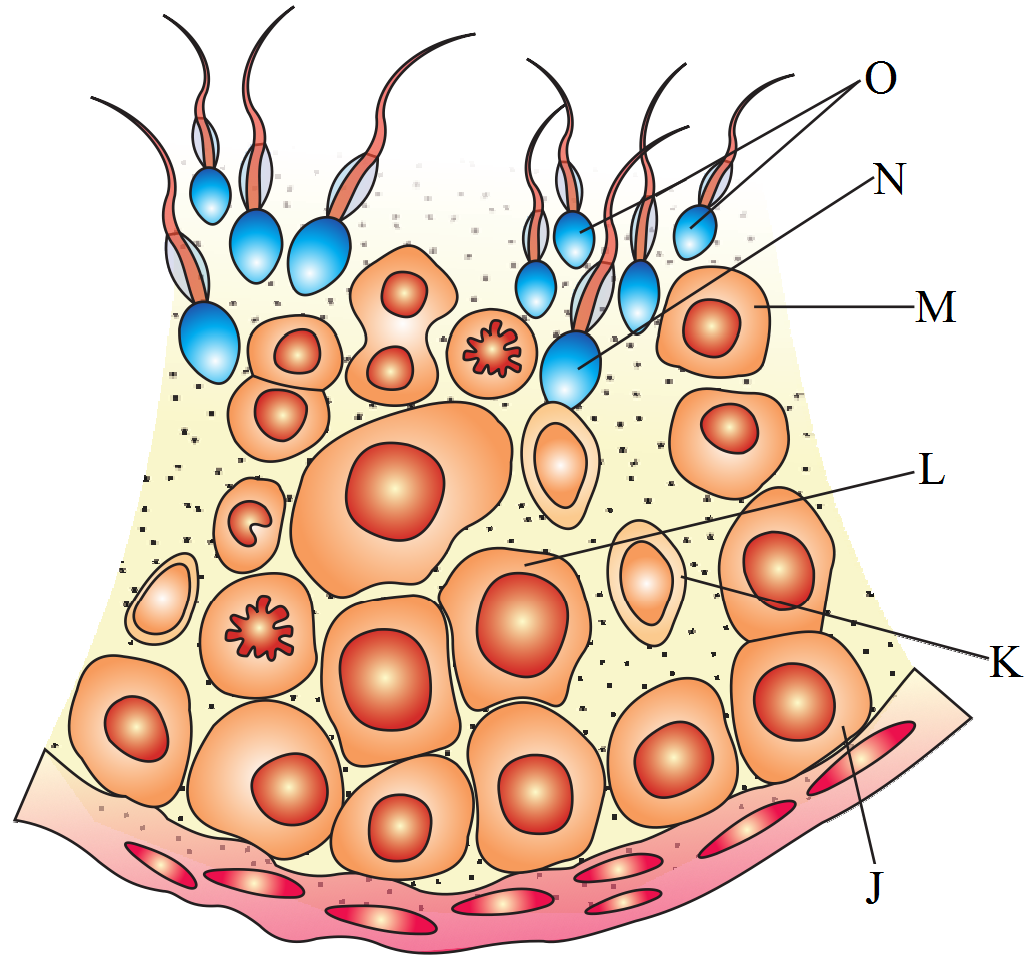
Each testicular globule of testis contains one to three highly coiled seminiferous tubules. Wall of each seminiferous tubule is formed of single layered germinal epithelium. Majority of cells in this epithelium are cuboidal, called male germ cells. Study the transverse section of part of seminiferous tubule and answer the following questions.
  1. What is the characteristic of K?
  1. K is spermatogonium which grows into primary spermatocyte.
  2. K is Sertoli cell which provides nutrition to spermatids.
  3. K is secondary spermatocyte which undergo meiosis II to form spermatid.
  4. K is spermatid being converted into sperm.
  1. Which of the following cell undergo reduction division to form secondary spermatocyte?
  1. J
  2. M
  3. L
  4. K
  1. How many among the following have 46 chromosomes?
  1. 2
  2. 4
  3. 5
  4. 3
  1. Select an option that correctly identifies different labels.
  1. L- Primary spermatocyte, N - Spermatozoa, M - Secondary spermatocyte.
  2. J - Spermatogonium, K - Sertoli cell, O - Spermatozoa.
  3. L- Primary spermatocyte, M - Secondary spermatocyte, N - Spermatozoa.
  4. J - Spermatogonium, K - Primary spermatocyte, N - Spermatid.
  1. Which hormone initiates spermatogenesis at puberty?
  1. FSH
  2. ICSH
  3. ABP
  4. GnRH
Explain co-dominance in humans with the help of example.
Read the following and answer any four questions from (i) to (v) given below:
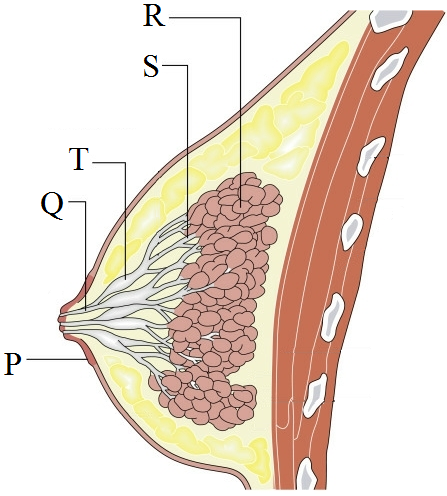
A functional mammary gland is characteristic of all female mammals. Mammary glands are paired structures that contain glandular tissue and variable amount of fat. Refer to the given figure of a mammary gland and answer the following questions.
  1. Mammary glands are modified:
  1. Sweat glands.
  2. Sebaceous glands.
  3. Sudoriferous glands.
  4. Lacrimal glands.
  1. Identify the incorrectly matched pair.
  1. P - Areola.
  2. Q - Lactiferous duct.
  3. S - Mammary duct.
  4. T - Mammary alveoli.
  1. Mammary ducts expand to form:
  1. Mammary alveoli.
  2. Mammary ampullae.
  3. Lactiferous ducts.
  4. Mammary tubules.
  1. What is areola?
  1. Grape-like clusters of milk secreting structures.
  2. Fatty tissue between the mammary lobes.
  3. Circular pigmented area of skin around nipple.
  4. Connective tissue that supports the alveoli and ducts.
  1. Assertion: The size of breast depends on the amount of adipose tissue.
Reason: The adipose tissue supports the alveoli and the ducts.
  1. Both assertion and reason are true, and reason is the correct explanation of assertion.
  2. Both assertion and reason are true, but reason is not the correct explanation of assertion.
  3. Assertion is true, but reason is false.
  4. Both assertion and reason are false.