Question
Describe how, fossil fuels were formed.

Answer

The fossil fuel such as coal is formed from the remains of dead vegetation. Earth had dense forests in low lying wetland areas about $300$ million years ago. Due to natural processes, like flooding, these forests got buried under the soil. Due to soil deposition over these dead plants, they were compressed. The temperature also increased as they sank deeper and deeper. Under high pressure and high temperature, dead plants got slowly converted to coal. As coal contains mainly carbon, the slow process of conversion of dead vegetation into coal is called carbonisation. Since it was formed from the remains of vegetation, coal is also called a fossil fuel. The fossil fuel such as petroleum is formed from the dead animals under the sea. As these organisms died, their bodies settled at the bottom of the sea. They got covered with layers of sand and clay. Over millions of years, in the absence of air, with high temperature and high pressure, these the dead organisms were transformed into petroleum and natural gas.

Need a full question paper?

Generate a complete, print-ready paper with questions like this in minutes — across 16+ boards, with answer keys.
Start Generating Free

Similar questions

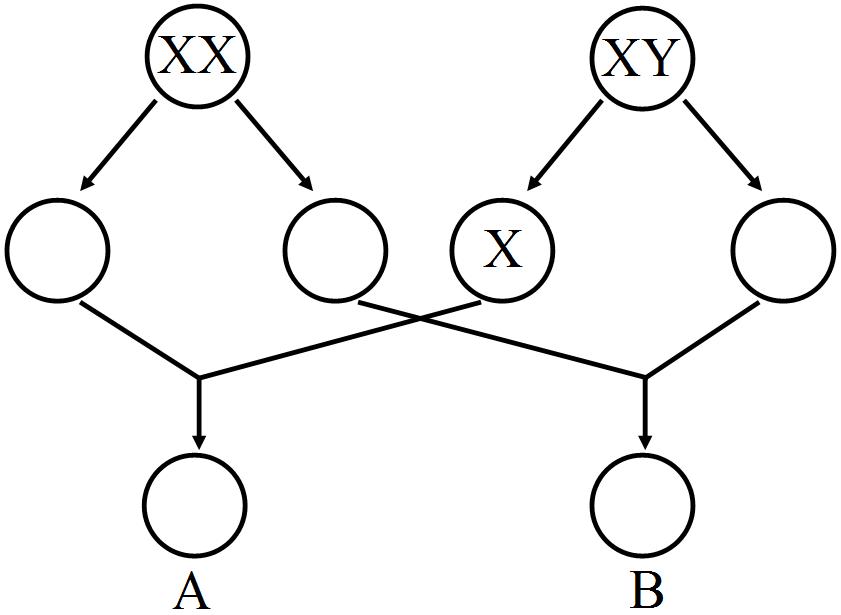
Fill the blank circles in figure and identify the sex of child $A$ and $B.$
Name one musical instrument each in which the sound is produced:
$a.$ By vibrating a stretched string.
$b.$ By vibrating air enclosed in a tube.
$c.$ By vibrating a stretched membrane.
$d.$ By vibrating metal plates.
Write a short note on term 'drag'. Explain why objects moving in fluids should have streamlined shape.
Draw the general diagram of a plant cell and label it.
Give two examples of each of the following:
$a.$ Stringed musical instruments.
$b.$ Wind musical instruments.
$c.$ Membrane musical instruments.
$d.$ Plate type musical instruments.
Give a list of five objects around you which are electroplated.
Describe an activity to show that a liquid exerts equal pressure in all the direction at a given depth.
Match the names of scientists given in Column $A$ with the discovery made by them given in Column $B.$
 
Column $A$
 
Column $B$
$(a)$
Louis Pasteur
$(i)$
Penicillin
$(b)$
Robert Koch
$(ii)$
Anthrax bacterium
$(c)$
Edward Jenner
$(iii)$
Fermentation
$(d)$
Alexander Fleming
$(iv)$
Small pox vaccine
 
 
$(v)$
Typhoid
Two very small organisms $X$ and $Y$ both reproduce by the method of budding. Organism $X$ is industrially very important because it is used in making alcohol from sugar. It is also used in making bread. Organisms $Y$ is a tiny animal having tentacles which live in water.
$1.$ What is organisms $X$?
$2.$ Name the process in which $X$ converts sugar into alcohol.
$3.$ To which class of organism does $X$ belong?
$4.$ What are organisms $Y$?
$5.$ Out of $X$ and $Y$, which organism is multicellular and which one is unicellular?
Name any four pollutants which cause water pollution. State any three ways of controlling water pollution.