Question
Describe how scientific principles help us understand the relationship between Moon phases and timekeeping. How did observations of celestial cycles influence early calendars and our routines on Earth?

Answer

The Moon’s phases change regularly due to its orbit around the Earth and the changing angle of sunlight hitting its surface. Ancient humans observed this predictable cycle to mark time. A new moon to full moon and back takes about 29.5 days, forming the basis of lunar months. People used these phases to create calendars and plan agriculture, festivals, and religious events. Scientific understanding now explains this through the relative positions of the Earth, Moon, and Sun. This knowledge also helps predict eclipses and tides. Hence, observation of celestial patterns using scientific methods influenced early timekeeping and continues to shape our routines.

Need a full question paper?

Generate a complete, print-ready paper with questions like this in minutes — across 16+ boards, with answer keys.
Start Generating Free

Similar questions

What is the cause of friction? Explain with the help of a labelled diagram.
What are metalloids? Name two metalloids.
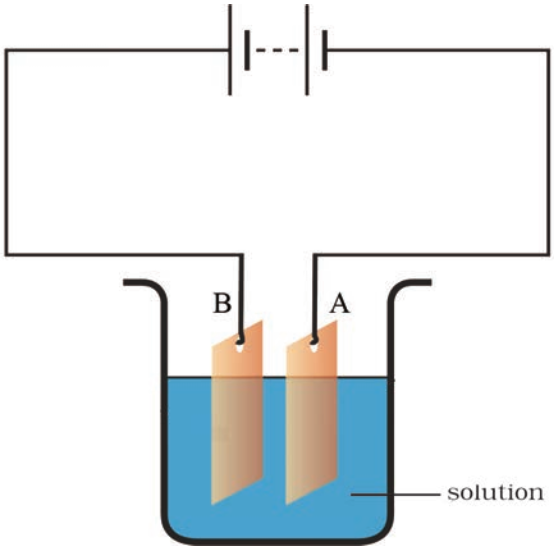
Observe the circuit given in Figure.

Boojho set up this circuit for purification of copper. What will be the nature of:
$i.$ Plate $A$.
$ii.$ Plate $B$.
$iii.$ The solution.
Explain the process of purification.
Which of the following articles made of plastics ‘can be recycled’ and which ‘cannot be recycled’? Give
reasons for your choice. Telephone instruments, Plastic toys, Cooker handles, Plastic covering on electrical wires, Electric switches,
Ballpoint pens, Carry bags, Plastic bottles, Plastic chairs.
What is meant by noise pollution? Mention some of the sources of noise pollution in your surroundings.
The substance $W$ is a fossil fuel. It occurs deep below the ground in certain areas of the earth. Another fossil fuel $X$ is found trapped above the deposits of $W$. When $W$ is subjected to a process called $Y$, then a number of different products are collected at different temperature ranges which are put to different uses. A special grade of product $Z$ obtained in this way is used as aviation fuel in jet aeroplanes.
$a.$ What are $(i) W$, and $(ii) X$ ?
$b.$ What is the physical state of $(i) W,$ and $(ii) X$ ?
$c.$ Name the process $Y$.
$d.$ Name the product $Z$.
What is meant by a non$-$contact force? Explain with the help of an example.
What are the harmful effects of acid rain?
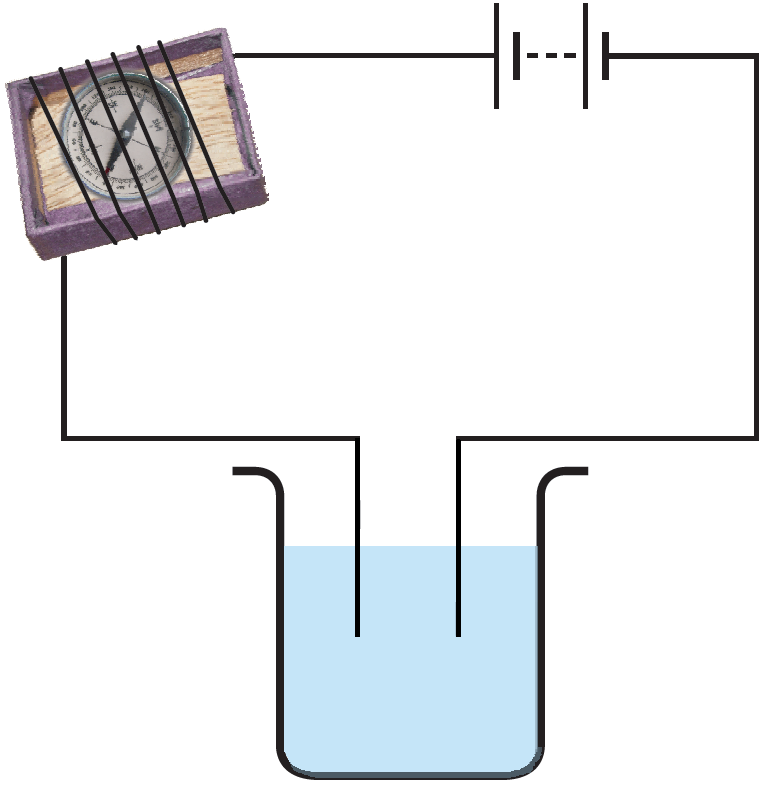
Name three liquids which when tested in the manner shown in figure given alongside may cause the magnetic needle of compass to deflect.
What is meant by ‘secondary sexual characteristics’ in humans? Explain with the help of two examples.