Maharashtra BoardEnglish MediumSTD 11 ScienceChemistryBasic Principles of Organic Chemistry6 Marks
Question
Describe inductive effect in detail.
✓
Answer
Inductive effect:
$i.$ When an organic molecule has a polar covalent bond in its structure, polarity is induced in adjacent carbon$-$ carbon single bonds too. This effect is called as inductive effect.
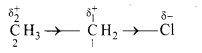
$ii.$ For example, in chloroethane molecule, the covalent bond between $‘C \ ’$ and $‘Cl \ ’$ is a polar covalent bond whereas $C-2$ and $C-1$ bond $(C-C$ bond$)$ is expected to be nonpolar covalent bond. But, this bond acquires some polarity as chlorine is more electronegative than carbon. Chlorine pulls the bonding pair of electrons towards itself. Thus, the chlorine atom acquires a fractional negative charge, while the $C-1$ carbon atom acquires a fractional positive charge. As $C-1$ is further bonded to $C-2,$ the positive polarity of $C-1$ pulls the shared pair of electrons of the $C-2 – C-l$ bond more towards itself. As a result, a smaller positive charge is developed on $C-2.$ Thus, the electron density gets displaced towards the chlorine atom not only along the $[C-1 – Cl]$ bond, but also along the $[C-2 – C-1]$ bond due to the inductive effect of $Cl.$ This is represented as follows:
$iii.$ The arrow head shown in the centre of the bond represents inductive effect. The direction of the arrow head indicates the direction of the permanent electron displacement along the sigma bond in the ground state.
$iv.$ The inductive effect of an influencing group is transmitted along a chain of $C-C$ bonds. However, this effect decreases rapidly with the increase in the number of intervening $C-C$ single bonds and it becomes negligible beyond three $C-C$ bonds.
$CH _3-\stackrel{\delta_3^{+}}{ C } H _2 \rightarrow-\stackrel{\delta_2^{+}}{ C } H _2 \rightarrow-\stackrel{\delta_1^{+}}{ C } H _2 \rightarrow-\stackrel{\delta-}{ a }$ Where, $\delta_1^{-}>\delta_2^{-}>\delta_3^{-}$
$v.$ The direction of the inductive effect of a bonded group depends upon whether electron density of the bond is withdrawn from the bonded carbon or donated by the bonded carbon. On the basis of this ability, the groups/substituents are classified as either electron withdrawing $($accepting$)$ or electron donating $($releasing$)$ groups with respect to hydrogen.
e.g. In chloroethane, $Cl$ withdraws electron density from the carbon chain and is electron withdrawing. Therefore, chlorine is said to exert an electron withdrawing inductive effect or negative inductive effect $(-I$ effect$)$ on the carbon chain.
$vi. \ a.$ Substituents or groups that shows $-I$ effect $: -Cl, -NO_2, -CN, -COOH, -COOR, -OAr,$ etc.
$b.$ Substituents or groups that shows $+I$ effect: Alkyl groups such as $-CH_3, -CH_2CH_3,$ etc.
Need a full question paper?
Generate a complete, print-ready paper with questions like this in minutes — across 16+ boards, with answer keys.