Question
Describe pregnancy and embryonic development.

Answer

→ Immediately after implantation, the inner cell mass (embryo) differentiates into an outer layer called ectoderm and an inner layer called endoderm.
→ A mesoderm soon appears between the ectoderm and the endoderm.
→ These three layers give rise to all tissues (organs) in adults.
→ The inner cell mass contains certain cells called stem cells which have the potency to give rise to all the tissues and organs.
→ The human pregnancy lasts 9 months.
→ In human beings, after one month of pregnancy, the embryo's heart is formed. The first sign of growing foetus may be noticed by listening to the heart sound carefully through the stethoscope.
→ By the end of the second month of pregnancy, the foetus develops limbs and digits.
→ By the end of 12 weeks (first trimester), most of the major organ systems are formed, for example, the limbs and external genital organs are well-developed.
→ The first movements of the foetus and appearance of hair on the head are usually observed during the fifth month.
→ By the end of about 24 weeks (end of second trimester), the body is covered with fine hair, eye-lids separate, and eyelashes are formed.
→ By the end of nine months of pregnancy, the foetus is fully developed and is ready for delivery.
Image
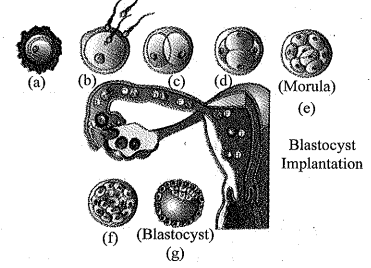
→ The zygote is formed at the ampulla-isthmus junction of the fallopian tube when the union of secondary oocyte and spermatozoa occurs. The zygote undergoes various divisions and changes before it reaches the uterus for implantation.
→ The figure shows the various stages of development of a zygote as it passes through the oviduct and uterus:
(a) The zygote divides into a two-celled stage wide via division or 1st cleavage while the ozygote is still in the isthmus of the oviduct.
(b) Several more mitotic divisions or cleavages occur in the 2 celled stage to form a 2, 4, 8 and finally a 16-celled stage of the zygote.The 16 celled stage is called the morula and various cells formed after cleavage are called blastomeres.
(c) Morula then changes into a blastocyst after a few more divisions and this stage contains a fluid filled cavity in the embryo. The blastomeres become arranged and line up into an outer layer of cells called the trophoblast and an inner mass of cells. The fluid filled cavity is called blastocoel.
(d) Implantation of the embryo occurs at this blastocyst stage by the help of trophoblast layer which embeds itself into the uterine endometrium.
Need a full question paper?

Generate a complete, print-ready paper with questions like this in minutes — across 16+ boards, with answer keys.

Start Generating Free

Similar questions

Read the following and answer any four questions from (i) to (v) given below:

Priya was 4 years old when she contracted chicken pox. It took her around 15 days to recover completely. Now Priya is 5 years old, so her mother got her vaccinated few days back for DPT (5th dose) as per immunisation program. Recently she was playing with her friend in the park when her friend accidently fell on iron pipe and badly bruised her knee. She was taken to the hospital where doctor gave her ATS injection and painkillers. Based on the above information, answer the following questions.

  1. Select the correct statement.
  1. Priya has developed natural active immunity against chicken pox.
  2. Priya has developed artificial active immunity against DPT.
  3. Priya's friend has developed artificial passive immunity against tetanus.
  4. All of these
  1. Which of the following do you think is an example of natural passive immunity?
  1. Administration of AGS (anti gas gangrene serum) in a person.
  2. Transfer of IgA antibodies from mother to baby through mother's milk.
  3.  A person recovered from viral infection.
  4. A child vaccinated for polio.
  1. Which of the following is true for active immunity?
  1. It provides immediate relief.
  2. It is temporary, not long lasting
  3. It has no side effects.
  4. None of these
  1. Select the incorrect match.
  1. Passive immunity-IgG antibodies crossing placental barrier to reach fetus.
  2. Active immunity-Vaccination against corona virus.
  3. Active immunity-Administration of antidiphtheria serum in patient.
  4. Passive immunity-Fetus having mother's milk.
  1. Assertion: A person recovered from measles develops an active immunity against this infection.

Reason: In active immunity, person's own cells develop antibodies in response to infection.

  1. Both assertion and reason are true and reason is the correct explanation of assertion.
  2. Both assertion and reason are true, but reason is not the correct explanation of assertion.
  3. Assertion is true, but reason is false.
  4. Both assertion and reason are false.
Origin and Evolution of Man:
Write a short note on transcription unit.### Explain : Transcription unit
Loss of habitat and fragmentation leads to loss in biodiversity. Explain with example.
Differentiate between Monohybrid & Dihybrid Cross.
Bacteria cannot be seen with the naked eyes, but these can be seen with the help of a microscope. If you have to carry a sample from your home to your biology laboratory to demonstrate the presence of microbes with the help of a microscope, which sample would you carry and why?
What is the mechanism by which the AIDS virus causes deficiency of immune system of the infected person?
Read the following and answer any four questions from (i) to (v) given below:

Tools used in the formation of recombinant DNA are of three types. These are enzymes, cloning vectors and competent host. lysing enzymes are used to extract DNA for experimental purpose from the cells. Cleaving enzymes break the DNA molecules. TI1ey are of three types : exonucleases, endonucleases and restriction endonucleases. A competent host is required for transformation with recombinant DNA and cloning vectors help to propagate DNA.

  1. Which of the following is an example of natural Iysing activity in a human body?
  1. Lysozyme present in tears dissolve the bacterial cell wall.
  2. Conversion of starch to maltose in the buccal cavity
  3. Absorption of digested food into the intestinal cells.
  4. Conversion of protein molecules into amino acids in the stomach.
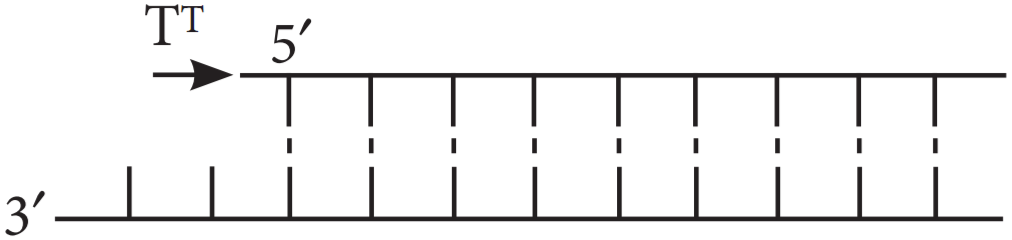
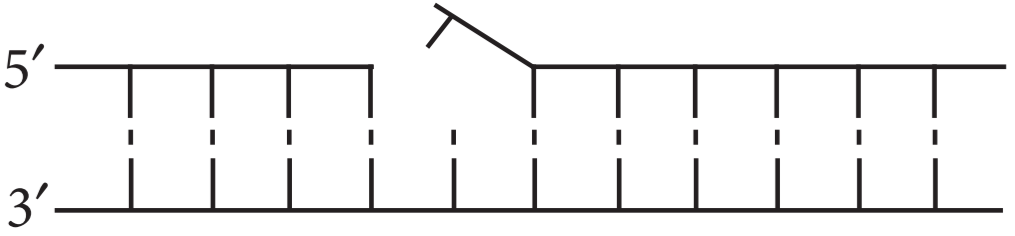
  1. Which of the following depicts exonuclease activity?
  1.  

  1.  

  1.  


  1. All of these
  1. Cloning vectors are the DNA molecules that.
  1. Carry foreign DNA segment but do not replicate inside the host cell.
  2. Carry foreign DNA segment and replicate inside the host cell.
  3. Transfer nuclear DNA form nucleus to the cytoplasm of the same cells.
  4. Help in sealing gaps in DNA segments.
  1. Transfer of DNA into a eucaryotic cell is called:
  1. Transformation.
  2. Transduction.
  3. Transfection.
  4. Electroporation.
  1. Assertion: Type I restriction enzymes are not used in rDNA technology.

Reason: Biotechnology mostly involves cutting and pasting of desired DNA fragments.

  1. Both assertion and reason are true and reason is the correct explanation of assertion.
  2. Both assertion and reason are true but reason is not the correct explanation of assertion.
  3. Assertion is true but reason is false.
  4. Both assertion and reason are false.
Read the following text carefully and answer the questions that follow:
The following is the illustration of the sequence of ovarian events (a-i) in a human female.
Image
i. Identify the figure that illustrates ovulation and mentions the stage of oogenesis it represents. (1)
ii. Name the ovarian hormone and the pituitary hormone that have caused the above-mentioned event. (1)
iii. Explain changes that occur in the uterus simultaneously in anticipation. (2)
OR
Draw a labelled sketch of the structure of a human ovum prior to fertilization. (2)
Read the following and answer any four questions from (i) to (v) given below:

In today's world, more than 25% of human population is suffering from hunger and malnutrition. Scientists have developed techniques where microbes are grown on industrial scale as a source of good protein which can be grown from waste water, animal manure and even sewage. Single cell proteins are such products. TI1e biomass or protein is extracted from pure or mixed cultures of algae, yeasts, fungi or bacteria. These are a very good source of food for human consumption.

  1. Why the name single cell protein is applied?
  1. It contains only one type of protein.
  2. It is obtained from unicellular edible microbes.
  3. It contains only one type of microorganism.
  4. All of these.
  1. Which of the following is considered under single cell protein?
  1. Algae.
  2. Fungi.
  3. Cyanobacteria.
  4. All of these.
  1. Microorganisms can be a useful food resource for increasing human population because:
  1. These are easy to harvest.
  2. These can grow in water system.
  3. They have a high rate of multiplication thus producing huge biomass.
  4. They have high level of nucleic acid.
  1. Single cell protein can be grown from:
  1. Waste water.
  2. Animal manure.
  3. Sewage.
  4. All of these.
  1. Assertion: Production of single cell protein reduces pollution.

Reason: Single cell protein can be grown from waste water and even sewage.

  1. Both assertion and reason are true and reason is the correct explanation of assertion.
  2. Both assertion and reason are true but reason is not the correct explanation of assertion.
  3. Assertion is true but reason is false.
  4. Both assertion and reason are false.