Question
Describe structure and functions of plasma membrane.

Answer

Plasma membrane: Every cell is bounded by a thin, elastic, delicate, living membrane called plasma membrane or cell membrane. It is the outermost covering of the cell which separates the cell content from its external environment.
Plasma membrane is continuous lipid bilayer with protein molecules occurring both on inside and outside of the bilayer. We can see plasma membrane with the help of electron microscope. Structurally, plasma membrane is very flexible. The flexibility of plasma membrane helps the cell to engulf in food and other substances from its external environment.
Functions:
  1. Plasma membrane is a selective permeable membrane. Therefore, it allows or permits the entry and exit of some materials in and out of the cell.
  2. It protects the cell from injury.
  3. The flexibility of plasma membrane helps the cell to engulf in food and other substances from its external environment. This process is known as endocytosis.
  4. It bounds the semi-fluid content of the cell.

Need a full question paper?

Generate a complete, print-ready paper with questions like this in minutes — across 16+ boards, with answer keys.
Start Generating Free

Similar questions

Define acceleration due to gravity. Derive an expression for acceleration due to gravity in terms of mass of the earth (M) and universal gravitational constant (G).
How could you convince a small child that when ou speak, it is not necessary for air to travel from your mouth to the ear of a listener?
When extremely small particles $X$ derived from the another of a flower were suspended in a liquid $Y$ and observed through a microscope, it was found that the particles $X$ were moving throughout the liquid $Y$ in a very zig zag way. It was also observed that warmer the liquid $Y$, faster the particles $X$ moved in its surface.
  1. What could particles $X$ be?
  2. What do you think liquid $Y$ is?
  3. What is the zig-zag movement of particles $X$?
  4. What is causing the zig-zag movement of particles $X$?
  5. Name the scientist who discovered this phenomenon.
  6. What does this experiment tell us about the nature of liquid $Y$?
A car is travelling along the road at 8ms-1. It accelerates at 1ms-2 for a distance of 18m. How fast is it then travelling?
What are the features and drawbacks of Rutherford’s nuclear model of an atom?
What is fractional distillation? What is the use of fractionating column in fractional distillation?
The mass of one atom of an element $X$ is $2.0 \times 10^{-23} g$.
i. Calculate the atomic mass of element $X$.
ii. What could element $X$ be?
Classify each of the following as a physical or a chemical change. Give reasons.
i. Drying of a shirt in the sun.
ii. Rising of hot air over a radiator.
iii. Burning of kerosene in a lantern.
iv. Change in the colour of black tea on adding lemon juice to it.
v. Churning of milk cream to get butter.
Explain the terms 'compression' and 'rarefactions' of a wave. What type of waves consist of compressions and rarefactions?
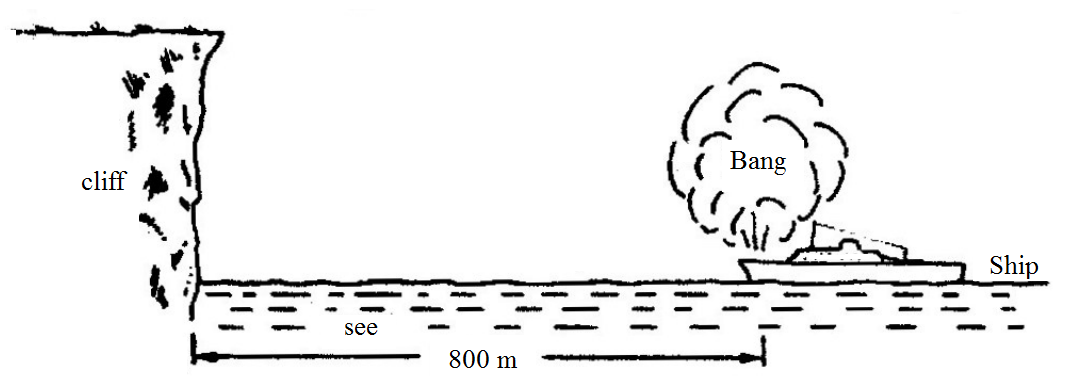
The drawing shoes a ship $800m$ from a cliff. A gun is fired on the ship. After $5$ seconds the people at the front of the ship hear the sound of the gun again.
  1. What is the name of this effect$?$
  2. What happens to the sound at the cliff$?$
  3. How far foes the sound travel in $5$ seconds$?$
  4. Calculate the speed of sound.