Question
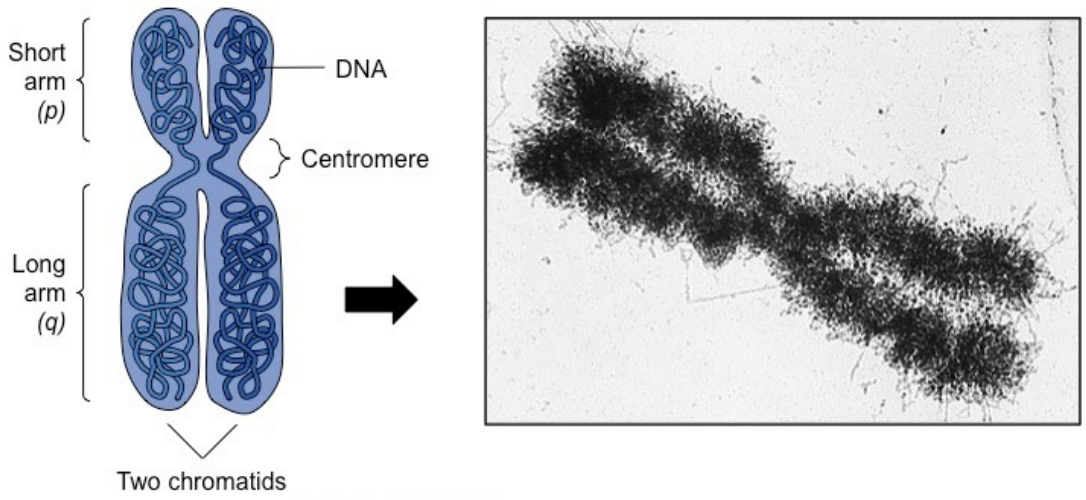
Describe structure of a chromosome.

Answer


Chromosomes are thread like structures usually present in the nucleus that become visible only during cell divisions. Chromosomes contain information for inheritance of features from parents to next generation in the form of $DNA$ (Deoxyribo Nucleic Acid) molecules. Chromosomes are composed of $DNA$ and protein. $DNA$ molecules contain the information necessary for constructing and organising cells. Functional segments of $DNA$ are called genes.

A chromosome consists of two identical and spirally coiled threads called sister chromatids. They are joined at a constriction called centromere.

Need a full question paper?

Generate a complete, print-ready paper with questions like this in minutes — across 16+ boards, with answer keys.
Start Generating Free

Similar questions

An atom of an element $X$ may be written as $^{9}_4\text{X} $
  1. What does the figure $9$ indicate$?$
  2. What does the figure $4$ indicate$?$
  3. What is the number of protons in atom $X?$
  4. What is the number of neutrons in atom $X?$
  5. What is the number of electrons in atom $X?$
  6. How many electrons are there in the outermost shell of an atom of element $X?$
  7. Write the symbol of ion formed by an element $Z$ is $2, 8, 8$.
Define motion. What do you understand by the terms ‘uniform motion’ and ‘non-uniform motion’? Explain with examples.
Make a comparison and write down ways in which plant cells are different from animal cells.
Show by an activity that the gases are highly compressible as compared to liquids.
Give any one advantage of irrigation.
Which separation techniques will you apply for the separation of the following?
  1. Sodium chloride from its solution in water.
  2. Ammonium chloride from a mixture containing sodium chloride and ammonium chloride.
  3. Small pieces of metal in the engine oil of a car.
  4. Different pigments from an extract of flower petals.
  5. Butter from curd.
  6. Oil from water.
  7. Tea leaves from tea.
  8. Iron pins from sand.
  9. Wheat grains from husk.
  10. Fine mud particles suspended in water.
State the various postulates of Dalton’s atomic theory of matter.
With the help of labelled diagram, show oxygen cycle in nature.
A body of $2kg$ falls from rest. What will be its kinetic energy during the fall at the end of $2s? ($Assume $g = 10m/s^2)$
You are given a mixture of water, groundnut oil and common salt. How will you separate groundnut oil and common salt from it?