Question
Describe the activity that shows that a current-carrying conductor experiences a force perpendicular to its length and the external magnetic field. How does Fleming’s left-hand rule help us to find the direction of the force acting on the current carrying conductor?

Answer

The activity is as follows:

Take a small aluminium rod AB. Using two connecting wires suspend it horizontally from a stand, as shown in figure given below.
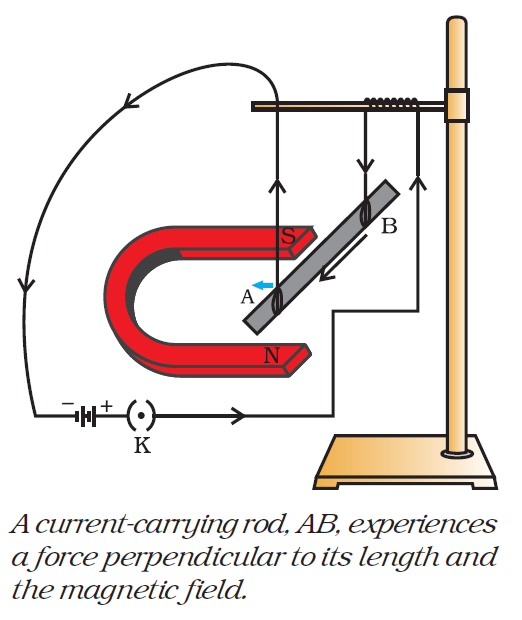
Place a strong horse-shoe magnet in such a way that the rod lies between the two poles with the magnetic field directed upwards. For this put the North Pole of the magnet vertically below and South Pole vertically above the aluminium rod.

Connect the aluminium rod in series with a battery, a key and a rheostat.

Now pass a current through the aluminium rod from end B to end A.

It is observed that the rod is displaced towards the left and rod gets displaced.

Reverse the direction of current flowing through the rod and observe the direction of its displacement. It is now towards the right.

Need a full question paper?

Generate a complete, print-ready paper with questions like this in minutes — across 16+ boards, with answer keys.

Start Generating Free

Similar questions

What is the difference between direct current generator and alternating current generator?
What is meant by ‘reflection of light’? Define the following terms used in the study of reflection of light by drawing a labelled ray-diagram :
  1. Incident ray.
  2. Point of incidence.
  3. Normal.
  4. Reflected ray.
  5. Angle of incidence.
  6. Angle of reflection.
What is electrical resistivity of a material? What is its unit? Describe an experiment to study the factors on which the resistance of conducting wire depends.
Define magnetic field lines. Describe an activity to draw a magnetic field line outside a bar magnet from one pole to another pole.
With the help of a labelled circuit diagram illustrate the pattern of field lines of the magnetic field around a current carrying straight long conducting wire. How is the right hand thumb rule useful to find direction of magnetic field associated with a current carrying conductor?
i. What is meant by resistance of a conductor? Define its SI unit.
ii. List two factors on which the resistance of a rectangular conductor depends.
iii. How will the resistance of a wire be affected if its
I. length is doubled, and
II. radius is also doubled?
Give justification for your answer.
A concave lens of focal length 60 cm is used to form an image of an object of length 9 cm kept at a distance of 30 cm from it. Use lens formula to determine the nature, position and length of the image formed. Also draw labelled ray diagram to show the image formation in the above case.
  1. Draw a ray diagram to explain the term angle of deviation.
  2. Why do the component colours of incident white light split into a spectrum while passing through a glass prism, explain.
  3. Draw a labelled ray diagram to show the formation of a rainbow.
a. What is a lens? List two main categories of lenses. In which category is a double concave lens placed?
b. A convex lens of focal length 15 cm forms a real image at a distance of 20 cm from its optical centre. Find the position of the object. Is the image formed by the lens magnified or diminished?
A student is unable to see clearly the words written on the blackboard placed at a distance of approximately 4m from him. Name the defect of vision the boy is suffering from. Explain the method of correcting this defect. Draw ray diagram for the:
  1. Defect of vision and also.
  2. For its correction.