Question
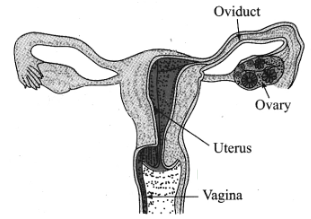
Describe the human female reproductive system.

Answer


Image
  • All the organs of the human female reproductive system are located inside the lower abdomen.
  • There are pair of ovaries, pair of fallopian ducts and a single median uterus.
  • The uterus opens out by vagina. In vaginal walls there are Bartholin’s glands.
  • The urethra in female body is separate and not a common passage as in male body.
  • The free end of fallopian duct is funnel-like having an opening in the centre. The oocyte released from the ovary due to ovulation is picked up by this funnel.
  • The other end of fallopian duct opens into uterus. There are cilia on inner surface of oviduct. With the help of the cilia the oocyte is pushed to the uterus through the fallopian duct.
  • The fertilization of oocyte can take place only in the middle’part of the fallopian duct.
  • The lower end of uterus opens into vagina. The contractions of uterus help in the process of parturition.
  • Vagina is the birth canal as well as copulatory passage. It is also a passage for menstrual flow.

Need a full question paper?

Generate a complete, print-ready paper with questions like this in minutes — across 16+ boards, with answer keys.

Start Generating Free

Similar questions

The speed of light in air is $3 \times 10^8m/ s$. In medium $X$ its speed is $2 \times 10^8m/ s$ and in medium $Y$ the speed of light is $2.5 \times 10^8m/ s.$ Calculate:
  1. $air ^nx$
  2. $air ^ny$
  3. $X ^ny$
Draw all possible structural formulae having molecular formula $\mathrm{C}_6 \mathrm{H}_{14}$. Give names to all the isomers.
What are space expeditions? Explain their need and importance in your words. (Practice Activity Sheet – 2)
What are the objectives of mock drill?
Write the types and examples of biodiversity.
Write evolutionary history of modern man.
Explain with examples types of asexual reproduction in unicellular organisms.
Green corridor refers to a special road route that enables harvested organs meant for transplants to reach the destined hospital. A 45-year-old woman, a victim of a railway accident, was declared brain dead, her husband and children agreed to donate her kidneys, liver and heart. One of her kidneys was transplanted to a patient in MGM Hospital and the second kidney helped a patient in Jaslok hospital. Her liver helped the transplant of a patient in Wockhardt Hospital. And her heart was sent to Fortis to the patient on a super urgent priority list, transported via a green corridor covering 18km in less than 16 minutes. This was possible due to Green corridor.
1.What is Green corridor?
2.Which organs of brain-dead lady were transplanted?
3.Four patients lives were saved due to organ donation of one lady.
4.How was distance of 18km covered in 16 minutes? Why?
5.Who takes the decision to donate the organs?
Draw a neat labelled diagram: Forth floatation.
explain the various effects of the disaster of railway accident.