Question
Describe the Lamarkism in relation to organic evolution.

Answer

Lamarck was one of the most brilliant stars on the horizon of the history of evolution.
He was the first naturalist to put forward a general theory of evolution in his famous book Philosophic Zooligique published in 1809. His evolutionary theory may be summarised in the form of following laws :
(1) The internal forces of life tend to increase the size of an organism.
(2) The necessity in animals produces new structures.
(3) The effect of use and disuse of organs.
(4) Inheritance of acquired characters.
(1) The internal forces of life tend to increase the size of an organism : Lamarck believed that there is some kind of internal force which is constantly working in living beings. It tries to make the animal bigger in size.
(2) The necessity in animals produces new structures : According to this law, each organ and structure is the product of some continuous necessity in the animals to develop it. He believed that it was not due to the direct influence of the environment but acted through the nervous system, the process being very slow. The plants, he said, were directly influenced by their environmental conditions.
(3) Effect of use and disuse of organs : Lamarck thought that the continuous use of a particular organ or structure tends to increase its size and its development. On the other hand, disuse results in disappearance of that structure, the process being slow and gradual. He supported this by a number of well-known examples. The long neck giraffe was the result of continuous stretching to obtain food from the trees (long neck was acquired due to excessive use) The wings of certain birds Ratitae were not used for long, as there were no formidable enemies and food was available in abundance. So they did not fly, consequently lost the power of flight. Their wings became rudimentary (flightless condition acquired due to the disuse of wings.)
(4) Inheritance of acquired characters : Lamarck in 1815 stated that all the characters, which are acquired in one's own lifetime are inherited by its offsprings.

Need a full question paper?

Generate a complete, print-ready paper with questions like this in minutes — across 16+ boards, with answer keys.

Start Generating Free

Similar questions

The following is the illustration of the sequence of ovarian events (a – i) in a human female.

Explain the changes that occur in the uterus simultaneously in anticipation.

A. Cryptorchidism is a condition in which the testes fail to descend into the scrotum. It can also lead to compromised Sertoli cell function and has an impact on Leydig cell function.
(i) Identify at least 3 parameters of male fertility which get affected due to cryptorchidism.
(ii) Which process will be affected if mature spermatids are not released from Sertoli cells?
(iii) Name and explain one assisted reproductive technology (ART process) in which the sperm/semen is used to assist fertilization.
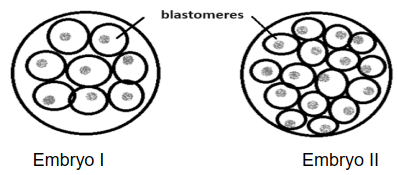
(iv) Name and explain the assisted reproductive technology that should be used to complete the development of embryos I and II shown in the figure given below.
Had Darwin been aware of Mendel’s work, would he been able to explain the origin of variations. Discuss.
Can you list 10 recombinant proteins which are used in medical practice? Find out where they are used as therapeutics (use the internet).
What is meant by the term bio-pesticide? Name and explain the mode of action of a popular bio-pesticide.
Give reasons why:
Groundnut seeds are exalbuminous and castor seeds are albuminous.
What is meant by immunity? What are the four barriers to innate immunity? Explain . Draw a labelled diagram of the structure of an antibody molecule.
Compare and contrast the advantages and disadvantages of production of genetically modified crops.
Human female is not fertile after menopause whereas males can produce gametes at any age after puberty. Analyse the statement and schematically represent a comparison between gametogenesis in males and females.
Name the type of cells attacked by AIDS virus in the human body. Also, explain the events in sequence undertaken by virus to increase its progeny.