Question
Describe the logistic population growth.
Answer

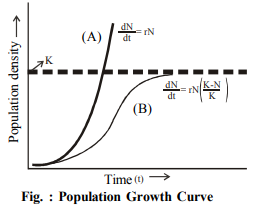
Logistic Growth : No population of any species in nature has at its disposal unlimited resources to permit exponential growth. This leads to competition between individuals for limiting resources. Eventually, the 'fittest' individual will survive and reproduce. A population growing in a habitat with limited resources show initially a lag phase, followed by phases of acceleration and deceleration and finally an asymptote, when the population density reaches the carrying capacity. A plot of N in relation to time (t) results in a sigmoid curve. This type of population growth is called Verhulst-Pearl Logistic Growth and is described by the following equation;
$dN / dt =\frac{ rN ( K - N )}{ K }$
Where, N = Population density at time t
r = Intrinsic rate of natural increase
K = Carrying capacity
Since resources for growth for most animal populations are finite and become limiting sooner or later, the logistic growth model is considered a more realistic one.
Image
(A) When responses are not limiting the growth, plot is exponential. 
(B) When responses are limiting the growth, plot is logistic, K is carrying capacity.

Need a full question paper?

Generate a complete, print-ready paper with questions like this in minutes — across 16+ boards, with answer keys.
Start Generating Free

Similar questions

Describe the species according to their susceptibility to extinction and the IUCN Red List.
Draw a diagrammatic labelled sectional view of a seminiferous tubule of a human.
How many different types of gametes could result from each of the following genotypes? What will be their genotypes?
  1. Aa.
  2. AABB.
  3. AaBb.
  4. EeCc.
  5. FFIIJj.
Describe the evidence of evolution from comparative anatomy and morphology?
Replication was allowed to take place in the presence of radioactive deoxynucleotides precursors in E.coli that was a mutant for DNA ligase. Newly synthesised radioactive DNA was purified and strands were separated by denaturation. These were centrifuged using density gradient centrifugation. Which of the following would be a correct result?

Match the terms in Column I with those in Column II.
S. No.
Column I
 
Column II
A
Transcription
1
A set of three bases on RNA that is complementary to the bases of codon on mRNA.
B
Anticodon
2
A unit of DNA that codes for a polypeptide.
C
Cistron
3
Process of synthesis of polypeptide as dictated by mRNA.
D
Translation
4
Process by which mRNA carries the information from nucleus to ribosomes.
a. Explain the process of syngamy and triple fusion in angiosperms.
b. Trace the development of the product of syngamy upto its mature stage in a dicot plant.
c. Draw and label three important parts of a mature dicot embryo.
Trace the events that would take place in a flower from the time the pollen grain of the same species falls on the stigma up to the completion of fertilisation.
  1. Explain primary productivity and the factors that influence it.
  2. Describe how do oxygen and chemical composition of detritus control decomposition.
Define genetic engineering. Mention its main stages.