Question
Describe the steps of PCR technique.
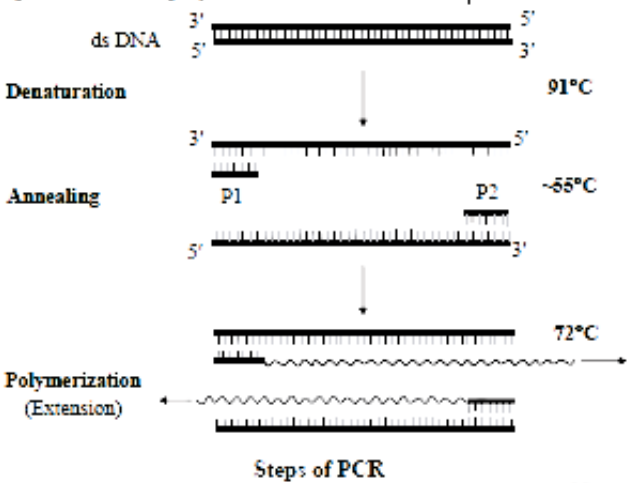
Answer

One cycle of Polymerase Chain Reaction involves three basic steps:

1. Denaturation
2. Annealing
3. Polymerization

1. Denaturation:
The desired DNA is heated to a high temperature of about 91°C and forms a single-stranded DNA. It results in the separation of the two strands of DNA, each of which would function as a template for the synthesis of a new molecule of DNA.

2. Annealing:
It is the process in which the two primers (oligonucleotides) hybridize to each of the strands of DNA. It requires a temperature of 55°C.

3. Polymerization:
In this step, the Taq polymerase carries out the synthesis of the DNA region between the two primers by using deoxyribonucleotides (dNTPs) and Mg2+. The optimum temperature for this polymerization reaction is 72°C.
Image

Need a full question paper?

Generate a complete, print-ready paper with questions like this in minutes — across 16+ boards, with answer keys.

Start Generating Free

Similar questions

Classify the following disorders of respiratory system given below as per Column A and complete Column ‘B’. Select from the given options:
(i) Pneumonia
(ii) Asbestosis
(iii) Emphysema
(iv) Laryngitis
(v) Chronic bronchitis
(vi) Silicosis

Column AColumn B
(1) Occupational disorders————
(2) Disorders due to smoking and air pollution————
(3) Disorders due to viruses and bacteria————

Mention the types of deviations from Mendel’s finding.
OR
Describe Neo-Mendelism in short.
Describe the process of cocoon formation.
  1. Write the two limitations of traditional breeding technique that led to promotion of micro propagation.
  2. Mention two advantages of micro propagation.
  3. Give two examples where it is commercially adopted.
What are the advantages of the techniques of GM crops?
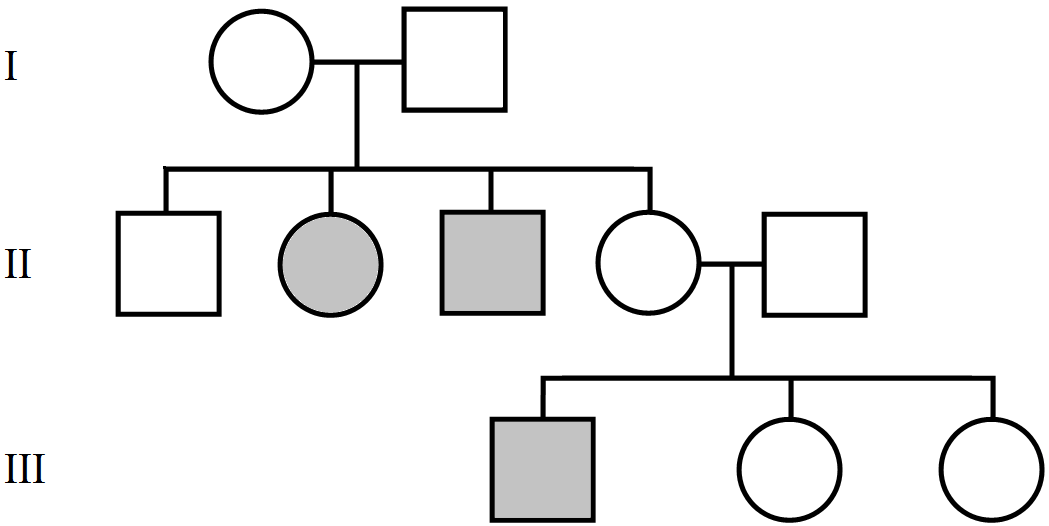
Study the given pedigree chart and answer the questions that follow.
  1. Is the trait recessive or dominant?
  2. Is the trait sex linked or autosomal?
  3. Give the genotypes of the parents in generation I and of their third and fourth child in generation II.
Give examples of termination codons. Why are they known as termination codons?
Describe how do 'flocs' and 'activated sludge' help in Sewage Treatment.
Given below is the representation of amino acid composition of the relevant translated portion of b-chain of haemoglobin, related to the shape of human red blood cells.
Who are likely to suffer more from the defect related to the gene represented the males, the females or both males and females equally? And why?
"A population has been exhibiting genetic equilibrium."
Answer the following with regard to the above statement.
  1. Explain the above statement.
  2. Name the underlying principle.
  3. List any two factors which would upset the genetic equilibrium of the population.
  4. Take up any one such factor and explain how the gene pool will change due to factor.