Question
Describe the structure and functions of nucleus.

Answer

Structure of Nucleus: Nucleus is a dense, spherical or oval, dot like structure located centrally in the cell. It is bounded by two nuclear membranes, both forming nuclear envelope. Nuclear envelope separates the nucleus from the cytoplasm. It contains large number of pores which control the passage of substances outside or inside the nucleus.
Inside the nuclear envelope is the nucleoplasm or nuclear sap. It is transparent, semi-fluid and contains a large number of enzymes which are required for the synthesis and functioning of RNA and DNA. Within the nucleoplasm, two structures are embedded-chromatin material and nucleolus.
Chromatin material is a tangled fibrous mass. The chromatin material condenses to form chromosomes during cell division. Chromosomes contain information for inheritance of features from parents to next generation in the form of DNA (Deoxyribo Nucleic Acid) molecules. Chromosomes are composed of DNA and protein. DNA molecules contain the information necessary for constructing and organising cells. Functional segments of DNA are called genes.
Nucleolus may be one or more in number and is not bounded by any membrane. It is rich in protein and RNA molecules. Nucleolus acts as the site for ribosome formation, hence it is known as factory of ribosomes.
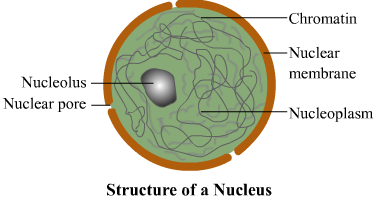
Functions of nucleus:
  1. Nucleus plays a central role in cellular reproduction, the process by which a single cell divides to form two new cells.
  2. Nucleus controls cell metabolism and other activities of cell, hence it is also called Master or Director of the cell.
  3. Along with the environment, nucleus directs the chemical activities of the cell. It determines the development and future form of the cell.
  4. It is concerned with the transmission of hereditary traits from the parent to offsprings.

Need a full question paper?

Generate a complete, print-ready paper with questions like this in minutes — across 16+ boards, with answer keys.

Start Generating Free

Similar questions

What is the momentum in kgm/s of a $10\ kg$ car travelling at $(a) 5\ m/s$ $(b) 20\ cm/s$, and $(c) 36\ km/h?$
Calculate the mass of sodium sulphate required to prepare its $20\%$ (mass percent) solution in $100\ g$ of water?
A stone is thrown in a vertically upward direction with a velocity of $5\ ms^{-1}$. If the acceleration of the stone during its motion is $10\ ms^{-2}$ in the downward direction, what will be the height attained by the stone and how much time will it take to reach there?
How do fossil fuels cause air pollution?
If there is low rainfall in a village throughout the year, what measures will you asuggest to the farmers for better cropping?
The production of food from animal sources has increased greatly in the last few decades. Justify it.
A $60g$ bullet fired from a $5kg$ gun leaves with a speed of $500m/s$. Find the speed (velocity) with which the gun recoils (jerks backwards).
A driver of a car travelling at 52km/ h−1 applies the brakes and accelerates uniformly in the opposite direction. The car stops in 5s. Another driver going at 3km/ h−1 in another car applies his brakes slowly and stops in 10s. On the same graph paper, plot the speed versus time graphs for the two cars. Which of the two cars travelled farther after the brakes were applied?
Water needs conservation even though large oceans surround the and masses. Is it true? Justify.
A stone is thrown vertically upward with an initial velocity of $40m/ s$. Taking $g = 10m/ s^2$, find the maximum height reached by the stone. What is the net displacement and the total distance covered by the stone?