Question
Describe the structure and functions of nucleus.

Answer


Structure of Nucleus: Nucleus is a dense, spherical or oval, dot like structure located centrally in the cell. It is bounded by two nuclear membranes, both forming nuclear envelope. Nuclear envelope separates the nucleus from the cytoplasm. It contains large number of pores which control the passage of substances outside or inside the nucleus.
Inside the nuclear envelope is the nucleoplasm or nuclear sap. It is transparent, semi-fluid and contains a large number of enzymes which are required for the synthesis and functioning of RNA and DNA. Within the nucleoplasm, two structures are embedded-chromatin material and nucleolus.
Chromatin material is a tangled fibrous mass. The chromatin material condenses to form chromosomes during cell division. Chromosomes contain information for inheritance of features from parents to next generation in the form of DNA (Deoxyribo Nucleic Acid) molecules. Chromosomes are composed of DNA and protein. DNA molecules contain the information necessary for constructing and organising cells. Functional segments of DNA are called genes.
Nucleolus may be one or more in number and is not bounded by any membrane. It is rich in protein and RNA molecules. Nucleolus acts as the site for ribosome formation, hence it is known as factory of ribosomes.
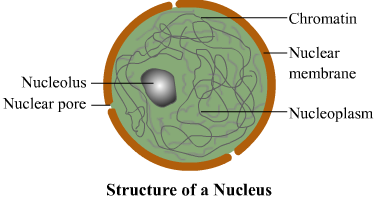
Functions of nucleus:
  1. Nucleus plays a central role in cellular reproduction, the process by which a single cell divides to form two new cells.
  2. Nucleus controls cell metabolism and other activities of cell, hence it is also called Master or Director of the cell.
  3. Along with the environment, nucleus directs the chemical activities of the cell. It determines the development and future form of the cell.
  4. It is concerned with the transmission of hereditary traits from the parent to offsprings.
Need a full question paper?

Generate a complete, print-ready paper with questions like this in minutes — across 16+ boards, with answer keys.

Start Generating Free

Similar questions

Give two examples each of longitudinal waves and transverse waves.
Explain the role of workers in a bee colony.
Draw a labelled diagram of a neuron.
You are provided with a mixture of naphthalene and ammonium chloride by your teacher. Suggest an activity to separate them with well labelled diagram.
What weight of oxygen gas will contain the same number of molecules as $56g$ of nitrogen gas$?$
$(O = 16u; N = 14u)$
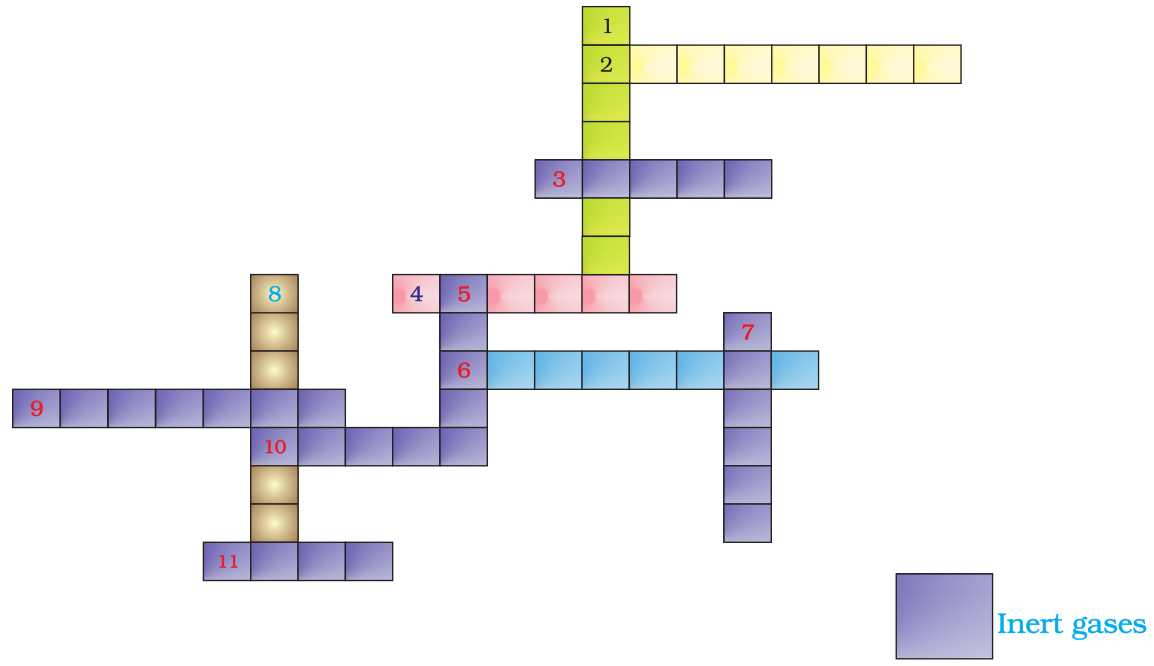
In this crossword puzzle (Figure), names of 11 elements are hidden. Symbols of these are given below. Complete the puzzle.
  1. Cl
  2. H
  3. Ar
  4. O
  5. Xe
  6. N
  7. He
  8. F
  9. Kr
  10. Rn
  11. Ne
What are longitudinal waves and transverse waves? Explain with the help of labelled diagrams.
When a beam of sunlight enters a room through a window, we can see tiny particles X suspended in a gas (or rather a mixture of gases) Y which are moving rapidly in a very haphazard manner.
  1. What could particles X be?
  2. Name the gas (or mixture of gases) Y.
  3. What is the phenomenon exhibited by particles X known as?
  4. What is causing the movement of particles X?
  5. What conclusion does the existence of this phenomenon give us about the nature of matter?
A truck of mass $500\ kg$ moving at $4\ m/s$ collides with another truck of mass $1500\ kg$ moving in the same direction at $2\ m/s.$ What is their common velocity just after the collision if they move off together?
A ball $X$ of mass $1\ kg$ travelling at $2\ m/s$ has a head-on collision with an identical ball $Y$ at rest. $X$ stops and $Y$ moves off. Calculate the velocity of $Y$ after the collision.