Question
Describe the structure and functions of nucleus.

Answer

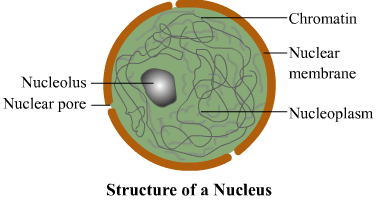
Structure of Nucleus: Nucleus is a dense, spherical or oval, dot like structure located centrally in the cell. It is bounded by two nuclear membranes, both forming nuclear envelope. Nuclear envelope separates the nucleus from the cytoplasm. It contains large number of pores which control the passage of substances outside or inside the nucleus.

Inside the nuclear envelope is the nucleoplasm or nuclear sap. It is transparent, semi-fluid and contains a large number of enzymes which are required for the synthesis and functioning of RNA and DNA. Within the nucleoplasm, two structures are embedded-chromatin material and nucleolus.

Chromatin material is a tangled fibrous mass. The chromatin material condenses to form chromosomes during cell division. Chromosomes contain information for inheritance of features from parents to next generation in the form of DNA (Deoxyribo Nucleic Acid) molecules. Chromosomes are composed of DNA and protein. DNA molecules contain the information necessary for constructing and organising cells. Functional segments of DNA are called genes.

Nucleolus may be one or more in number and is not bounded by any membrane. It is rich in protein and RNA molecules. Nucleolus acts as the site for ribosome formation, hence it is known as factory of ribosomes.

Functions of nucleus:

  1. Nucleus plays a central role in cellular reproduction, the process by which a single cell divides to form two new cells.
  2. Nucleus controls cell metabolism and other activities of cell, hence it is also called Master or Director of the cell.
  3. Along with the environment, nucleus directs the chemical activities of the cell. It determines the development and future form of the cell.
  4. It is concerned with the transmission of hereditary traits from the parent to offsprings.

Need a full question paper?

Generate a complete, print-ready paper with questions like this in minutes — across 16+ boards, with answer keys.

Start Generating Free

Similar questions

Give an account of structure and function of xylem.

Define animal husbandry. Write about its scope.
Explain the transformation of energy in the following cases:
  1. A ball thrown upwards.
  2. A stone dropped from the roof of a building.
What is the difference between a compression and a rarefaction in a sound wave? Illustrate your answer with a sketch.
  1.  

  1.  

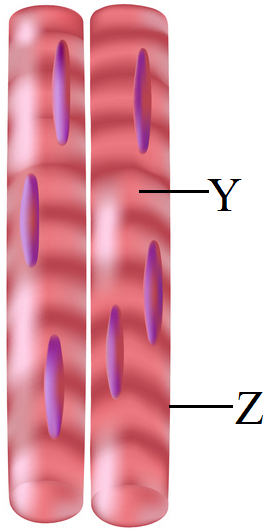
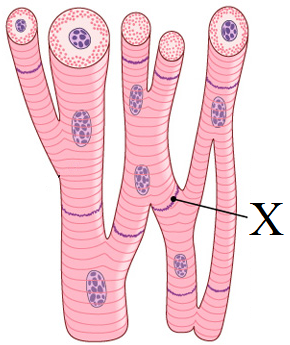
  1. Identify figures A and B.
  2. Label X, Y and Z.
  3. Which one act as impulse booster?
  4. Which one is under control our will?
There are three substances X, Y and Z. The substance X does not have a fixed melting point or boiling point and it still shows the individual properties of its constituents. The substance Y is a pure substance which occurs in nature as such. The substance Y has a fixed melting point and boiling point but it cannot be broken down into simpler substances by any chemical means. The substance Z is also a pure substance whose properties are entirely different from those of its constituents. The substance Z can, however, be divided by electrolysis into two substances which belong to the same class of substances as Y.
  1. What type of substance could X be? Name one substance like X.
  2. What type of substance could Y be? Name one substance like Y.
  3. What type of substance could Z be? Name one substance like Z.
  4. Whish process involves absorption or release of an appreciable amount of energy: formation of substance X or formation of substance Z?
  5. Name the three groups into which all the substances like Y are divided on the basis of their properties.
How are sol, solution and suspension different from each other?
Describe an experiment to show that sound cannot pass through vacuum.
Describe an activity of determine the boiling point of water and melting point of ice.

Describe the mechanism of crop variety improvement.