Question
Describe the structure of a flower.

Answer


The main parts of a flower are,
  1. Sepals These are the green leaf-like outermost circle of the flower. All the sepals are together referred to as calyx. The function of calyx is to protect the flower when it is in bud form.
Petals These are the colourful and most attractive part of flower. These lie inside the sepals. All the petals are together referred to as corolla. These are scented and attract insects for pollination.
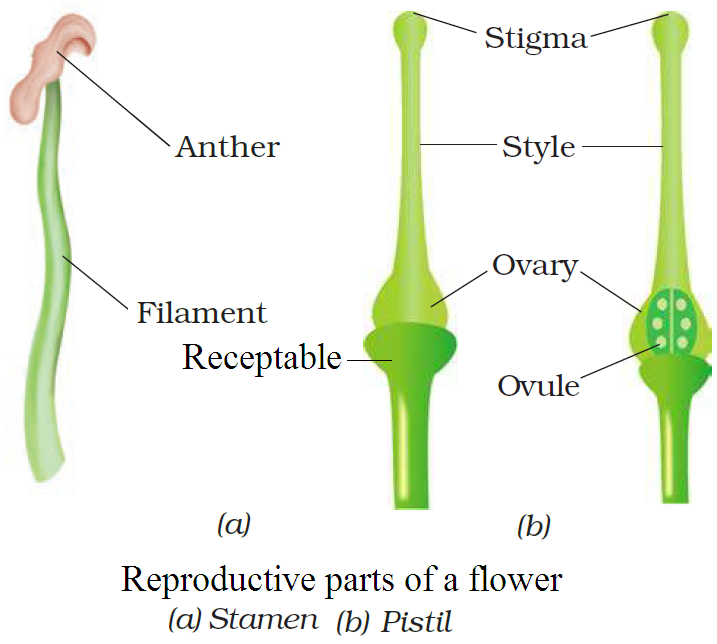
  1. Stamen It is a male reproductive organ of plant. These are the little stalks with swollen top and lies inside the ring of petals. The stamen is made up of two parts, i.e. filament and anther. The stalk of stamen is called filament and the swollen top of stamen is called anther.
Anther contains the pollen grain which have male gamete in it. Pollen grains are exposed when the anther ripens and splits. These appear as the yellow powder like substance which is sticky in nature. Flowers usually have a number of stamens in it.
  1. Pistil It is the female reproductive part of a flower that lies in the centre of a flower. These are flask-shaped structure which is made up of three parts, i.e. stigma, style and ovary.
The top part of pistil is called stigma. It receives the pollen grains from the anther during pollination. The middle part of the pistil is tube-like structure called style which connects stigma to the ovary.
  1. The swollen bottom part at the base of pistil is called ovary.
The ovary makes ovules and stores them. These ovules contain the female sex cells also called as egg cell. It is the female gamete of flower. Pistil is also called as carpel.
The pistil is surrounded by several stamens. The base of the flower on which all the parts of flower are attached is called receptacle.

Need a full question paper?

Generate a complete, print-ready paper with questions like this in minutes — across 16+ boards, with answer keys.

Start Generating Free

Similar questions

How can rusting be prevented? Give any three methods.
Fill in the blanks of the following paragraph using just two words – arteries and veins.
___$(a)$___ carry oxygen-rich blood from the heart to all parts of the body and ___ $(b)$___ carry carbon dioxide-rich blood from all parts of the body back to the heart. ___ $(c)$___ have thin walls and __ $(d)$___ have thick elastic walls. Blood flows at high pressure in ___ $(e)$____. Valves are present in __ $(f)$ ___ which allow blood to flow only towards the heart. __ $(g)$___ divide into smaller vessels. These vessels further divide into extremely thin tubes called capillaries. The capillaries join up to form ____ $(h)$_____.
How would you test the presence of starch in leaves?
Describe an activity to test the nature of substances using litmus paper.
List and explain different types of materials based on their ability to transmit light.
Define average speed and explain how it is calculated.
Ravi was sitting in a garden with his family. His younger sister comes running with different types of flowers and starts to name their parts. She stops as she forgets some names and Ravi noticing this comes to help her. His sister askes many Questions related to flowers and Ravi answers her with all information he has.
  1. What is a flower and mention its function during reproduction?
  2. Flowers help in pollination and fertilisation. Yes/ No? Give reason.
  3. Do all flowers have both male and female parts on them specify?
  4. What values are observed in Ravi and his sister?
Describe the different methods of asexual reproduction. Give examples.
Create a simple experiment to demonstrate a reversible physical change.
Match structures given in Column $I$ with functions given in Column $II.$
  Column $I$   Column $II$
$(i)$ Stomata $(a)$ Absorption of water
$(ii)$ Xylem $(b)$ Transpiration
$(iii)$ Root hairs $(c)$ Transport of food
$(iv)$ Phloem $(d)$ Transport of water
    $(e)$ Synthesis of carbohydrates