Question
Describe the working of Carnot engine. Obtain an expression for its efficiency.

Answer

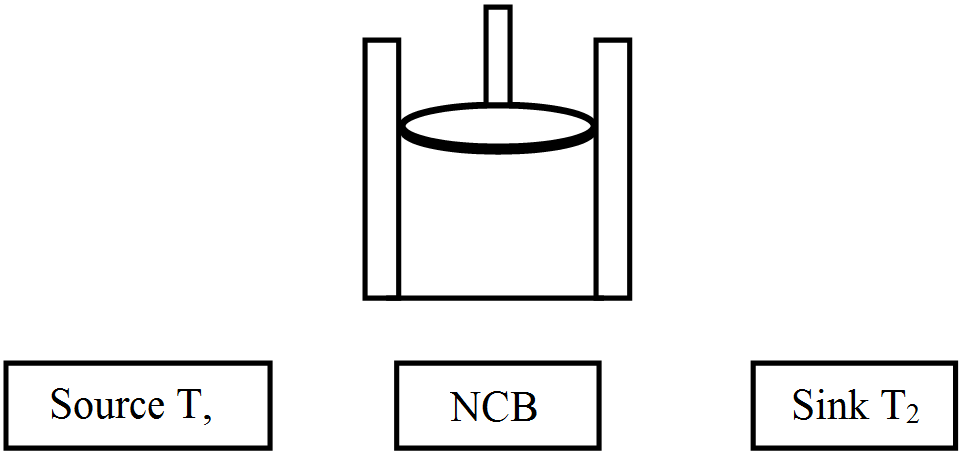
Carnot used a set of four devices—a source at a high temperature (say T1), a sink at a low temperature (say T2), a non-conducting base and a cylinder with a working substance, frictionless piston made of conducting base and non-conducting walls and piston.
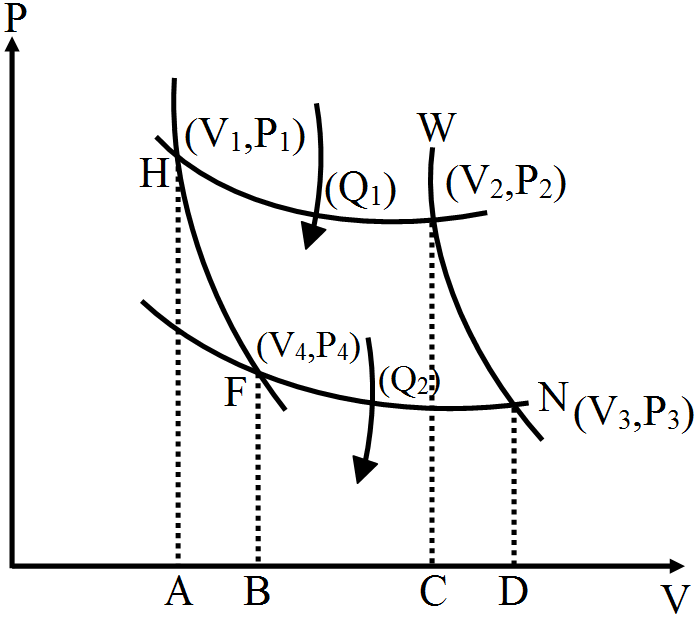
He carried the system through a step of four processes to complete a cycle as shown here.
Process I-HW is an isothermal expansion. Q1 energy flows in and temperature is maintained at T1 by placing the cylinder over the source.

Process II-WN is an adiabatic processes at a temperature flow from T1 to T2 conducted with cylinder over (NCB = Non conducting base).
Process III-NF is an isothermal process at T2 which gives out an energy Q2 with cylinder over sink
Process IV-FH is an adiabatic process which changes the temperature from T2 to T1 conducted with the cylinder placed over (NCB = Non conducting base).

In the process, a net work equalling the area HWNFH is done with the net heat intake,
Q1 - Q2 So, Efficiency $=\frac{\text{Work done}}{\text{heat supplied}}$
$=\frac{\text{Q}_1-\text{Q}_2}{\text{Q}_1}=1-\frac{\text{Q}_2}{\text{Q}_1}=1-\frac{\text{T}_2}{\text{T}_1}$

Need a full question paper?

Generate a complete, print-ready paper with questions like this in minutes — across 16+ boards, with answer keys.
Start Generating Free

Similar questions

Use the formula $\text{v}=\sqrt{\frac{\gamma\text{P}}{\rho}}$ to explain why the speed of sound in air:
Increases with temperature,
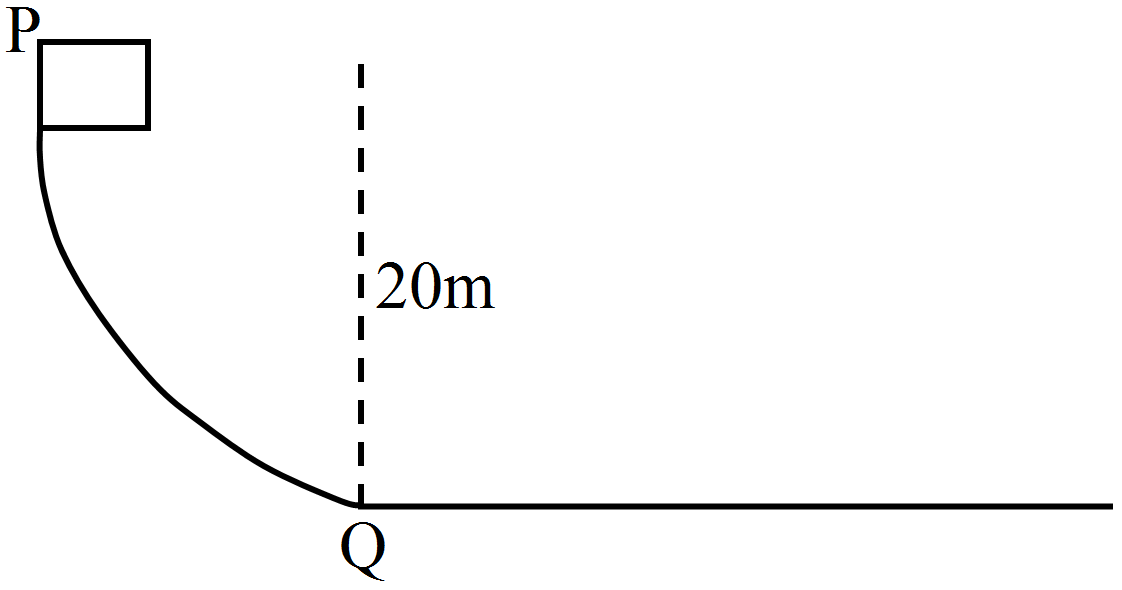
A block of mass 200g is released from P which slides down without friction till it reaches a point Q of a circular path of radius 2.0m. Find.

  1. The velocity of the block at point Q and.
  2. The coefficient of friction if the block comes to rest 2.0m from Q, assuming the horizontal part of the path is rough. Take g = 10ms-2.


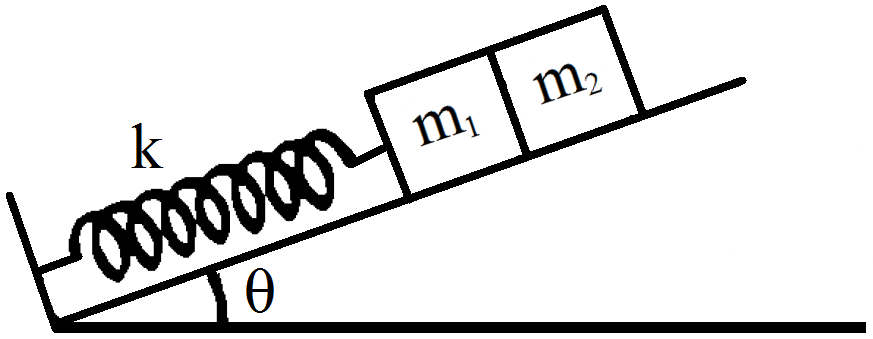
The block of mass m1 shown in figure is fastened to the spring and the block of mass m2 is placed against it.

  1. Find the compression of the spring in the equilibrium position.
  2. The blocks are pushed a further distance $\big(\frac{2}{\text{k}}\big)(\text{m}_1+\text{m}_2)\text{g}\sin\theta$ sine against the spring and released. Find the position where the two blocks separate.
  3. What is the common speed of blocks at the time of separation?

Two masses 8kg and 12kg are connected at the two ends of a light inextensible string that goes over a frictionless pulley. Find the acceleration of the masses, and the tension in the string when the masses are released.
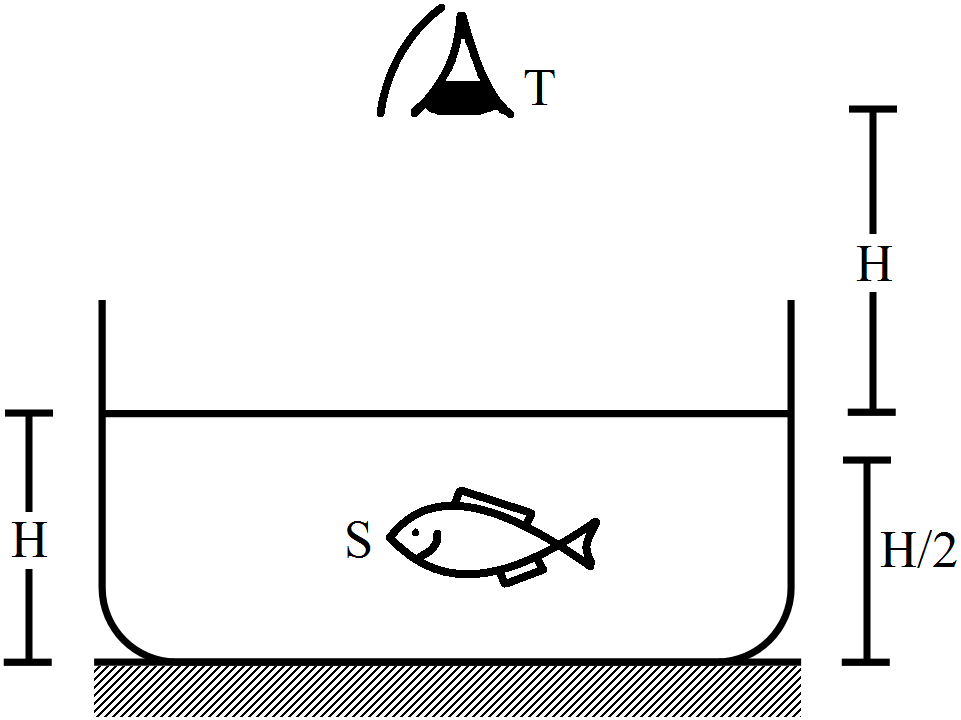
Consider the situation in figure. The bottom of the pot is a reflecting plane mirror, S is a small fish and T is a human eye. Refractive index of water is.
  1. At what distance(s) from itself will the fish see the image(s) of the eye?
  2. At what distance(s) from itself will the eye see the image(s) of the fish.

A block of mass 200g is suspended through a vertical spring. The spring is stretched by 1.0cm when the block is in equilibrium. A particle of mass 120g is dropped on the block from a height of 45cm. The particle sticks to the block after the impact. Find the maximum extension of the spring. Take g = 10m/s2.

An air bubble of volume 1.0cm3 rises from the bottom of a lake 40m deep at a temperature of 12°C. To what volume does it grow when it reaches the surface, which is at a temperature of 35°C?
Is it possibe for a body to have inertia but no weight?
An ideal gas having density 1.7 × 10-3g-cm-3 at a pressure 1.5 × 105Pa is filled in a Kundt tube. When the gas is resonated at a frequency of 3.0KHz, nodes are formed at a separation of 6.0cm. Calculate the molar heat capacities CP and Cv of the gas.
3 A man stands on a rotating platform, with his arms stretched horizontally holding a 5kg weight in each hand. The angular speed of the platform is 30 revolutions per minute. The man then brings his arms close to his body with the distance of each weight from the axis changing from 90cm to 20cm. The moment of inertia of the man together with the platform may be taken to be constant and equal to 7.6kgm2.
  1. What is his new angular speed? (Neglect friction).
  2. Is kinetic energy conserved in the process? If not, from where does the change come about?