Question
Determine, by drawing graphs, whether the following system of linear equations has a unique solution or not:
$2y = 4x - 6, 2x = y + 3.$

Answer

The given equations are,
$2y = 4x - 6 ........(i)$
$2x = y + 3 ..........(ii)$
From (i), $\text{y}=\frac{4\text{x}-6}{2}\ .....(\text{iii})$
When $x = 0, y = -3$
$x = 1, y = -1$
$x = 2, y = 1$
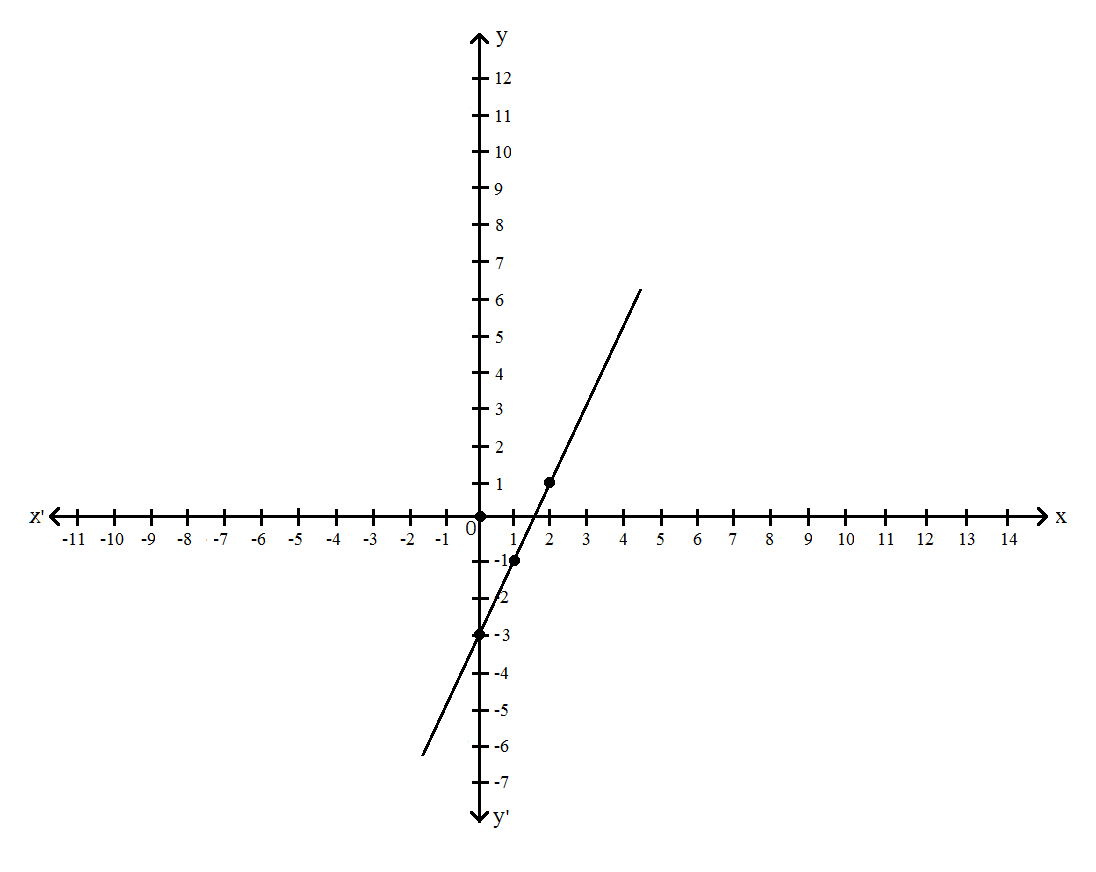
P lot these points $A(0, -3), B(1, -1)$ and $C(2, 1)$ on graph paper and join then,
From $(ii), y = 2x - 3 ......(iv)$
When $x = 0, y = -3$
$x = 1, y = -1$
$x = 2, y = 1$
P lot these points $P(0, -3), Q(1, -1)$ and $R(2, 1)$ on graph paper and join then.

We observe that points $A, B, C$ and $P, Q, R$ on same line so the syatem of equation has infinitaly many solutions.

Need a full question paper?

Generate a complete, print-ready paper with questions like this in minutes — across 16+ boards, with answer keys.

Start Generating Free

Similar questions

The sum of two numbers is $1000$ and the difference between their squares is $256000$. Find the numbers.
Show that the cube of a positive integer is of the form $6q + r$, where q is an integer and $r = 0, 1, 2, 3, 4, 5.$
A hemispherical bowl of internal radius $9\ cm$ is full of water. Its contents are emptied into a cylindrical vessel of internal radius $6\ cm$. Find the height of water in the cylindrical vessel.
A fraction becomes $\frac { 9 } { 11 }$ if $2$ is added to both numerator and denominator. If $3$ is added to both numerator and denominator it becomes $ \frac { 5 } { 6 }$. Find the fraction by substitution method.
The radii of the circular bases of a frustum of a right circular cone are $12\ cm$ and $3\ cm$ and the height is $12\ cm$. Find the total surface area and the volume of the frustum.
Find the area and perimeter of an isosceles right-angled triangle, each of whose equal sides measures $10\ cm.$ $\big[\text{Given}:\sqrt{2}=1.41\big]$
Find the arithmetic mean of each of the following frequency distributions using step-deviation method:
Age (in years) $18-24$ $24-30$ $30-36$ $36-42$ $42-48$ $48-54$
Number of workers $6$ $8$ $12$ $8$ $4$ $2$
Solve the following systems of equations:
$\frac{44}{\text{x}+\text{y}}+\frac{30}{\text{x}-\text{y}}=10,$
$\frac{55}{\text{x}+\text{y}}+\frac{40}{\text{x}-\text{y}}=13.$
The area of a rhombus is $480cm^2$, and one of its diagonals measures $48\ cm.$
Find:
  1. The length of the other diagonal.
  2. The length of each of its sides.
  3. Its perimeter.
If $\sin\theta+\cos\theta=\text{x},$ prove that $\sin^6\theta+\cos^6\theta=\frac{4-3(\text{x}^2-1)^2}{4}.$