Question
Determine graphically the minimum value of the objective function Z = -50x + 20y subject to the constraints:
2x - y $\geq$ - 5
3x + y $\geq$ 3
2x - 3y $\leq$ 12
x $\geq$ 0, y $\geq$ 0
Answer

2x - y $\geq$ - 5
3x + y $\geq$ 3
2x - 3y $\leq$ 12
x $\geq$ 0, y $\geq$ 0
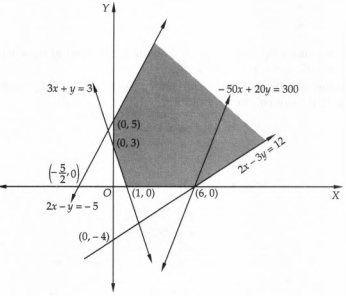
The feasible region of the system of inequations given in constraints is shown in a figure. We observe that the feasible region is unbounded.

The values of the objective function Z at the comer points are given in the following table:

Corner point (x, y) Value of the objective function Z = -50x + 20y
(0,5) Z = - 50 $\times$ 0 + 20 $\times$ 5 = 100
(0,3) Z = - 50 $\times$ 0 + 20 $\times$ 3 = 60
(1,0) Z = - 50 $\times$ 1 + 20 $\times$ 0 = - 50
(6,0) Z = -50 $\times$ 6 + 20 $\times$ 0 = - 300

Clearly, - 300 is the smallest value of Z at the corner point (6, 0). Since the feasible region is unbounded, therefore, to check whether - 300 is the minimum value of Z, we draw the line - 300 = -50x + 20y and check whether the open half plane -50 x + 20y < -300 has points in common with the feasible region or not. From Fig., we find that the open half plane represented by - 50 x + 20y < - 300 has points in common with the feasible region. Therefore, Z = - 50x + 20y has no minimum value subject to the given constraints.

Need a full question paper?

Generate a complete, print-ready paper with questions like this in minutes — across 16+ boards, with answer keys.

Start Generating Free

Similar questions

If $\text{y}=\sqrt{\text{x}}+\frac{1}{\sqrt{\text{x}}},$ prove that $2\text{x}\frac{\text{dy}}{\text{dx}}=\sqrt{\text{x}}-\frac{1}{\sqrt{\text{x}}}$
Find the vector and cartesian equation of the line through the point (5, 2, -4) and which is parallel to the vector $3\hat{\text{i}}+2\hat{\text{j}}-8\hat{\text{k}}.$
If the line drawn from (4, -1, 2) meets a plane at right at the point (-10, 5, 4) find the equation of the plane.
Prove that:
$\begin{vmatrix}\text{a}+\text{b}&\text{b}+\text{c}&\text{c}+\text{a}\\\text{b}+\text{c}&\text{c}+\text{a}&\text{a}+\text{b}\\\text{c}+\text{a}&\text{a}+\text{b}&\text{b}+\text{c}\end{vmatrix}=2\begin{vmatrix}\text{a}&\text{b}&\text{c}\\\text{b}&\text{c}&\text{a}\\\text{c}&\text{a}&\text{b} \end{vmatrix}$
Verify Rolle's theorem for the following function on the indicated intervals
$f(x) = (x - 1) (x - 2)^2$ on $[1, 2]$
Solve the following differential equations:$(1+\text{x})(1+\text{y}^2)\text{dx}+(1+\text{y})(1+\text{x}^2)\text{dy}=0$
Evaluate the following integrals:
$\int\sin^7\text{x}\text{ dx}$
Find the intervals in which the following functions are increasing or decreasing. $f(x) = 2x^2 - 24x + 7$
Find the integrals of the functions in Exercises:
$\frac{1}{\cos(\text{x}-\text{a})\cos(\text{x}-\text{b})}$
Let $d_1, d_2, d_3$ be three mutually exclusive diseases. Let $S$ be the set of observable symptoms of these diseases. A doctor has the following information from a random sample of $5000$ patients: $1800$ had disease $d_1, 2100$ has disease $d_2,$ and others had disease $d_3. 1500$ patients with disease $d_1, 1200$ patients with disease $d_2,$ and $900$ patients with disease $d_3$ showed the symptom. Which of the diseases is the patient most likely to have?